
The Elephant in the Room: What is Left Unsaid in Natural History Museums’ Animal Displays.
Postat den 11th November, 2026, 10:34 av karubakeeb
Museums, I would like to think, are capsules of memory. They are places with fragments of pasts, preserved, for the future. Inside, there is a sense of ‘forever’, of time being frozen.
But just as much as museums remember, they also, often, forget.
By forgetting I do not mean the provenance of objects or specimens museums do not have access to, which I consider more of a gap in knowing. By forgetting I mean the thought-out, deliberate kind of forgetting.
Considering my interest in human-nonhuman animal relationships, both within this programme and beyond, I situate this writing within Gallery 10 in the Colombo National Museum of Natural History (CNMNH) in Sri Lanka. Gallery 10 is the osteology gallery at the CNMNH, and houses, among others, 3 full skeletal structures of Asian Elephants. They are placed in a straight line; an adult male tusker, a baby and an adult female.
Animals often live in the shadow of museums. They are forgotten in multiple ‘layers of forgetting’. When they enter the space of the museum, their personhood is forgotten, and they are reinscribed as ‘specimens’. Their individual lives, personalities, stories of their interaction with each other or even humans—even the little that is known of it—is all flattened into straightforward Linnaean taxonomy. This changes slightly with the elephants’ proximity to religion and ritual, but that also allows for another layer of forgetting; labour.
Rosa Dyer’s ongoing doctoral work in the Pitt Rivers museum as shared in ‘Animal Highlights’—an academic animal-studies blog/podcast—perfectly illustrates the idea of ‘flattening’ the memory of animals in museum spaces. Dyer’s studies of featherwork collections alongside her studies of hummingbirds in the wild allows her to see this flattening of personality all the more clearly.1 In the wild, hummingbirds are notoriously feisty, territorial birds, but they are preserved in the feathered fan in a romantic aesthetic that allows an unknowing viewer to presume that they are birds who would peacefully coexist. This display without explanation makes it possible for exhibition spaces to mould narratives they see fit.
This flattening made me think of the elephant skeletons displayed in Gallery 10. All three are, to varying degrees, flattened into merely a neat structure. The baby elephant (below) is the least remembered. There is no information attached to the display beyond a taxonomic one, and the obvious reference to age. There isn’t even a mention of where or how they were acquired from; were their remains found in the wild or did they die in captivity? But even more than this, I want to know them like I know the animals in my home or neighbourhood. What were they like as an individual? – shy, playful, naughty? What did they like to eat? Elephants are incredibly social animals. With whom did this little one spend their time with? How did they die? While I do understand this information may not be accessible if their remains were found in the wild, even the elephants in captivity do not seem to escape this forgetting.
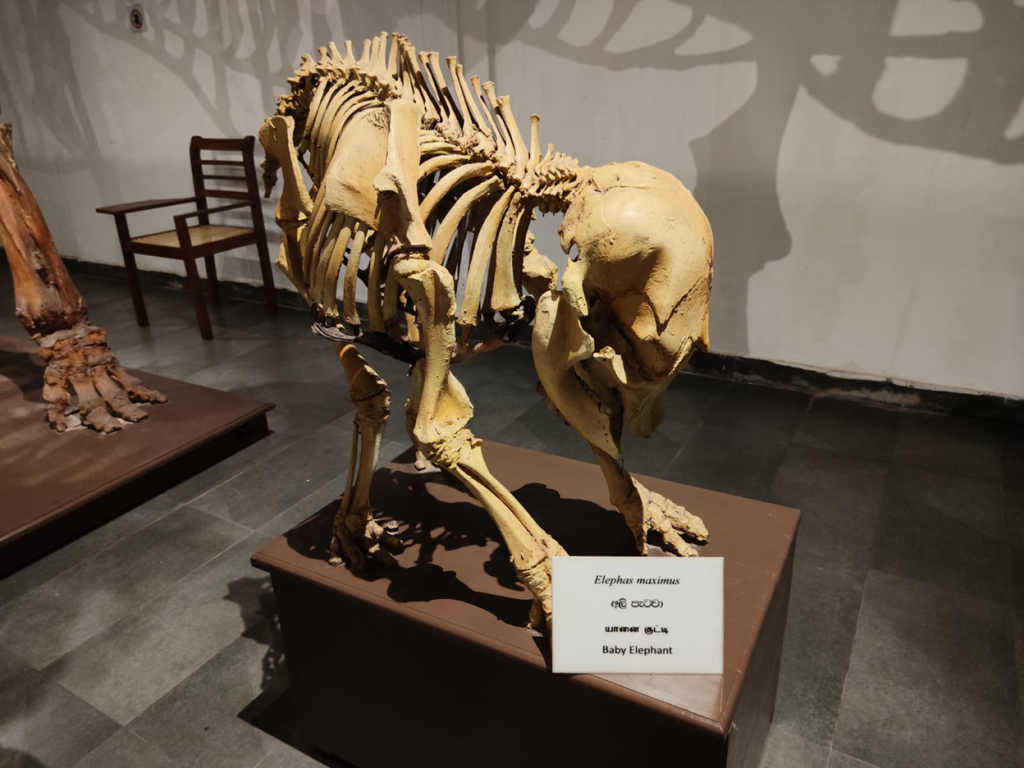
The adult female skeletal structure (below) that stands behind the baby elephant structure is a little less forgotten. She has a name; Lechchamii, and the description plate mentions where she came from – the National Zoological Gardens (NZG). Her name makes me curious about her story. Lechchamii is a Tamil name (an ethnic minority), and captive elephants in Sri Lanka, with their close ties to Buddhist temples, are often given Sinhala names, the ethnic majority most closely associated with the Buddhist faith. There is no mention of how old she was, or how and where she came to the National Zoological Gardens from.
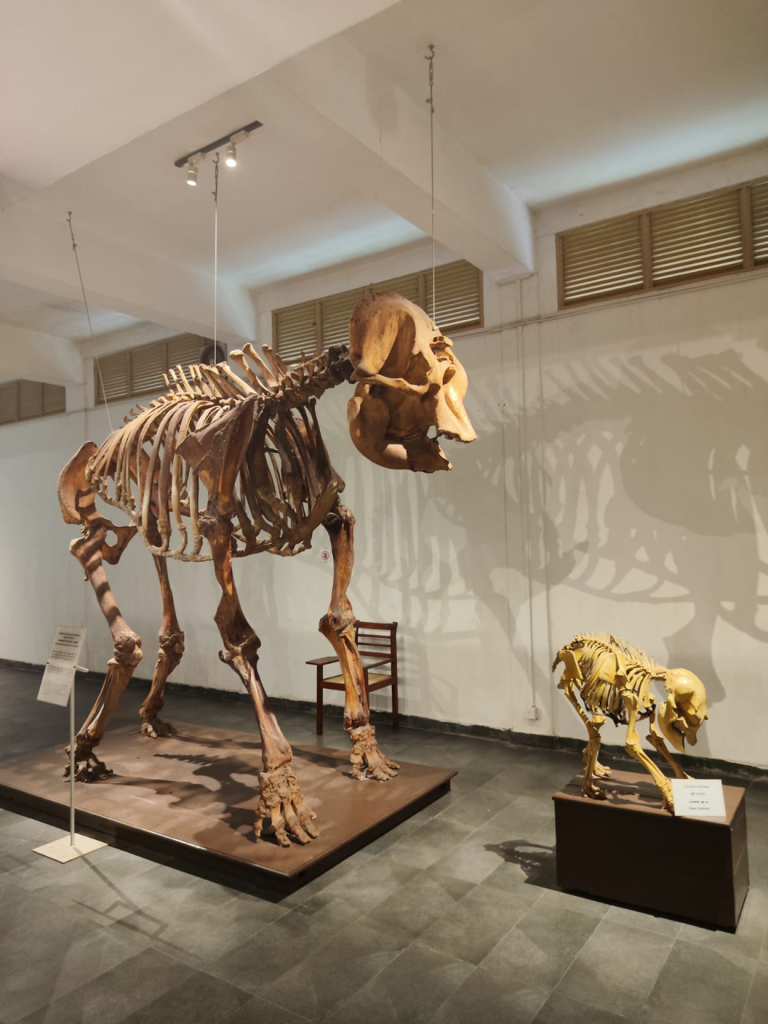
Despite coming from the NZG and living in close proximity to humans, there seems to be a total forgetting of this human-elephant connection. No mention of who took care of her, if she had one or multiple mahouts and if they shared a special bond. What she was like with the crowds that came to see her? Was she a shy and gentle elephant or was she feisty and difficult? The plate (below) first communicates taxonomic information. It then clinically reads that “the animal was named Lechchamii” – almost unfeelingly as a labelled object – and promptly continues to confirm her place in this space by remembering her as only a “specimen”, to be studied, assembled, exhibited and looked at.
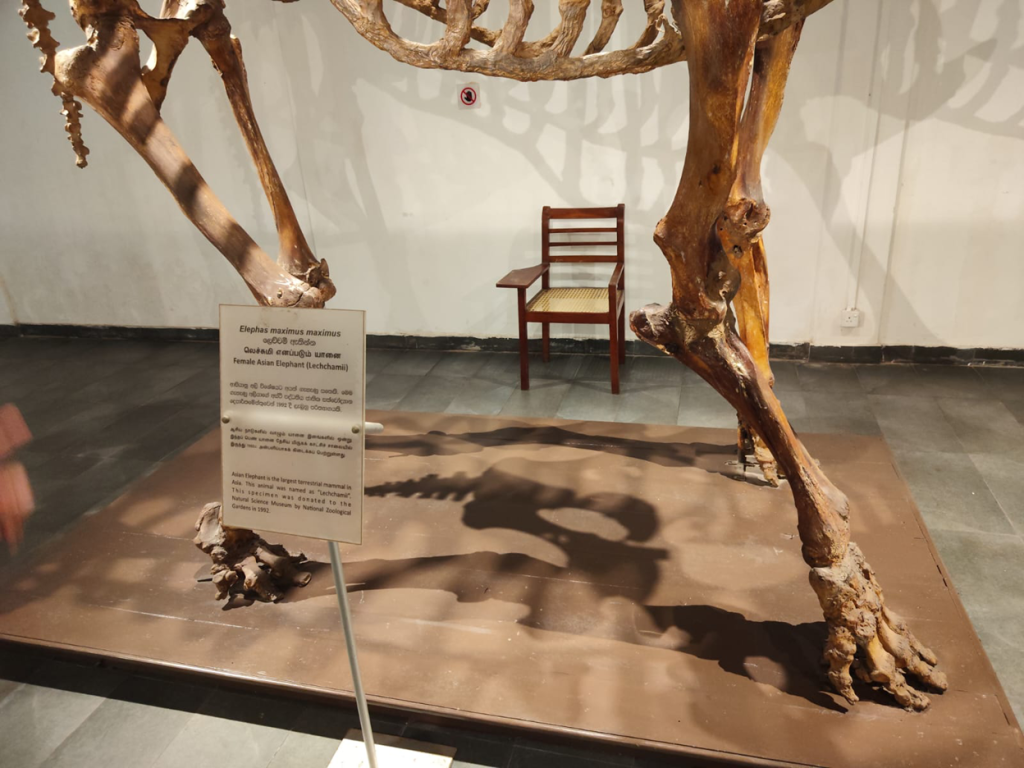
The plate reads “(The) Asian Elephant is the largest terrestrial mammal in Asia. The animal was named as Lechchamii. This specimen was donated to the Natural Science Museum by (the) National Zoological Gardens in 1992.”
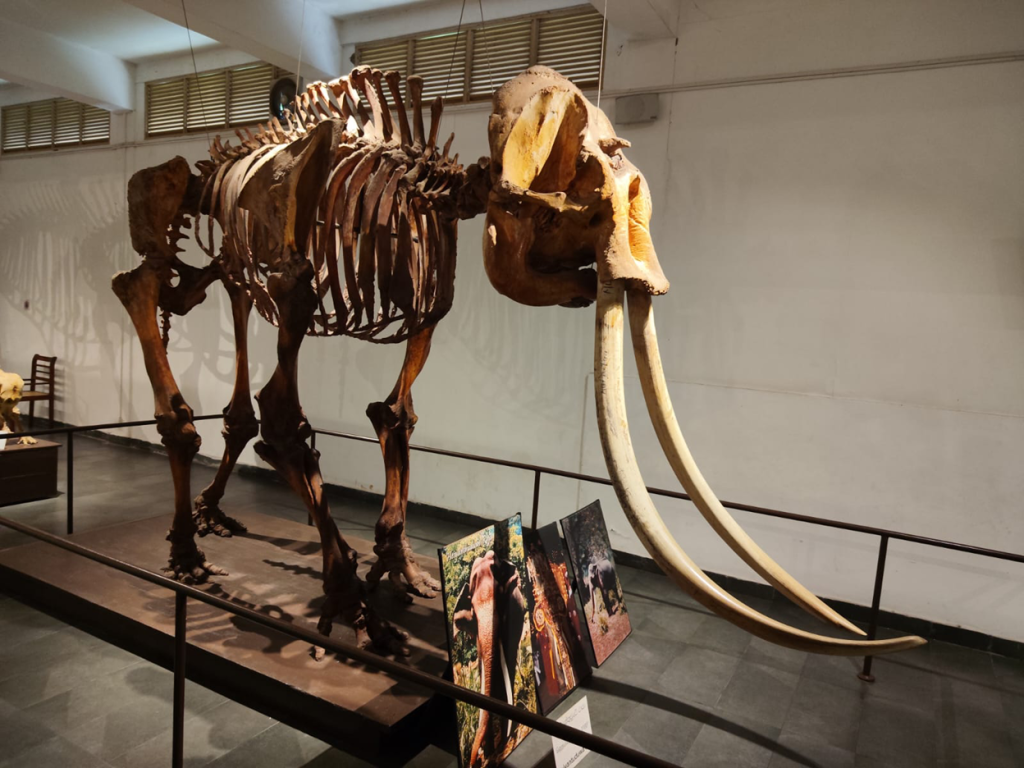
Of the three, it is Heiyantuduwa Rāja who is least forgotten. A decorated ceremonial tusker, Rāja (above) was known for his exceptionally long pair of tusks. Tusks are a rarity in the Sri Lankan Asian Elephant population, only seen in some males. Having them (among other requirements) qualifies these elephants to carry the casket that holds the sacred relic (believed to be) of the Buddha, that is annually displayed to the public in a ceremonial parade. Unlike Lechchamii and the baby elephant, Heiyantuduwa Rāja is remembered prominently by his name on the descriptive plate, and the photographs that are both near his exhibit and on the large placard adjacent to his skeletal structure. The Gajaga Vannama—a tune traditionally played during the perahára (the ceremonial parade) in which the elephants carry the sacred casket—is played on loop in the background.
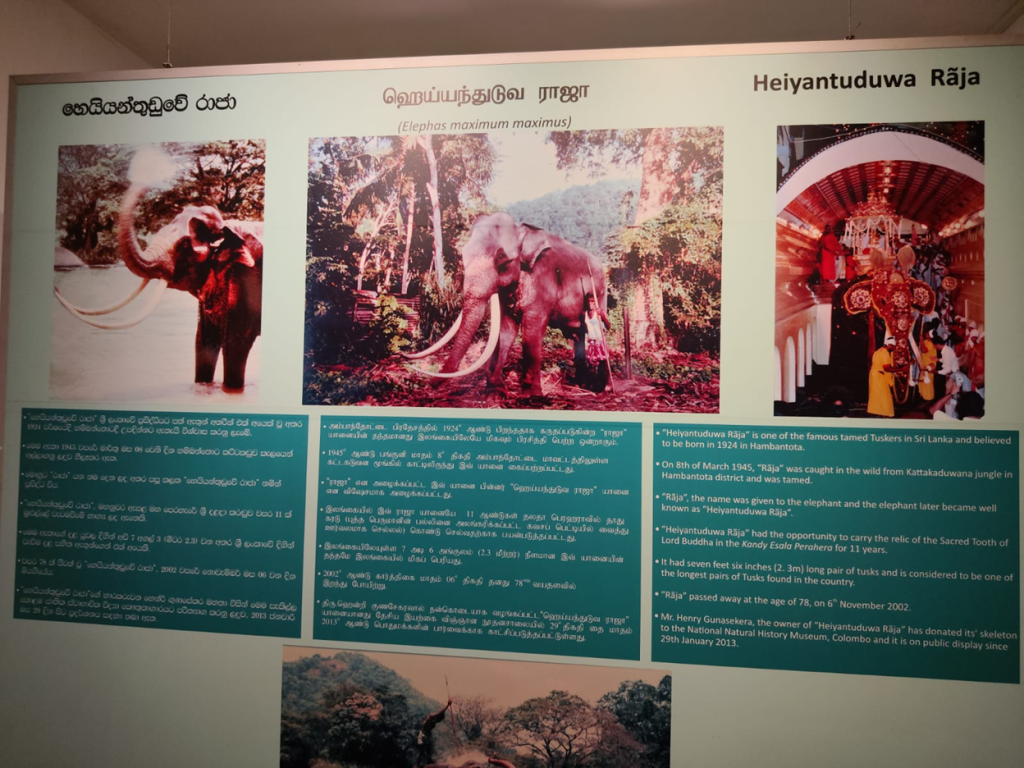
The poster/placard (above) records an approximate year of birth, the date and place of his capture, and the date of his passing. It also shows photos of his day-to-day, taking a bath in the river, with his mahout, and what he is most remembered for, carrying the sacred relic, dressed in the ceremonial regalia.
His proximity to the ethno-religious majority, and subsequently to the ethno-religious state, ensures he is remembered in a state institution. Yet, despite all this remembering, there is much that is forgotten. The placard, almost dismissively, states that he was “caught in the wild…and tamed”, actively forgetting the brutality of his displacement and the ensuing physical and emotional pain that would have been inflicted to ‘tame’ him into a docile, accepting being. While the image of his bullhook-yielding mahout is on the same placard, this connection is not easily made. As with most ceremonial elephants attached to temples, Heiyantuduwa Rāja is also anthropomorphised. By giving him a (false?) sense of human-ness, he is easily made part of a system of religious belief that allows the extraction of labour that is required of temple elephants, under the guise of an “opportunity” or (as read in the Sinhala translation) “good fortune” to accumulate merit for his next life.
The three elephant skeletal structures in the Osteology Gallery of the Colombo National Museum of Natural History are, for me, an interesting starting point in the study of non-human animals within museums. Animal (hi)stories get lost with relative ease within ethnographic museums, both in physical objects (as inside the craft galleries that hold intricate ivory carvings that have forgotten the elephant) and in iconography – in flags, swordheads, stone carvings and jewellery that depict animals, both mythical and real. But forgetting the animal in a natural history museum seems like a paradox in itself, forgetting the very thing it is meant to remember. But a quick peep into the history of these spaces will tell us that they were never meant to remember just the animal. They were spaces built to collect, entertain, to immortalize stories of conquest and far-away exotic places. And when museum spaces only allow for one kind of remembering, it will also function as a space of forgetting.
References
1 Rosa Dyer, “Hummingbirds: Warrior birds and feathered jewels,” The Animal Turn (blog), March 23, 2026. https://www.theanimalturnpodcast.com/post/hummingbirds-warrior-birds-and-feathered-jewels
Det här inlägget postades den November 11th, 2026, 10:34 och fylls under blogg