
Reclaiming the Body: The Islamic Republic and the Colonization of Iran
Postat den 11th November, 2026, 10:31 av karubakeeb
Somayeh Aghajani
When the “Woman, Life, Freedom” uprising captured global headlines, the Western media apparatus defaulted to a familiar, liberal Eurocentric binary. The complex, deep-rooted struggle inside Iran was swiftly flattened into a tidy “clash of civilizations”—a predictable conflict between secular liberation and religious fundamentalism. Within this narrative, Iranian women are frequently cast as passive victims of an archaic, medieval patriarchy, waiting to be conceptually “saved” by Western ideals of modernity.
As a student of colonial and postcolonial studies, I argue that this binary is entirely inadequate. To truly comprehend the current situation in Iran, we must look past superficial religious rhetoric and ask a harder question: What if the Islamic Republic is operating not as an ancient theological relic, but as a hyper-modern, totalitarian colonial state that has turned the entire nation into an occupied territory?
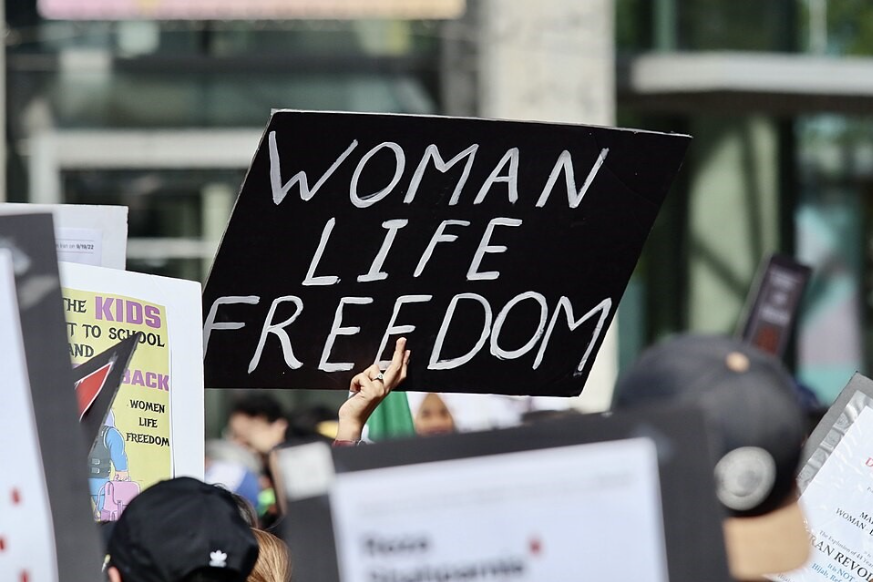
Caption: A demonstrator holds a handmade “Woman Life Freedom” sign during a rally. Source: Taymaz Valley / Flickr / CC BY 2.0
The Totalizing Project: Colonizing Minds and Bodies
In classical decolonial theory, colonization extends far beyond physical geography or foreign empires; it is a profound project of control targeting both the mind and the body. Looking closely at Iran, the state operates through a distinct form of internal coloniality. For over four decades, the regime has sought to completely restructure the private and public spheres, attempting to colonize the thoughts, choices, and physical presence of its citizens. Historians track this four-decade trajectory back to the immediate aftermath of the 1979 revolution, when the state systematically consolidated power by transforming individual moral choices into institutionalized mandates of absolute civil compliance (Milani, 2011).
To unpack this mechanism, we must center the everyday reality of the Gasht-e Ershad —the morality police. For any woman navigating an Iranian street, the morality police are not an abstract theological concept; they represent a physical, omnipresent panopticon. Armed with discretionary powers of detention, public humiliation, and bodily chastisement, these units actively enforce state regulations on how a woman must walk, what she must wear, how much hair escapes her headscarf, and how her body occupies public space (Amnesty International, 2023).
In her work on the “Modern/Colonial Gender System,” decolonial feminist María Lugones (2007) argues that enforcing strict, hierarchical body categorization is a core axis of state power. The state demands total sovereignty over the subaltern body to preserve its own authority.
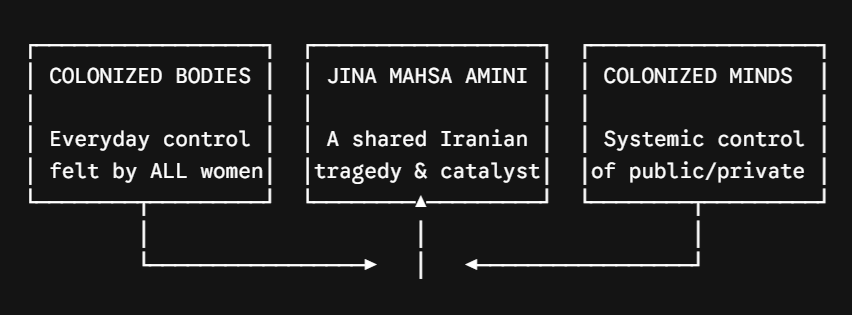
When applying Lugones’ framework to the Iranian context, a striking realization emerges: the mandatory hijab enforced by the morality police is not merely a sign of religious piety. It is a tool of state biopolitics—the literal colonization of the body. By turning the female body into an ideological battleground, the state uses systematic surveillance, psychological terror, and physical violence to enforce its rule. This structural violence targets all women across Iran. Every single time an Iranian woman steps outside, her body is treated as state property to be regulated, watched, and subdued.
Capillary Power and the Bureaucracy of the State
Yet, the coloniality of the Islamic Republic goes far deeper than a single police force driving green-striped vans. To understand how this regime has colonized the minds, bodies, and spaces of the entire country, we must analyze how the state transforms ordinary citizens into extensions of its own disciplinary power.
This structural dynamic is explained deeply by Aníbal Quijano’s (2000) concept of the “coloniality of power.” Quijano posits that modern colonial structures persist long after classical geopolitical empires recede, operating as an integrated matrix that hinges on the total control of authority and the institutional imposition of essentialized social hierarchies to classify, dominate, and exploit populations. In the context of Iran, this matrix is fueled, institutionalized, and state-directed through a foundational Islamic moral tenet: Al-Amr bil-Ma’ruf wan-Nahy ‘anil-Munkar (“Commanding right and forbidding wrong”). As the historian Michael Cook (2000) documents in his extensive study of the concept, this duty historically served as a decentralized moral obligation for Muslims to uphold communal ethics.
However, the Iranian regime systematically institutionalized and bureaucratized this concept. Within the state’s interpretation of Islam, Amr bil-Ma’ruf is framed not merely as a theological ideal, but as an individual religious duty incumbent upon every single Muslim to police the moral behavior of others. To direct, enforce, and organize this collective surveillance, the state established a formal, powerful bureaucratic apparatus: The Headquarters for Enjoining Right and Forbidding Wrong (ستاد امر به معرف و نهی از منکر). This expansive administrative body issues formal directives, coordinates with paramilitary wings, and operationalizes civil surveillance by training civilian volunteers to actively monitor public spaces (Human Rights Watch, 2022).
By transforming an individual religious concept into a state-directed, bureaucratic mandate, the regime successfully outsources its violence to the public sphere. It creates an atmosphere of constant societal surveillance where minds and bodies are managed by a collective, internalized gaze.
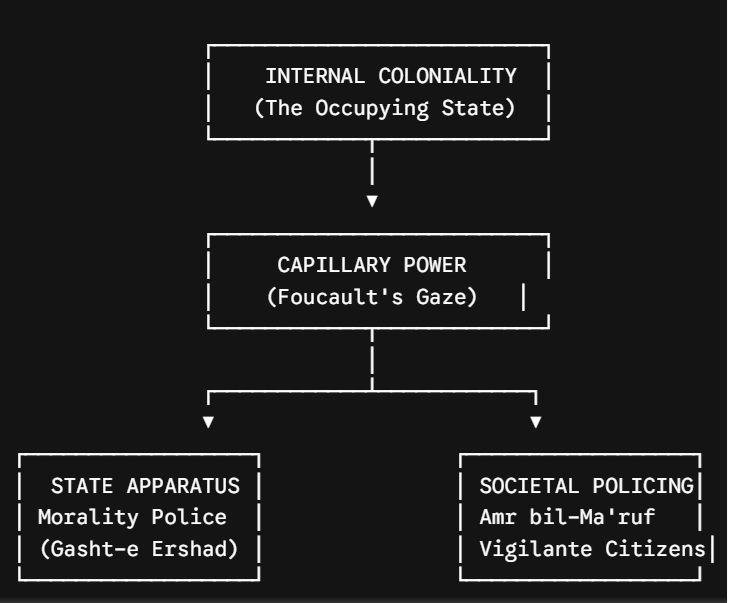
Consequently, the colonization of the body is enacted not just by men in uniform, but by a neighbor, a passerby on the street, or a passenger in a taxi. Under the direct ideological backing of the State Headquarters, these individuals assume the right to dictate how a woman must dress, what people can eat or drink during Ramadan, or whether a person is allowed to consume alcohol. This dynamic closely mirrors what French philosopher Michel Foucault (1977) observed regarding the architecture of modern power. Foucault argued that control becomes “capillary” when it flows through the everyday interactions of society until citizens internalize the panopticon, effectively turning the gaze of power onto themselves and one another.
Jina Mahsa Amini: A Shared Iranian Tragedy
When Jina Mahsa Amini was arrested in Tehran for an allegedly “improper” hijab and subsequently killed while in the custody of the morality police, the resulting shockwave did not fragment the country; it united it (United Nations Fact-Finding Mission, 2024). For the people of Iran, the tragedy was deeply personal and universally understood. She was not targeted as an outsider; she was targeted because she was a young woman trying to exist in her own country.
Every Iranian woman saw herself, her sister, or her daughter in Jina Mahsa Amini. Every Iranian citizen recognized the violent hand of a regime that has spent decades suffocating their collective future. Her death became the catalyst for an uprising precisely because it exposed the raw, unyielding nature of the state’s bodily colonization.
The Kurdish and Persian chant “Zan, Zendegi, Azadi (Woman, Life, Freedom)” resonated from Tehran to the furthest corners of the country because it was a collective demand to decolonize everyday life—to rip the state’s hands off the minds, bodies, and futures of the Iranian people. As an intersectional cry, “Zan, Zendegi, Azadi (Woman, Life, Freedom)” deliberately targeted the very core of the state’s internal colonial authority, fusing gender liberation, bodily autonomy, and a rejection of totalitarian subjugation into a singular political paradigm (Abdi, 2023).
Dismantling the Rhetorical Illusion
The ultimate irony of the Islamic Republic lies in its intense anti-imperialist, anti-Western rhetoric. For over forty years, the regime has framed itself as the ultimate bulwark against the Western empire. However, a decolonial lens allows us to see through this rhetorical illusion.
A state does not need to be white, Western, or European to practice coloniality. When we align Quijano’s coloniality of power with the actions of the Iranian state, the structural parallels become undeniable. By relying on a centralized bureaucracy, constant ideological policing through institutions like the Headquarters for Enjoining Right and Forbidding Wrong, the institutionalized degradation of women, and the total subjugation of its citizens’ personal freedoms, the Iranian state utilizes the exact same violent mechanisms of control perfected by modern colonial empires. It behaves as an occupying force within its own borders.
When Iranian women stand in front of the morality police, strip off their headscarves, and demand their fundamental rights, they are not asking for Eurocentric “enlightenment” or Western liberal salvation. They are engaging in a deeply radical, localized, and indigenous act of decolonial resistance. They are fighting to reclaim their bodies, their minds, and their country from a modern colonial machine.
References:
Abdi, N. (2023). Epistemic Shifts and Indigenous Resistance: Unpacking Zan, Zendegi, Azadi. Middle Eastern Critical Studies, 14(2), 105–122.
Amnesty International. (2023). Iran: Intensified Crackdown on Women and Girls Defying Discriminatory Mandatory Veiling Laws. Amnesty International Secretariat.
Cook, M. (2000). Commanding Right and Forbidding Wrong in Islamic Thought. Cambridge University Press.
Foucault, M. (1977). Discipline and Punish: The Birth of the Prison. Vintage Books. Human Rights Watch. (2022). The Bureaucracy of Repression: Inside Iran’s State-Directed Surveillance Apparatus.
Human Rights Watch Report.
Lugones, M. (2007). Heterosexualism and the Colonial/Modern Gender System. Hypatia, 22(1), 186–209.
Milani, F. (2011). Words, Not Swords: Iranian Women Writers and the Freedom of Movement. Syracuse University Press.
Quijano, A. (2000). Coloniality of Power, Eurocentrism, and Latin America. Nepantla: Views from the South, 1(3), 533–580.
United Nations Independent International Fact-Finding Mission on the Islamic Republic of Iran. (2024). Report on Human Rights Violations and the Catalyst of Custodial Deaths. UN Human Rights Council.
Det här inlägget postades den November 11th, 2026, 10:31 och fylls under blogg