A Decolonial View

By students in the Colonial and Postcolonial Master

A visit to the Gothenburg Book Fair – celebrity cultural capital and the power to speak back

2026-01-15

By: Serena Fedeli

Disclaimer: this post is intended as a recollection of personal experiences following a university seminar and two interviews which I attended. I will relate them along with some excerpts which I have noted down by hand, and which therefore should be taken for what they are: loose quotations. In what follows, you will see authors, discussions and even scholarship through my eyes. 

A few weeks ago, I attended the annual Gothenburg book fair, an event which gathered almost 100 000 visitors this year. I was interested in particular in listening to two interviews with two Nigerian authors, which I wished to observe and compare. The idea came from a discussion from a seminar that I attended recently, in which the guest lecturer, dr. Doseline Kiguru, discussed African celebrity writers and canon formation, as well as the idea of ‘poverty/trauma-porn’. According to my understanding of Kiguru’s arguments, there is in fact a connection between contemporary African fields of literary production, canon formation and capital circulation which should not be overlooked. In short, Kiguru’s analysis, building on Bourdieusian notions of cultural capital, places the literary text within a framework of production, to bring forth the interlocking mechanisms that exist between cultural/literary capital value and circulation, and canon formation (see Kiguru 2016 for more on this topic). A common denominator between the two texts read to prepare for the seminar was the figure of the celebrity African writer, often a winner of prestigious literary prizes, who embodies in their public persona the accruement of social and cultural value, and therefore power, in Bourdieusian terms (see Kiguru, 2022 for the figure of the celebrity writer). Moreover, during the seminar, we had the chance to observe the features of the short stories which, throughout the years, won the Caine Prize for African Writing, finding a blatant similarity amongst them all: the common topic of poverty, trauma and sufferance. With these in mind, I headed to the Gothenburg book fair, to listen to two award-winner Nigerian writers —Chigozie Obioma and Chimamanda Adichie— and observe if and how their ‘celebrity power’, so to speak, played out in the interviews. The experience did not disappoint.  
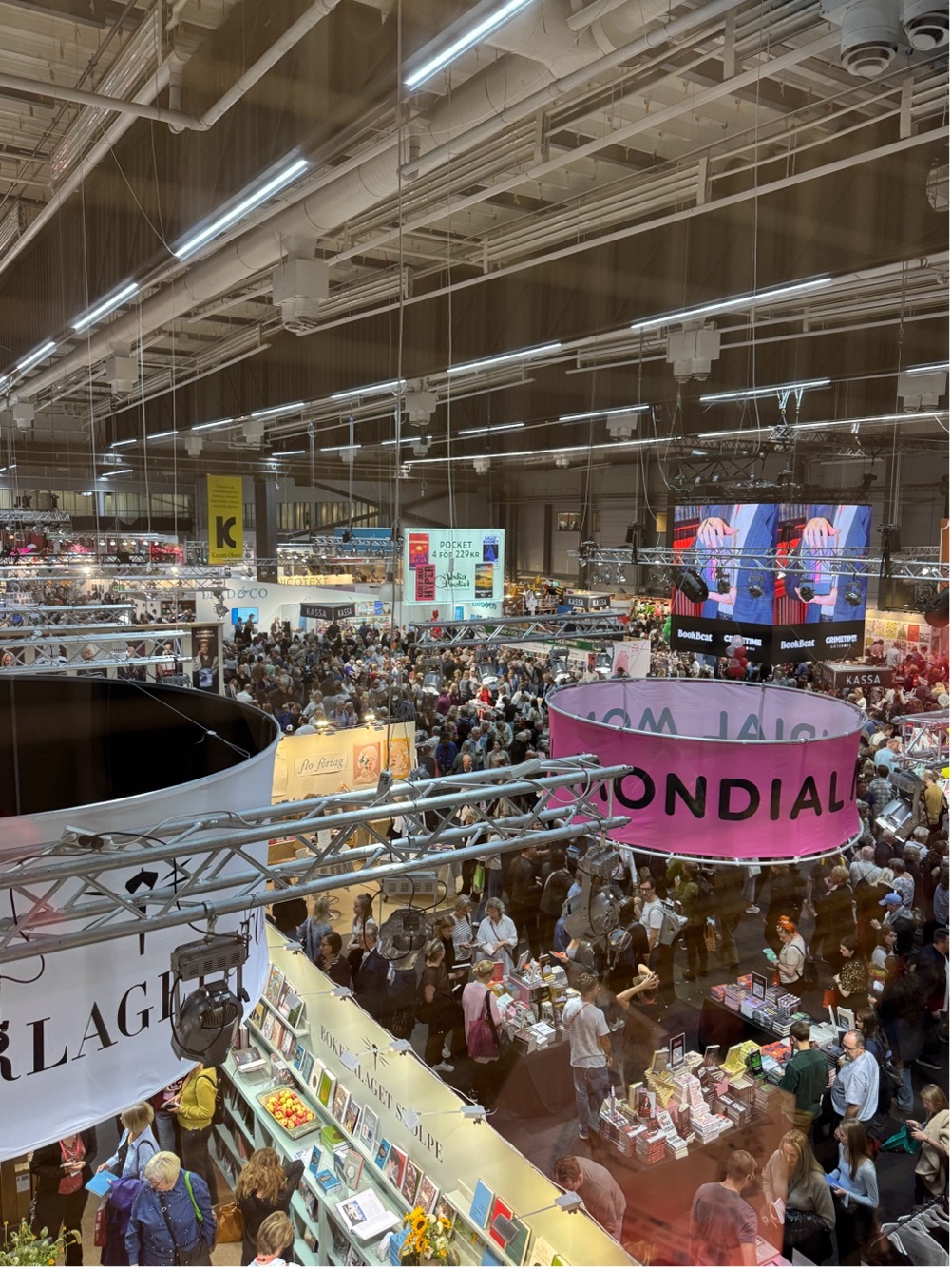
Figure 1: The large crowd at the Gothenburg Book Fair 2025 

The first interview I attended was with Chigozie Obioma, about— supposedly— his latest novel The Road to the Country, which, admittedly, I am yet to read (I will!). I hope Obioma will not get offended if I state that he is not quite the same celebrity as Chimamanda Adichie, though her popularity is truly hard to beat, but more on that later. Even though his words might not have been associated with fashion shows and Hollywood stars like Adichie’s, Obioma is still a well-established writer, with a bunch of prestigious achievements under his belt. In 2015 alone he was named one of the ‘100 global thinkers’ by Foreign Policy magazine and called ‘the heir to Chinua Achebe’ by The New York Times, which is, arguably, quite impressive. Moreover, he served as a judge for the Booker Prize, and he is a distinguished professor of English at the university of Georgia, which, to me, means that he knows a thing or two. Nonetheless, the Gothenburg book fair did not consider that he would gather such a crowd, and in fact the interview took place in a rather small room.  
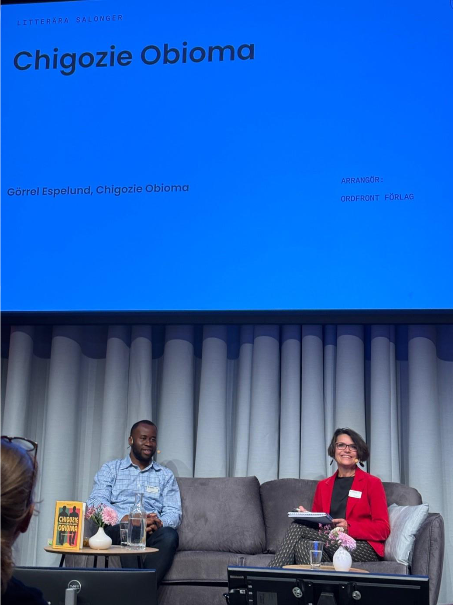
Figure 2: Chigozie Obioma 

Interestingly, the interviewer (a journalist) set the tone for the whole conversation right from the first moment, contextualising the novel in the period of the Biafra war. A large chunk of the time was subsequently dedicated to asking the author about the formation of the Nigerian nation state, colonialism, and the arrival of the British. Despite this speedy lesson on colonial history, the interviewer at this point said again: “Though, really, the war is the centrepiece of the novel”. Obioma explained then that he believed some of the best stories to be those that deal with “a rebel without a cause, fighting against his own convictions”, and proceeded to illustrate what he saw as the most interesting features of his novel: the inner development of the main character, the deep bond he formed with the other soldiers, “the genuine attention and love for others”, “war as a refining tool for human identity”… in other words, showing that war is not to be monumentalised, and that such a tendency is part of a larger “Enlightenment project”. Yet, monumentalising is precisely what I understood the interviewer to be aiming at. At this point in fact, an interesting back-and-forth dynamic surfaced between interviewer and interviewed. On the one hand, the journalist who time and time again went back to real-life issues of war and trauma, such as the author’s research on the Biafra war, his meetings with veterans: “how much of it is based on real events?”. On the other, Obioma talking about African literature, the importance of the mystical in today’s life, and his attempt to “offer the metaphysical to open up questions in the reader’s mind”, insisting that veterans do not really talk much about the war. This exchange, which in the end was centred around real-life war, resulted in the author exclaiming: “I know you are all very pragmatic and rational, this is Sweden after all!”. Ok, I said to myself, should I take this as frustration? Nevertheless, this talk was all about the ‘trauma-porn’ we discussed with Kiguru, and I wondered if that could be due to the fact that the author did not embody enough power in his celebrity personhood to simply speak about whatever he wanted: cosmology, mysticism, identity, solidarity…cool stuff! Instead, he ended up feeding his Swedish audience a generous portion of trauma and sufferance so dear to the sympathetic Western reader. Admittedly, I was a bit frustrated by the predictable outcome, somewhat ashamed to embody the stereotypical Western reader myself and still rather curious to hear what the author could have said about his writing, if only he had been given the opportunity. Let’s move on. 

Next on my program was nothing less than celebrity-superstar writer Chimamanda Adichie. The Gothenburg book fair had organised her seminar in the biggest room they had, which holds 500 people. To give you an idea, after queuing for 45 minutes I got nervous that I would not manage to get in! If you are not familiar with Adichie (aren’t you though?!), she is exceptionally famous, she won more prizes than I can list here, she spoke with Michelle Obama, Kamala Harris, Robert De Niro among many others, she collaborated with Beyoncé, Dua Lipa and the Met Gala designers, her Ted Talk words were printed on Dior’s clothes …in short, celebrity capital through the roof. I must admit, I was not immune to her charm, this became clear to me right away. I even forgave her for arriving almost 40 minutes late, in true celebrity style. I liked her right away, when she said that the first thing she thinks about when she finds out that she has won an award, is what she is going to wear; this small detail, I thought, served the purpose of instantly connecting her to her audience: she is one of us in some ways, but with an added wow-factor that makes her different from us…she has a stylist, after all!  

This talk was surprising. Adichie received the 2025 Mermaid Award, and was interviewed during the ceremony by author Agri Ismaïl. The dynamic between the two was very different than in Obioma’s interview, not because of the interviewer, I would say, but because Adichie stirred the conversation from the beginning. In fact, Ismaïl started by talking of Adichie’s supposed postcolonial identity, but she replied that she is “not nostalgic of pre-colonial West Africa”, and when asked about her intention to move from a postcolonial to a post-postcolonial narrative she asserted that the African writer always gets asked about postcolonialism, but she wants to talk about those same “universal feelings that drive Western classics”, insisting that formerly colonized people do not think of themselves as postcolonial subjects all the time and —drum roll— that people read novels from the global south as anthropology, while literature is universally human; therefore, she does not want “to see her characters framed as representatives of Nigeria’s postcolonial identity”. At this point, Ismaïl was literally forced to change the trajectory of his interview (which he did, with a few bumps, rather well).  
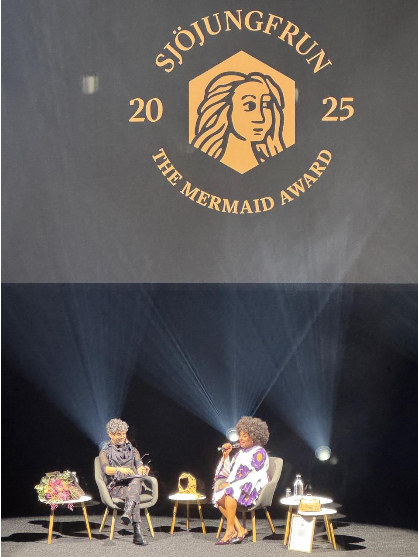
Figure 3: Chimamanda Adichie receiving the Mermaid Award 

It was really clear to me as a spectator that Adichie from this point on stirred the conversation towards what she wanted to talk about: the evolution of her characters, her relationship to them and how this relationship registers in the narrative’s form in terms of first- or third-person narration, for example. Nonetheless, the speaker tried again to discuss some more ‘postcolonialism’ and brought up literary historian and critic Franco Moretti and the idea of the novel as the prime cultural artifact of the European Bourgeoisie. He asked: “doesn’t the form itself force you to conform to something that doesn’t really represent non-Western realities?”. To which Adichie replied that “the novel has become African because Africans have written it” and reiterated, once again, that belonging to a formerly colonized country should not define everything that the African writer does, including when it comes to the use of the English language: “Igbo is mine and English is also mine. Can we just move on?!”. Towards the end of the interview, the conversation acquired a somewhat political tone, as Ismaïl asked Adichie for some advice to those in the U.S, “living their first dictatorship”. According to Adichie, who has herself been living in the U.S for decades, people in America should remember that their country has a long history of imposing dictatorships to others, so they should “suck it up”. The end, long applause. Wow, I was truly mesmerized not only by her words, but also by her wittiness and audacity, her presence and power.  
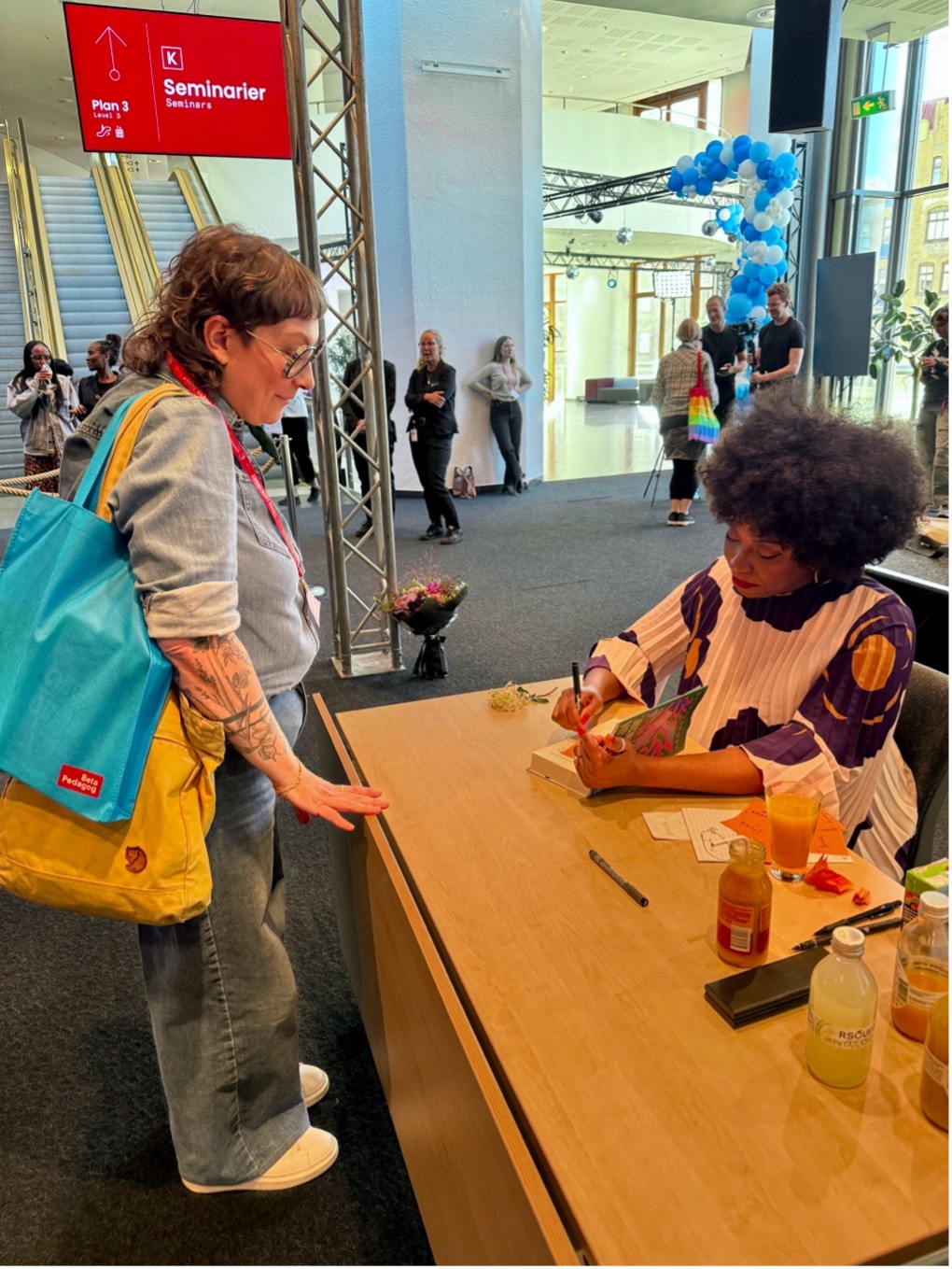
Figure 4: Chimamanda Adichie signing my copy of her latest book 

To sum up my considerations of this experience then, I think that not only do we, Western readers, still seem to have a very soft spot for ‘poverty-porn’, a need to feel sympathetic towards the so-called Global South, even when it comes to fictional representations of it; that this, in simple words, is still what sells. But also, I got to observe the very evident connection between celebrity status and ‘power’, and how the writer who has been canonized through recognitions and international literary awards, accrues enough symbolic and economic power that can be used to support and/oroppose other matters and causes which depart from the literary industry and expand to larger cultural, social and political issues. Essentially, the subaltern can speak, in Spivak’s words, but only when she is a superstar.  

Further readings 

Kiguru, Doseline. 2016. “Literary Prizes, Writers’ Organisations and Canon Formation in Africa”, African Studies 75:2, pp. 202–214. 

Kiguru, Doseline. 2022. “Contemporary African literature and celebrity capital”, in African Literatures as World Literature, edited by: Alexander Fyfe & Krishnan Madhu, New York: Bloomsbury Academic, pp. 189–211. 

Spivak, Gayatri Chakravorty. 2001. “Can the Subaltern Speak?” In Imperialism, edited by Mark Harrison and Peter J. Cain, 171–219. 1st ed. London: Routledge. 
Poetry as Knowledge 

By: Kim Hoa Hof

One part of studying and fostering decoloniality for myself is to find practical tools to radically broaden academia. How can academia hold and reflect more of the world of knowledge production existing in the lives of the systemically underserved and marginalized? 

In the intersection of art and research (whatever is firmly outside of art in the humanities) I’m interested in poetic language as knowledge production. (Lee 2014, 30-31, Lykke 2014, 34-35) Poetry is often seen as something outside of knowledge, something only emotional or artistic. Yet, poetry can create its own kind of knowing. It does not offer facts or fixed answers but shows truths that can only be felt, glimpsed, or lived. Through rhythm, images, and fragments, poetry gives shape to what ordinary language cannot hold—grief, longing, memory, and the body’s quiet knowledge.  

Writing in this way is also an act of risk (Lee 2014, 12-13). To write poetically is to open oneself, to let words carry both strength and vulnerability. It resists being reduced to one single story or identity. Instead, it allows space for contradiction and for the possibility that meaning may shift over time. 

Poetry also bends time (Lee 2014, 115-117). It moves between past and present, between what is gone and what still lingers. It makes visible the moments where we are out of step with the world, where ordinary measures of time and truth no longer apply.  

Seen this way, poetry is not a decoration to thought but a method of knowledge. It produces knowledge through openness, through its ability to hold complexity, and through its insistence that imagination and lived experience matter. 

For all the above as well as further through beyond, this is one more text with the purpose of reminding academia that it needs the expansion of a lyrical language as one way of producing knowledge.  

Academia as a search for new knowledge  

should  

know no  

outer boundaries but instead look for the edges as guidance 

for 

creating friction, 

cracks, 

boundary events, for 

light let through, to 

peak in to 

something  

before 

felt  

unknowable.  

The enemy SHOULD be 

The conservator 

The fan of 

formats and praxis and procedures… 

Paragrafryttarens höga häst 

Dasssss besserwisser 

The Singularity 

who 

already knows 

all there is to know 

about what you can know 

about knowledge. 

Fellow student—dear teacher,  

I have decided to urge you to allow your light to shine through. 

Stay in touch with your particular brand of silliness! 

Break stuff—without a plan on how to make it whole again! 

Lose yourself! 

Leave your bed unmade! 

Let in the mites! 

Look for them… they are crawling in new patterns over the peaks where your duvet fell this morning. 

Steep to 

find your accidental 

penicillin… 

References 

Lee, Mara. 2014. När Andra skriver: skrivande som motstånd, ansvar och tid. Glänta produktion. 

Lykke, Nina. 2014. Writing academic texts differently: intersectional feminist methodologies and the playful art of writing. Routledge. 

Read more poetry within academia 

Anzaldúa, Gloria. 1999. Borderlands/La Frontera. Aunt Lute Books. 

Hallgren, Hanna. 2013. “Prolog till den litterära vetenskapsteorin”. Tidskrift för genusvetenskap: nr 1 2013. 

 “Concerning Violence: Nine Scenes from the Anti-Imperialistic Self-Defense” –  An affective reflection on a (post-)colonial documentary 

By: Omar Mohamed

How would it feel if we could see or listen to Fanon’s writings? How would it feel if the narrativization of “On Violence” blended in a discussion with the indigenous peasant, the Liberian striking workers, and the colonized from Mozambique, Burkina Faso, Angola, and Guinea-Bissau? Or even with Lamco’s administrators, with the colonial pawn of indirect rule, or the Christian missionaries of the European dreams, the soldiers and the cops, the settler who thinks that she belongs there, and the other one who is afraid because the social fabric changes in South Africa? What type of feelings does one experience when Spivak’s brief introduction to the Fanonian thought witnesses the mutilated Black Venus, breastfeeding her mutilated baby? And the women guerrillas talking about the existence of gender equality within the context of resistance? Or when rewatching Thomas Sankara’s interviews while Fanon’s “The Wretched of the Earth” (1963) echoes through Lauryn Hill’s voice? Indeed, it is powerful to witness decolonization in the making. 

“Concerning Violence – Nine Scenes from the Anti-Imperialistic Self-Defense” (2014) is a documentary by director Göran Olsson that blends the emblematic “Wretched of the Earth” (Fanon 1963)with Swedish archival material that documents the realities in those African countries in the turbulent process of/for decolonization. Instead of imposing Fanon’s words into the visual and acoustic bricolage, the film gives room for interpretation. It does not dictate nor command the viewer to think in a particular way. It provides space for the viewer to creatively formulate linkages between the image, the music, the testimonies, and the narration. It is an amalgamation of raw footage and the discourse of violence, reminding us of violence as the means for liberation and for the invention of a new human. Not the individual, not the homo economicus, not the bearer of European consciousness, but a human in plural, a relational and communal human, whose existence does not presuppose the others’ subjugation. Where in the vision of that future environment there will be no room for the Hegelian master-slave dualism.  

Here, I share a few moments from the film in an affective manner, as a viewer of violence. The carefree soldiers drinking in the city are the relentless killing machines of the colonial mission.Looking at a group of possible murderers enjoying life, whose imperial military uniform has become their first skin layer, reminds me of Fanon’s metaphor of the colony as a living hell for the colonized that, to become a paradise, the colonizers must be replaced. We witness a soldier shooting livestock from a helicopter. Having landed, a relentless repetition of the action takes place while the footage is focused on the dead face of the animal until blood flows. Meaningless murder and brutality. Those images are more relevant than ever today as well. We scroll through images on social media of IDF solders unloading bullets on animals, uprooting olive trees as a tactic of starvation and erasure. When Lauryn Hill reminds us Fanon’s quote that “colonialism is not a thinking machine” (Olsson 2014, 7:33) I realise that the system is carefully planning to achieve alienated zombies—in the words of Fela Kuti. 

Rather than being confessions of passivity or testimonies of victimization, the footage provides an insight into the agency of the freedom fighters. Although in the hands of the director, their strategies, their intellect, their desires, and the rationale behind their actions are communicated in an unmediated manner. One could say that the director tailors the footage with Spivak’s question: “Can the Subaltern Speak?” on his mind. I find it exceptionally peculiar to be able to listen to the voices and see the faces of subjects of resistance that are determined to die for the ultimate goal of emancipation. The insight that is provided also adds up to the footage’s importance in capturing the naturalization of colonization in everyday societal life. There seems to be a chaos amidst that order. It boils inside the subjugated and is ready to flood the colonies in order to sweep their structures away. This antithesis reflects the parallel, segregated worlds within the colony, the black and the white zones. 

Furthermore, the interview with Tonderai Makoni reveals the shocking effects of imprisonment and torture on the anticolonial consciousness. I interpret his growing feelings of indifference and detachment as evidence of the colonial methods of alienation and strategies of castration. A glimpse into the participation of other international agents of colonial rule is provided with the documentation of the workers’ strike and their imprisonment in Liberia. The interviews with Lamco’s Swedish CEO, the president of Liberia, and a cop, expose how corporate extractivist capital regulates the laws and the rules of the economy in coordination with the authorities and the state. Any form of resistance or opposition to the colonial-capitalist power relations seems to have destructive repercussions on the lives of the local population. That alone is telling of the sacrifice that is willing to be taken to live a life of dignity. Again, Lauryn Hill quotes Fanon: “In the colonies the economic substructure is also a superstructure. The cause is the consequence. You are rich because you are white; you are white because you are rich” (Olsson 2014, 35:45-35:58) 

One of the most terrifying pieces of footage is that of the Christian missionaries in Tanzania. Locals dig the soil to build a church while they discuss their civilizing religious purpose. Far in the background, a child stares at them, and I cannot stop wondering what was on that kid’s mind. Maybe I am overthinking this. But as I am listening to the missionaries—in their clean clothes and with their bright smiles—stating proudly that they are unaware of plans concerning the construction of schools and hospitals when Black people labor to fix the White Man’s church behind them, I keep thinking about the violent rhetoric of the civilizing mission. Then I wish that this child felt anger. An anger that explains the type of violence that Fanon is writing about. An anger that could have potentially stimulated a consciousness driven by decolonial violence. The same anger that connects Fanon to Audre Lorde and Sarah Ahmed when she states:  

“Anger is constructed in different ways: as a response to the injustice of racism, as a vision of the future, as a translation of pain into knowledge, and as loaded with information and energy. Crucially, anger is not simply defined in relationship to a past, but as opening up the future. In other words, being against something does not end with ‘‘that which one is against.’’ Anger can open up the world. This is not to say that anger is our only response to racism— after all, if anger is creative, then it gives us room to do other things. Nor is anger our duty; I am not obliged to keep hitting that wall, sometimes I will, and sometimes I won’t. But not to speak anger because it is pointless is not the answer. After all, even if we use softer language, we are already sore points. We might as well do things with these points. To speak about racism is to labor over sore points” (Ahmed 2012, 171). 

Bibliography 

Ahmed, Sara. 2012. On Being Included: Racism and Diversity in Institutional Life. Durham, N.C.; London: Duke University Press. 

Fanon, Frantz. 1963. The Wretched of the Earth. New York: Grove Press. 

Olsson, Göran, dir. 2014. Concerning Violence: Nine Scenes from the Anti-Imperialistic Self-Defense. Kino Lorber. 

Travelogue from Hanoi: Tattooing as Understanding Decolonial Practice 

By: Kim Hoa Hof

Decoloniality is a fleeting image to me still. I think one of the things that makes decoloniality interesting is in fact this ineffable quality. I think the practice, the application, and decoloniality as life lived is what interests me deeply. I think about what the great decolonial scholars refer to when they speak of third space and dwelling in the margins. Right now, I want to explore my own positionality as a marginalized position. Without caveats, without the nuances of my stacked privileges that have led me to this moment, to this text. I believe I can choose it—that the idea of decoloniality urges me to. So I do.  

I want to look at self-expression as a decolonial practice. I think about human existence as movements of expressing ourselves. And I wish to step out of expression as thoughts and analysis. I believe the obsession with this type of expression is a Eurocentric idea from the time popularized as the Enlightenment. I wish to steep in knowledge as far away from those ideas as possible.  

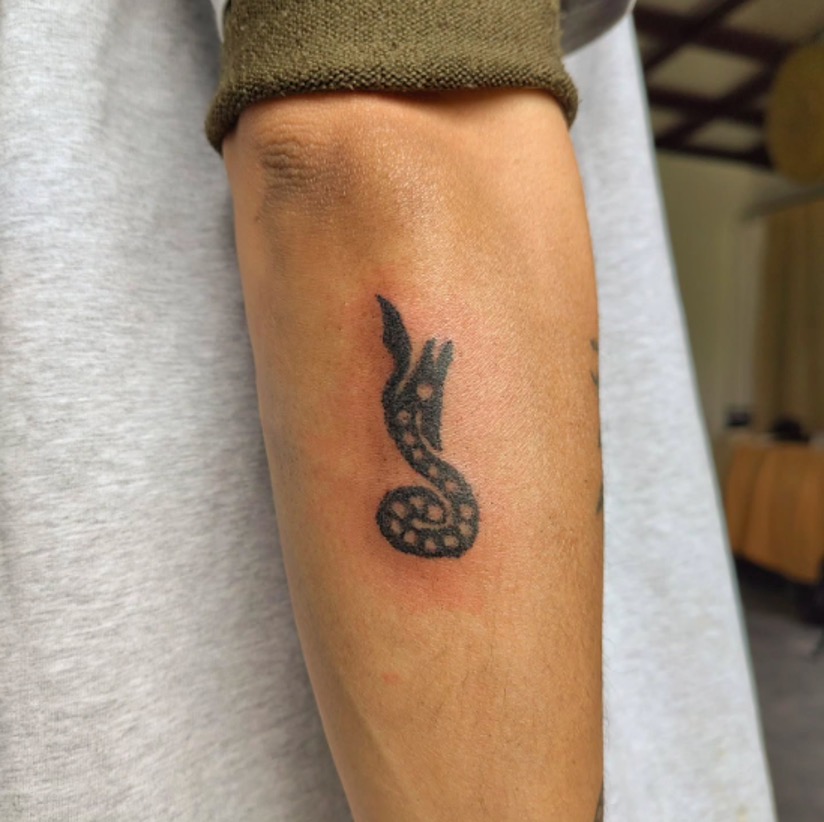
In Hanoi I found a tattoo artist based in Amsterdam. My Hanoi—dripping with postcoloniality. Like me, they had Vietnamese heritage. I lingered on the parallels of the diaspora of overseas Vietnamese and the history of colonized elites based in the metropoles. The artist told me that even the word tattoo has a colonial heritage—snatched from the Tahitian word for marking. They called their practice ancestral markings and explained that the only people they worked on were people with Vietnamese ancestry. This artist reminded me of the fact that I am not of the young minds anymore. Of how much expansion my world will benefit from in perpetuity.  

This artist had had the opportunity to search in the French colonial archives for traces of Vietnamese tattooing history. The fabled origin story of Vietnamese people contains tattooing—cementing tattooing as a heritage that matters to us. Of course, only colonial research is left. And the oral histories that I have stumbled upon. 

This is one story I have heard: the ancient land of Vietnam has been inhabited by people long before Vietnam became one land. We call land sea—the Vietnamese word for land is water. Long before the imperial reigns, tattooing was a part of living. Something that can be understood through the story of imperial dragon tattooing of the first imperial Ly dynasty. This emperor made the imagery of the dragon and the practice of tattooing an exclusively imperial practice. This should be understood in light of the fact that tattooing is a part of our origin story. To protect the first men from sea monsters—sea creatures’ eyes and scales were tattooed on stomachs and thighs. 

I came into this room set up as an Airbnb in one of Hanoi’s Soviet-era communal housing complexes. The artist had asked me to bring offerings and asked me to do a ritual to call upon my ancestors. I did what I felt in the moment.  

When I left, my skin was burning from the fresh ink and the sun had gone down. I thought of how marks can travel across time—through myth, through colonial erasure, through archives, through skin. My ancestral marking became a part of a becoming. A way of remembering what I cannot remember, a way of refusing and resisting through suddenly embodied ideas, a way of carrying ancestral history forward on my body. 

Perhaps this is what decoloniality is to me for now: not a finished thought, but a practice of dwelling in fragments, of letting the body speak, of finding meaning in what remains and what can be remade. 

Markings and photos by Lê Hương Quỳnh

A Refugee – Displacement through the Lense of Yvonne Adhiambo Owuor

By: Serena Fedeli

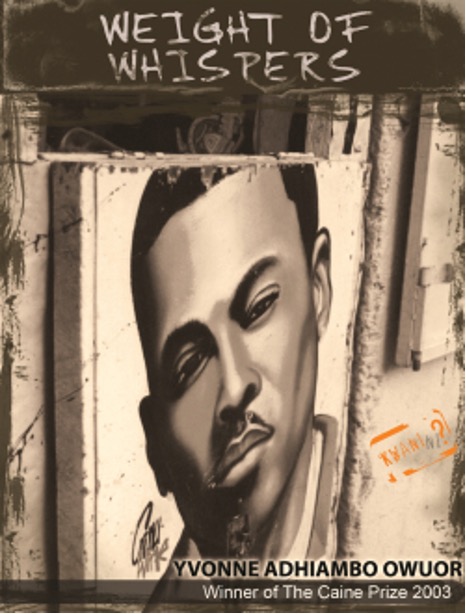
“Weights of Whispers” is a short story by Kenyan author Yvonne Adhiambo Owuor which won the prestigious Caine Prize for African writing in 2003. It is a short story that feels, well… long: it is slow, complex and intense. The first time I read it, these features confused me: shouldn’t a short story be immediate and, I guess, short? Moreover, I thought, can one really describe the experience of genocide in a short, limited space? It is, however, the story’s intricate complexity that captivates the reader and makes it impossible to let go of it. In what follows, I wish to highlight some of the ways in which Owuor’s skilful writing delivers the convoluted and multifarious experience of genocide in a brief novella, guiding the reader into, somehow, making sense of it. This story is set in Kenya and follows the experience of displacement and decline of Rwandan prince Boniface Louis R. Kuseremane and his aristocratic family, following the Rwandan genocide and their consequent exile to Nairobi: “The sum total of what resides in a very tall man who used to be a prince in a land eviscerated” (2). While it fictionalises a real event, the story is able to make it believable, I would argue, by approaching genocide from the perspective of the individual, and by narrating it in first person; that is, this story brings the reader close to the experiential level: it guides the reader into feeling a genocide, rather than just simply learning about it. 

It all begins as Kuseramane and his family are forced to escape Rwanda following the assassination of two presidents, for which Kuseremane ends, somehow, on a “ a list of génocidaires” (14). Along with his fiancé, mother and sister, he flees to Kenya with their belongings stuffed in exclusive Chanel suitcases, on four of “the last eight seats on the last flight out of [their] city. [They] assumed then, it was only right that it be so” (5), as if they deserved those seats somehow, given their status. In Nairobi, they check into a suite at the Hilton. Money is running low, both Kuseremane and the reader are well aware of it. It becomes clear to him that they will not be able to sustain their exclusive lifestyle for much longer. They are ultimately forced to flee the hotel in secret, aristocrats turned common thieves, without paying their bills; they leave the Chanel bags behind at least, since “they are good for at least US $1500. Agnethe-mama is sure the hotel will understand” (13). From that point on, life takes a very unfamiliar turn; it takes a while, for Kuseremane —the prince— to understand his new status, for, he states, “The Kuseremanes are not refugees. They are visitors, tourists, people in transit, universal citizens with an affinity…well…to Europe” (9). However, he will soon find out, to seek asylum is not to be a citizen of the world, it is, actually, to go from being a someone, to becoming dehumanised, all the same, a mass of people with no country and no name: “all eyes, hands and mouths, grasping and feeding off graciousness” (14). In one of the very many queues for visas and permits which he is forced to join, Kuseremane observes “Like the eminent-looking man in a pin-striped suit, I am now a beggar” (12), the fact that he is a diplomat and a prince is totally irrelevant. The visa application process proves to be literally impossible, for it must be done in one’s own country, and Kuseremane’s country is…well, even Kuseremane himself does not know what is left of his country at this point (11). He spirals more and more into anguish and fear, unsure of whether to give up or resist; he becomes too afraid to voice his terror to his family: “it is simpler to be silent” (9), to believe that the tears that wet his pillow in the morning are not his (13). Who is he, anyways? “Kuseremane, Kuseremane, Kuseremane” (13) he repeats, more for the sake of reminding himself than anything else, for nobody around him seems to remember him, even though they knew him well when he was a someone. He could be an “expatriate’ and therefore desirable” (27) back then, while now he is an “illegal alien” (24), a “pariah” (27) in exile, a nobody, whose humanity is rapidly fading before his very eyes. In his new condition, his identity needs to be suppressed: “Camouflage… place dictates form. […] The first lesson of exile – camouflage. When is a log…not a log? When a name is not a name” (30-31). 

Owuor is skilfully able to draw parallels between the character of Kuseremane and the figure of the Jew, without, however, universalising this experience in a way that would risk further degrading of the human behind it. In other words, the author uses the idea of the Jew as a trope, to challenge the reader’s ethical standpoint. Through Kuseremane we are uncomfortably reminded, once again, that “the zenith of existence cannot be human” (Owuor, 3), for “nobody wants to know that contemporary history has created a new kind of human beings” (Arendt, 111) with no rights left but human rights, as Hanna Arendt once wrote in her well-known text “We Refugees”. Arendt writes that to be a refugee is to be stripped of all humanity, but what are human rights good for, when humanity fails to see you as a human? Refugees do not want to be called ‘refugees’, they do all they can to prove themselves and others that they are “just ordinary immigrants” (110). Refugees, according to Arendt, have not only lost their home; they lost their language, their jobs, and their identity is now dismembered (110).

Kuseremane, the refugee prince—the genocidal prince perhaps— is not a Jew, yet he is not spared from this condition. However, the reader’s ethics are challenged here: we are unsure whether to see him as ‘the Jew’ or ‘the Nazi’, as some scattered textual elements reveal. His lack of tact and human empathy in meeting an academic whom he asks, bluntly, “are you a Jew?”, causing the man to cry, then simply walking away “unable to tolerate the tears of another man” (3).  Moreover, Kuseremane is often depicted wearing a Hugo Boss coat (15), a designer notably known for having made his fortune by creating uniforms for the Nazi government in the 1930s. In this way, “Weight of Whispers” arguably succeeds in making an ethical intervention; that is, Owuor uses tropes such as these historical references to place the reader in relation to the subject it engages with; not only in making us understand genocide from an experiential level, but also urging us to take an ethical stand, questioning ourselves, and in so doing making sense of things from an ethical perspective as well. The whole idea of Nazi Germany is, thus, encapsulated and crystallized in a Hugo Boss suit. Even those who might struggle with historical references (those for whom ‘the past is another country’, as someone once said), are given the opportunity to question their ethical point of view through, for instance, the questionable role of the UNHCR in Kuseremane’s process of asylum seeking. Indeed, what are human rights good for, when even the UN office for the protection of refugees requires a 200$ bribe to decide who gets to enter their offices? (22) And even then, when leaving depends on whether or not you are willing to ‘cooperate’, “by agreeing to be examined […] by the officials at their homes for a night.” (34)? Kuseramane is powerless, he can do nothing but watch (35). 

The story’s ambiguous end left me wondering if its protagonist will end up committing suicide —the ultimate identity erasure—again, echoing Arendt (112-113). But, much more importantly, the story ends leaving me uneasy, having to grapple with the experience of exile. Thus, this is not just a matter of first-person narrative. It is about the much larger question of first-person engagement in the real-life displacement of millions of people. This story demands that we —you and I— remember that according to the UNHCR’s latest report there are over 122 million forcibly displaced people in the world, real people, that is. Perhaps Owuor would argue that very many more might never reach the UNHCR at all. Albeit fictional, this story shakes our moral grounds, and urges us to keep seeing the human behind the figure of the Refugee. “Photographer, do you see us at all?” (Owuor, 32).

Further reading: 

Arendt, Hanna. “We Refugees”. Altogether Elsewhere: Writers in Exile. edited by Marc Robinson. Faber and Faber, 1994, pp. 110-19. Originally published in 1943.

Owuor , Yvonne Adhiambo. “Weight of Whispers”. Nairobi. Kwani Trust, 2003

UNHCR. “Press Releases, 12 June 2025. https://www.unhcr.org/news/press-releases/number-people-uprooted-war-shocking-decade-high-levels-unhcr  

Wikipedia. “Hugo Boss”. https://en.wikipedia.org/wiki/Hugo_Boss