China Research

A discussion forum on emerging markets, mainly China – from a macro, micro, institutional and corporate angle.

The Limits of Chinese Statistics

March 6, 2013

The main content of this blog article is not really new. I have been pointing several times before at the insufficiencies of Chinese economic statistics, both in this blog and in published articles – despite obvious statistical improvements in recent years.

We should not, however, judge the shortcomings of Chinese statistics from a position of Western arrogance. In the 1980s, the U.S. had a marked downsizing of statistical quality – a downsizing process that then, fortunately, was successfully combated with all thinkable energy, for example, by NABE’s (National Association for Business Economics, Washington D.C.) statistical front woman Maureen Haver. Furthermore, it is still not very unusual that major statistical revisions happen even in developed countries considerable time after the first publication date. Not to talk about the poor quality of Greek statistics before the eruption of the crisis!

We should understand that China in a statistical sense rather can be described as a whole continent than a single country. The gigantic size of China makes it certainly difficult to make necessary surveys really representative and to single out the appropriate methods for different calculations. That’s the side of the coin that should make us humble. On the other hand: China could do much more about statistical transparency and the quality of statistical publications.

For foreign analysts who are not able to read Chinese characters, the “Statistical Communiqué of the People’s Republic of China on the 2012 National and Economic Development” should be the most interesting source to find a summary for the previous year (without in this context considering the quality of the quoted different statistical indicators). But there are obviously statistical weaknesses that quite easily could be eroded.

For example, distinctions between nominal and real numbers are not always clear (which goes back to the old system with its references to nominal changes). Average numbers and year-on-year comparisons are not singled out sufficiently. GDP calculations do not show systematically the usual components from the expenditure side. Different price deflators in the national account cannot be found in the above-mentioned statistical summary (which I would be very keen to know more about, likewise a split into private and public consumption). Further shortcomings could be mentioned.

But we get informed on other issues which may be quite interesting. Some examples for 2012 are given below according to the latest official statistics (without real knowledge from my side about the size of underestimations or overestimations):

– total population: 1 354 million (male share 51.3 percent)
– urban population: 52.6 percent (=share in 2012; +1.3 percentage points      compared to 2011!)
– employment: 767 million (of which 152 million in unemployment insurance     programs)
– total number of migrant workers within China: 263 million
– annual per capita income, rural : 7 917 yuan (RMB, about 1250 USD)
– total GDP: 51 932 million yuan (+ 7.8%; value shares agriculture 10.1,    industry 45.3, services 44.6)
– R&D: 2 percent of GDP
– Chinese direct investment abroad: 77.2 billion USD (+ 28.6 percent;    FDI into China: 111.7 billion USD)
– increase of savings (+14.1 percent) and increase of credits (+15.6 percent)
– CPI: +2.6 (for food +4. 8 percent)
– kindergartens (number of attending children): 37 million

To summarize: it should be an important commitment to the new Chinese leaders to strongly support increased statistical transparency and qualitative improvements. Both China itself and the whole (analytical) world would benefit from such a development in the second largest economy in the world.


Hubert Fromlet
Professor of International Economics
Editorial board
 

Back to Start Page

China’s Trade in IT Products: Variety, Scale, and Economic Gains

February 6, 2013

Introduction and Testable Hypotheses
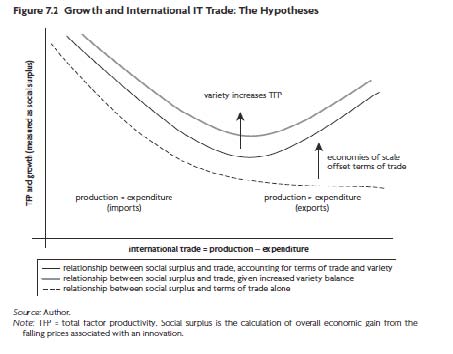
Globalization of information technology products (IT) relates to economic growth through three channels:

(1) Terms of trade. The fall in quality-adjusted prices of IT products favors use of IT in the domestic economy and yields TFP gains.

(2) Economies of scale. Total factor productivity is positively associated with the scale of production of IT products.

(3) Variety. Greater variety means that more domestic users find good matches between products and needs, which increases productivity and growth. Greater variety and uniqueness of exports is associated with increased prices and profits.
Figure 7.2 reproduced from the Chapter sets out these three factors in terms of an integrated hypothesis relating TFP and trade in IT products.

Click for original image size

Empirial analysis using a sample of 36 countries for 2000-2007 finds:

(1) With regard to terms of trade, importers of IT gain relatively more than exporters, on average, from the declining prices of IT coming through international trade.

(2) With regard to economies of scale, despite falling IT prices, most exporters enjoy positive economy-wide benefits of trading in IT because of economies of scale in production.

(3) With regard to variety, countries with greater variety tend to experience greater TFP gains relative to those with less variety. Against this backdrop and empirical validation, where does China fit in?


China’s gains from IT trade
China’s participation in global trade in IT products exploded over the 1990s and 2000s. From 2% of global exports in 1990, China+ (China plus Hong Kong SAR) rose to 15% of global exports (ranked 1st) in 2004. On the import side, China+ moved from 9th ranked at 4% of global imports to top ranked with 20% of global imports. In terms of importance in global expenditure on IT, however, China+ both grew less and is less important. China+’s share of global expenditure, although it rose four times over and ranks sixth in global expenditure at 3%, remains quite small in comparison to the country’s importance in global trade.

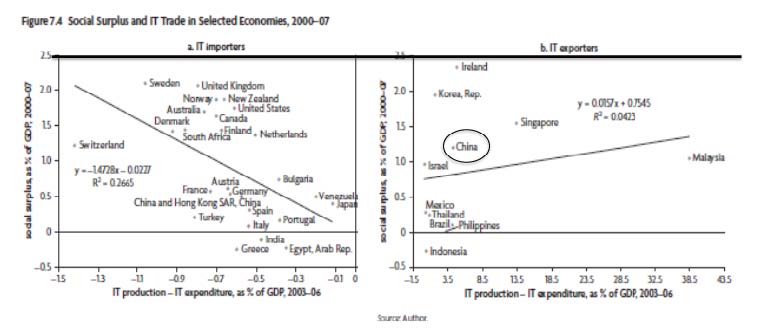
Putting the data on trade prices, and production and expenditure into the framework reveals a pattern similar to what was hypothesized (Figure 7.4 from the Chapter replicated below). Increased imports of IT products (left panel) is associated with greater economic gains as measured by the social surplus concept, a concept that is isomorphic to TFP. This is consistent with other findings on the relationship between IT use and TFP in the domestic context.

For IT exporters (right panel), the relationship could be positive (if economies of scale gains outweigh terms of trade losses) or negative. Since the trend line cuts the y-axis at around 0.76%, it appears that a country does gain from being a producer and exporter; but the simple correlation coefficient of 0.016 suggests that there is not a strong relationship between the magnitude of exports and economic gain.

Click for original image size


China, as an exporter, lies above the regression line, suggesting that it gains relatively more from its pattern of trade, production, and expenditure compared to other net exporters. The story for these relatively greater gains for China, despite being an exporter, pretains to the variety of China’s products in trade.

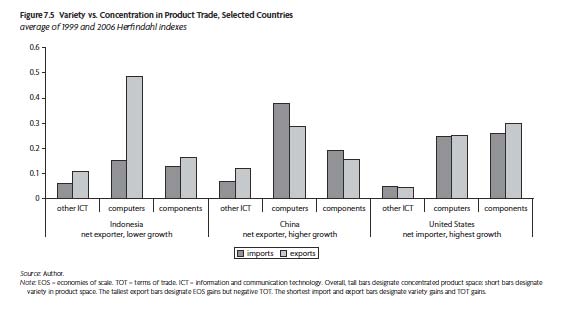
Variety can be measured in several ways; this paper uses the Herfindahl (H) index calculated across 178 different varieties of IT exports and imports allocated into broader product categories, including Computers, Components, and Other ICT (embedded ICT such as medical devices). Within a category, a Herfindahl close to 0 implies a high variety in product trade, and Herfindahl close to 1 implies highly concentrated product trade.
Figure 7.5 from the Chapter shows Herfindahl indexes for three countries and three product categories. Returning to Figure 7.4, Indonesia is an exporter with lower than average social surplus for exporters (lies below the trend line for exporters). It has a very high concentration of trade in Computer exports. With a highly concentrated export pattern, but lower than average social surplus, this suggests that economies of scale in production does not outweigh the terms of trade effect, and, with high concentration, there are no gains from variety.

Click for original image size


China is also a exporter, but with higher than average social surplus (lies above the trend line in Figure 7.4) for exporters. Although China’s exports of Computers are somewhat concentrated, it has an even greater concentration in imports of Components. Therefore, China may achieve higher than average economic gain by importing and getting the benefits of the terms of trade on Components. And, with high variety (low H) in exports of Other ICT, China may gain from market power in trade, with attendent benefits of higher prices and profits.


This short paper draws on Chapter 7, “Information Technology, Globalization, and Growth: Role for Scale Economies, Terms of Trade, and Variety”, in Otaviano Canuto and Danny Leipziger, eds 2012. Ascent after Decline : Regrowing Global Economies after the Great Recession. © World Bank . https://openknowledge.worldbank.org/handle/10986/2233

Catherine L Mann


Catherine L. Mann
Barbara ’54 and Richard M. Rosenberg Professor of Global Finance
International Business School, Brandeis University
Visiting Scholar, Federal Reserve Bank of Boston


Back to Start Page

China: Economic Discussions Move Forward – but what about Reality?

Developments in China get increasingly interesting for economists, other analysts, and – certainly – for many corporate decision-makers. This can particularly be said about:

– the more immediate economic development,

– economic reports and discussions, and

– the future economic policy of the new political leaders.

What concerns the first point, it seems to become increasingly probable that China is on its way to enter a period of somewhat accelerating rate of GDP growth. This was also indicated by Linnaeus University’s China Survey Panel in December. However, skepticism about Chinese GDP numbers and other statistics remains in place. Regular readers of this blog are familiar with the issue.

The second point to be mentioned is the trend of economic reports and discussions. Here, I can see continuous progress. Openness is improving, particularly in the past few years. After having followed economic reporting on China during at least two decades, current economic discussions seem to be on a very different – and more frank – level compared to 5-10 years ago (as long as it remains a pure issue of economics). The following headlines – which I just picked in the past two weeks – would probably have been distant from publication ten years ago (sources for the headlines: different Chinese newspapers – but the mentioned improvements have to be seen in Chinese relative terms, not measured according to our Western standards):

¤UK breakup from EU may hurt  China trade”: China’s concern about this risk is obvious.
¤China must strive to improve WTO relations”: China’s disputes with WTO should decrease.
¤“China’s fiscal deficit may hit new high”: a cautious warning signal about public debt.
¤“The bane of private consumption”: about the difficulties of changing the growth model.
¤“Full RMB convertibility ruled out”: indicating that full RMB convertibility is far away.
¤“Domestic lenders need global outlook”: pointing at an important management issue.
¤“China’s Q4 property loans accelerate”: could be a hidden warning signal.
¤“Tougher measures on corruption”: one of China’s most frequently discussed topics.
¤“Food struggle may threaten urbanization”: the food issue in another critical perspective.
¤“Product quality improved in 2012”: product quality – a major future challenge.
¤“Manufacturing turns youth off”: a topic that starts to reach China.
¤“Chinese firms willing to do more public good”: aiming at state-owned enterprises (SMEs).

The third point is about the future economic policy of China’s new political leaders. The National People’s Congress (NPC) in March will certainly give hints on economic policy priorities. Such policy declarations are, however, usually without concrete timeframes – or held very generally. Consequently, one should not take these official ambitions for the future too verbally in all respects, even if they may indicate the road on which China’s new main political decision-makers wish to move forward.

Moving forward on a certain road does not say too much about real ambitions, speed and sustainability of the plans. This kind of more precise and applicable planning won’t be given already next month. It may be added as an example and little reminder that China’s already some years ago envisaged the transition to a more consumption-oriented economy. This strategy still remains invisible in reality. Rather the opposite is true when we look at the latest statistics – and probably in 2013 as well. Chinese reality remains many times very harsh – despite all progress we’ve seen in the past decade in quite some important economic areas.


Hubert Fromlet
Professor of International Economics
Editorial board
Back to Start Page