China Research

A discussion forum on emerging markets, mainly China – from a macro, micro, institutional and corporate angle.

Asia Drives Global Investment – a Self-priming Pump?

March 6, 2013

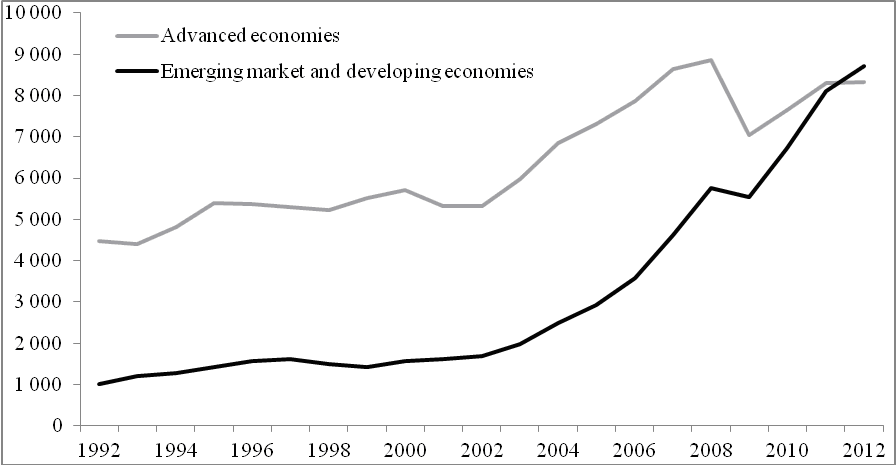
Global investment has skyrocketed in the past decade. Worldwide gross capital formation – i. e. private and government investment in machinery, equipment, buildings and inventories – climbed from US$ 7,000 billion in 2002 to more than US$ 17,000 billion in 2012. This contrasts with an absolute increase of a mere US$ 1,500 billion during the previous decade, 1992 to 2002. Moreover, in the latter part of that period, 1995 to 2002, global capital formation stagnated at a more or less constant level of US$ 7,000 billion.

Figure 1
Global investment

Nominal domestic capital formation (US$ billions)
Sources: IMF; own calculations

As a result of this mighty investment boom, which took off in 2002, the global structure of capital formation has changed enormously (Figure 1). While only a quarter of global investment went to emerging markets and developing economies in 2002, this share surged to slightly more than 50 percent in 2012. For the first time in the modern age, the global investment volume was allocated to emerging and advanced economies in equal parts. This shift in weighting has accelerated in the last couple of years as investment in advanced economies has been impaired by the global financial market crisis. Investment in the industrialized countries has not yet regained the level of 2007 and 2008. By contrast, the financial market crisis has barely hit emerging economies. Their investment boom has continued almost unabated, reaching a new peak of US$ 8,700 billion in 2012.

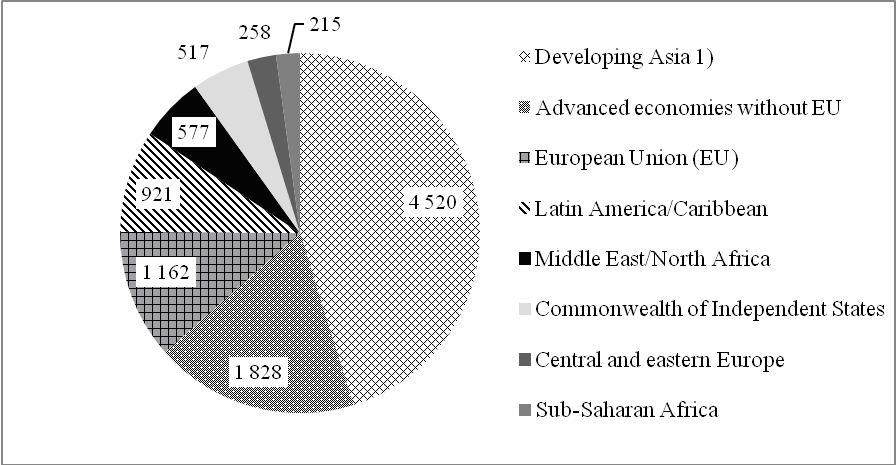
The emerging market and developing economies contributed 70 percent of the total global increase in investment (US$10,000 billion) in the decade from 2002 to 2012. In the previous decade, distinctly moderate growth had been driven by the advanced economies. A closer look reveals that the latest global investment boom was powered by the emerging market and developing economies in Asia in particular. Among emerging markets Asian countries played a dominant role as an investment target. Around US$ 4,500 billion, or 45 percent, of the total increase in investment can be attributed to the emerging economies in the Far East (i.e. excluding the advanced Asian economies of Japan, Korea, Hong Kong, Taiwan and Singapore).

Of course, this can partially be explained by the high population of this region. In 2010, almost 4.2 billion people, or around 60 percent of the world population of almost 7 billion, lived in Asia. Even if the five advanced countries are excluded, Asia’s share of the world population still amounts to 58 percent. Figure 2 shows that the other emerging regions were virtually eclipsed by the Asian performance. This was especially true of the absolute increases in investment between 2002 and 2012 in Central and Eastern Europe (US$ 258 billion) and in Africa (US$ 215 billion), while the member countries of the European Union (US$ 1,162 billion ) still outperformed the Latin American and Caribbean countries (US$ 921 billion).

Figure 2
Structure of the global investment boom

Change of domestic gross capital formation 2002 to 2012 in US$ billion
1) Asia excluding Japan, Korea, Hong Kong, Taiwan, Singapore.
Sources: IMF; own calculations

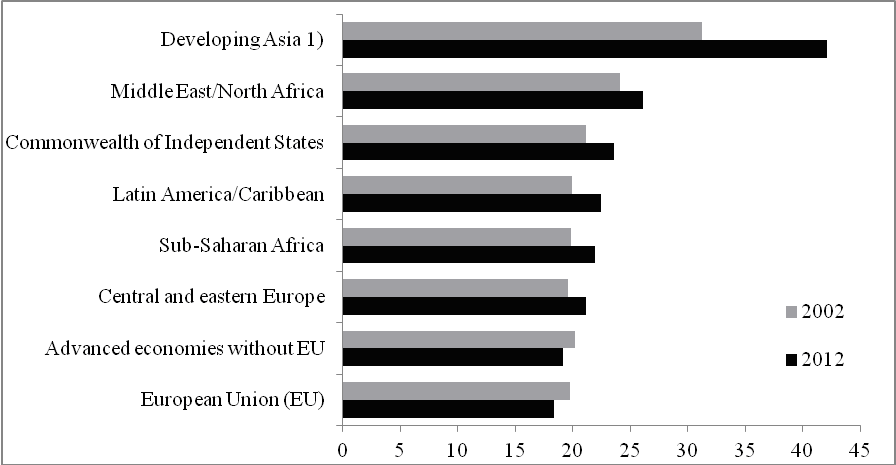
Emerging and advanced economies are diverging not only regarding investment dynamics but also with respect to the significance of investment in the domestic use of gross domestic product (GDP). However, this divergence has in turn contributed to the economic convergence of both country groups. While investment accounts for less than a fifth of GDP in advanced economies, the investment ratio (gross capital formation as a percentage of GDP) amounts to a third in emerging market and developing economies. Moreover, at 19 percent, the investment ratio of the advanced economies in 2012 was slightly lower than a decade ago (20 percent). In the European Union the ratio declined from 20 to 18 percent. In contrast, over the same period investment in emerging markets increased more or less steadily from a quarter to a third of GDP.

The Asian emerging market and developing economies dominate the overall picture (Figure 3): The Asian investment ratio was already by far the highest in 2002. From 2002 to 2012 the investment share of GDP climbed from 31 to 42 percent. This development reflects the enormous efforts made by Asian countries in capital formation and their preference for investment over consumption. The investment ratio of other emerging regions showed only a moderate increase. On average, investment as a percentage of GDP increased by only 2 percentage points. Moreover, the investment ratios in Central and Eastern Europe, Africa and Latin America are not markedly different from the values observed in the advanced economies.

Figure 3
Regional investment ratios

Domestic gross capital formation as a percentage of GDP
1) Asia excluding Japan, Korea, Hong Kong, Taiwan, Singapore. Sources: IMF; own calculations

Current forecasts predict that, on aggregate, the divergence of global investment activities between emerging and advanced economies illustrated in Fig. 3 will continue. In 2013 investment is expected to decline in some of the largest European economies, such as Germany, France, Italy and Spain. Japan may achieve at best a small increase. The USA, Canada and some Scandinavian countries can be expected to provide a modest contrast.

In most of the emerging economies, though, the investment boom is expected to continue. However, it cannot be taken for granted that the investment cycle in the emerging market and developing economies will be sustained: Some emerging markets will have to fight hard to remain an attractive location for investment. Several sizeable emerging markets in Asia, Africa and South America have benefited from the increasing global demand for natural resources and the resulting price increases. It is a moot point whether these countries can compensate for a possible cutback in their present growth driver with stronger domestic demand or exports of other goods. Certain other emerging economies, e. g. China, have already gained momentum from flourishing exports of manufactured goods. However, it remains debatable whether these countries can offset a possible deceleration in this segment – triggered by falling demand from Europe and the USA. The critical question is how flexible those economies are in adjusting their economic structures.

On the whole, the growing population in the emerging market and developing economies and their desire to catch up favor ongoing investment. If their standard of living is to continue to rise, there is no alternative to increasing capital formation and the capital-labor ratio.


Michael Grömling
Professor, Cologne Institute for Economic Research (IW) , International University of Applied Sciences, Bad Honnef / Bonn


Back to Start Page

The Limits of Chinese Statistics

The main content of this blog article is not really new. I have been pointing several times before at the insufficiencies of Chinese economic statistics, both in this blog and in published articles – despite obvious statistical improvements in recent years.

We should not, however, judge the shortcomings of Chinese statistics from a position of Western arrogance. In the 1980s, the U.S. had a marked downsizing of statistical quality – a downsizing process that then, fortunately, was successfully combated with all thinkable energy, for example, by NABE’s (National Association for Business Economics, Washington D.C.) statistical front woman Maureen Haver. Furthermore, it is still not very unusual that major statistical revisions happen even in developed countries considerable time after the first publication date. Not to talk about the poor quality of Greek statistics before the eruption of the crisis!

We should understand that China in a statistical sense rather can be described as a whole continent than a single country. The gigantic size of China makes it certainly difficult to make necessary surveys really representative and to single out the appropriate methods for different calculations. That’s the side of the coin that should make us humble. On the other hand: China could do much more about statistical transparency and the quality of statistical publications.

For foreign analysts who are not able to read Chinese characters, the “Statistical Communiqué of the People’s Republic of China on the 2012 National and Economic Development” should be the most interesting source to find a summary for the previous year (without in this context considering the quality of the quoted different statistical indicators). But there are obviously statistical weaknesses that quite easily could be eroded.

For example, distinctions between nominal and real numbers are not always clear (which goes back to the old system with its references to nominal changes). Average numbers and year-on-year comparisons are not singled out sufficiently. GDP calculations do not show systematically the usual components from the expenditure side. Different price deflators in the national account cannot be found in the above-mentioned statistical summary (which I would be very keen to know more about, likewise a split into private and public consumption). Further shortcomings could be mentioned.

But we get informed on other issues which may be quite interesting. Some examples for 2012 are given below according to the latest official statistics (without real knowledge from my side about the size of underestimations or overestimations):

– total population: 1 354 million (male share 51.3 percent)
– urban population: 52.6 percent (=share in 2012; +1.3 percentage points      compared to 2011!)
– employment: 767 million (of which 152 million in unemployment insurance     programs)
– total number of migrant workers within China: 263 million
– annual per capita income, rural : 7 917 yuan (RMB, about 1250 USD)
– total GDP: 51 932 million yuan (+ 7.8%; value shares agriculture 10.1,    industry 45.3, services 44.6)
– R&D: 2 percent of GDP
– Chinese direct investment abroad: 77.2 billion USD (+ 28.6 percent;    FDI into China: 111.7 billion USD)
– increase of savings (+14.1 percent) and increase of credits (+15.6 percent)
– CPI: +2.6 (for food +4. 8 percent)
– kindergartens (number of attending children): 37 million

To summarize: it should be an important commitment to the new Chinese leaders to strongly support increased statistical transparency and qualitative improvements. Both China itself and the whole (analytical) world would benefit from such a development in the second largest economy in the world.


Hubert Fromlet
Professor of International Economics
Editorial board


Back to Start Page

China’s Trade in IT Products: Variety, Scale, and Economic Gains

February 6, 2013

Introduction and Testable Hypotheses
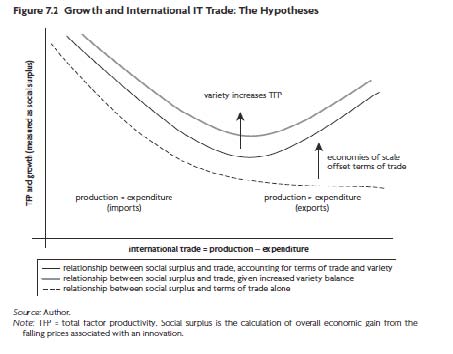
Globalization of information technology products (IT) relates to economic growth through three channels:

(1) Terms of trade. The fall in quality-adjusted prices of IT products favors use of IT in the domestic economy and yields TFP gains.

(2) Economies of scale. Total factor productivity is positively associated with the scale of production of IT products.

(3) Variety. Greater variety means that more domestic users find good matches between products and needs, which increases productivity and growth. Greater variety and uniqueness of exports is associated with increased prices and profits.
Figure 7.2 reproduced from the Chapter sets out these three factors in terms of an integrated hypothesis relating TFP and trade in IT products.

Click for original image size

Empirial analysis using a sample of 36 countries for 2000-2007 finds:

(1) With regard to terms of trade, importers of IT gain relatively more than exporters, on average, from the declining prices of IT coming through international trade.

(2) With regard to economies of scale, despite falling IT prices, most exporters enjoy positive economy-wide benefits of trading in IT because of economies of scale in production.

(3) With regard to variety, countries with greater variety tend to experience greater TFP gains relative to those with less variety. Against this backdrop and empirical validation, where does China fit in?


China’s gains from IT trade
China’s participation in global trade in IT products exploded over the 1990s and 2000s. From 2% of global exports in 1990, China+ (China plus Hong Kong SAR) rose to 15% of global exports (ranked 1st) in 2004. On the import side, China+ moved from 9th ranked at 4% of global imports to top ranked with 20% of global imports. In terms of importance in global expenditure on IT, however, China+ both grew less and is less important. China+’s share of global expenditure, although it rose four times over and ranks sixth in global expenditure at 3%, remains quite small in comparison to the country’s importance in global trade.

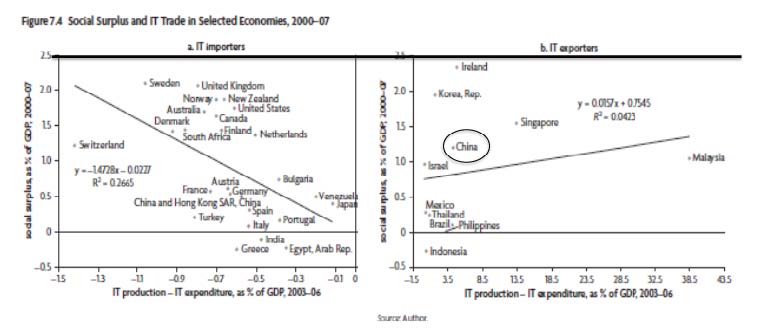
Putting the data on trade prices, and production and expenditure into the framework reveals a pattern similar to what was hypothesized (Figure 7.4 from the Chapter replicated below). Increased imports of IT products (left panel) is associated with greater economic gains as measured by the social surplus concept, a concept that is isomorphic to TFP. This is consistent with other findings on the relationship between IT use and TFP in the domestic context.

For IT exporters (right panel), the relationship could be positive (if economies of scale gains outweigh terms of trade losses) or negative. Since the trend line cuts the y-axis at around 0.76%, it appears that a country does gain from being a producer and exporter; but the simple correlation coefficient of 0.016 suggests that there is not a strong relationship between the magnitude of exports and economic gain.

Click for original image size


China, as an exporter, lies above the regression line, suggesting that it gains relatively more from its pattern of trade, production, and expenditure compared to other net exporters. The story for these relatively greater gains for China, despite being an exporter, pretains to the variety of China’s products in trade.

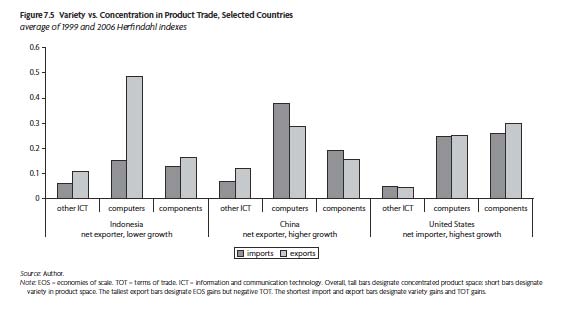
Variety can be measured in several ways; this paper uses the Herfindahl (H) index calculated across 178 different varieties of IT exports and imports allocated into broader product categories, including Computers, Components, and Other ICT (embedded ICT such as medical devices). Within a category, a Herfindahl close to 0 implies a high variety in product trade, and Herfindahl close to 1 implies highly concentrated product trade.
Figure 7.5 from the Chapter shows Herfindahl indexes for three countries and three product categories. Returning to Figure 7.4, Indonesia is an exporter with lower than average social surplus for exporters (lies below the trend line for exporters). It has a very high concentration of trade in Computer exports. With a highly concentrated export pattern, but lower than average social surplus, this suggests that economies of scale in production does not outweigh the terms of trade effect, and, with high concentration, there are no gains from variety.

Click for original image size


China is also a exporter, but with higher than average social surplus (lies above the trend line in Figure 7.4) for exporters. Although China’s exports of Computers are somewhat concentrated, it has an even greater concentration in imports of Components. Therefore, China may achieve higher than average economic gain by importing and getting the benefits of the terms of trade on Components. And, with high variety (low H) in exports of Other ICT, China may gain from market power in trade, with attendent benefits of higher prices and profits.


This short paper draws on Chapter 7, “Information Technology, Globalization, and Growth: Role for Scale Economies, Terms of Trade, and Variety”, in Otaviano Canuto and Danny Leipziger, eds 2012. Ascent after Decline : Regrowing Global Economies after the Great Recession. © World Bank . https://openknowledge.worldbank.org/handle/10986/2233

Catherine L Mann


Catherine L. Mann
Barbara ’54 and Richard M. Rosenberg Professor of Global Finance
International Business School, Brandeis University
Visiting Scholar, Federal Reserve Bank of Boston


Back to Start Page