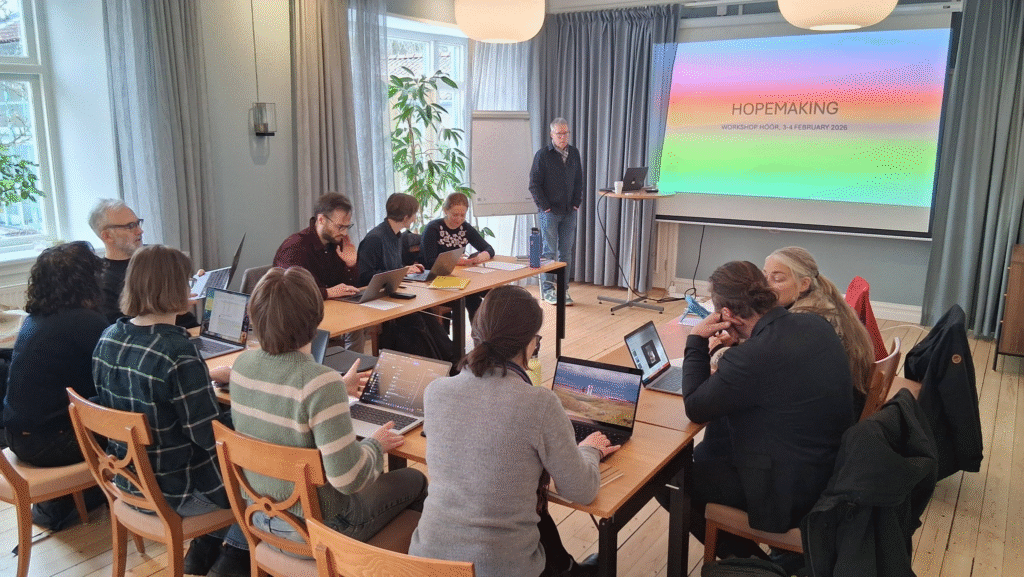
As many as four of us (Emily Hanscam, Gustav Wollentz, Marcy Rockman and Cornelius Holtorf) participated actively in a stimulating workshop in Höör (Scania, Sweden) on Hopemaking, bringing together artists, an art curator, and scholars at Linnaeus University in English Literature and us in Archaeology with different agendas exploring common ground.
The project explores hopemaking as a way of countering the paralyzing predisposition to imagine future disaster as inevitable and of nurturing alternative cultures of hope and resilience. In the project, we collaborate with three local artists and Kalmar Art Museum in the context of their exhibition entitled “Survival Kit”.
Particularly exciting was to meet the two artists behind Kultivator, Malin and Mathieu. In their experimental work, they combine art with agriculture. For our project, they are keen to contribute to hopemaking by visualizing different futures. We are very excited! 🙂
Compiled by Helena Rydén, Assistant to the UNESCO Chair on Heritage Futures at Linnaeus University.
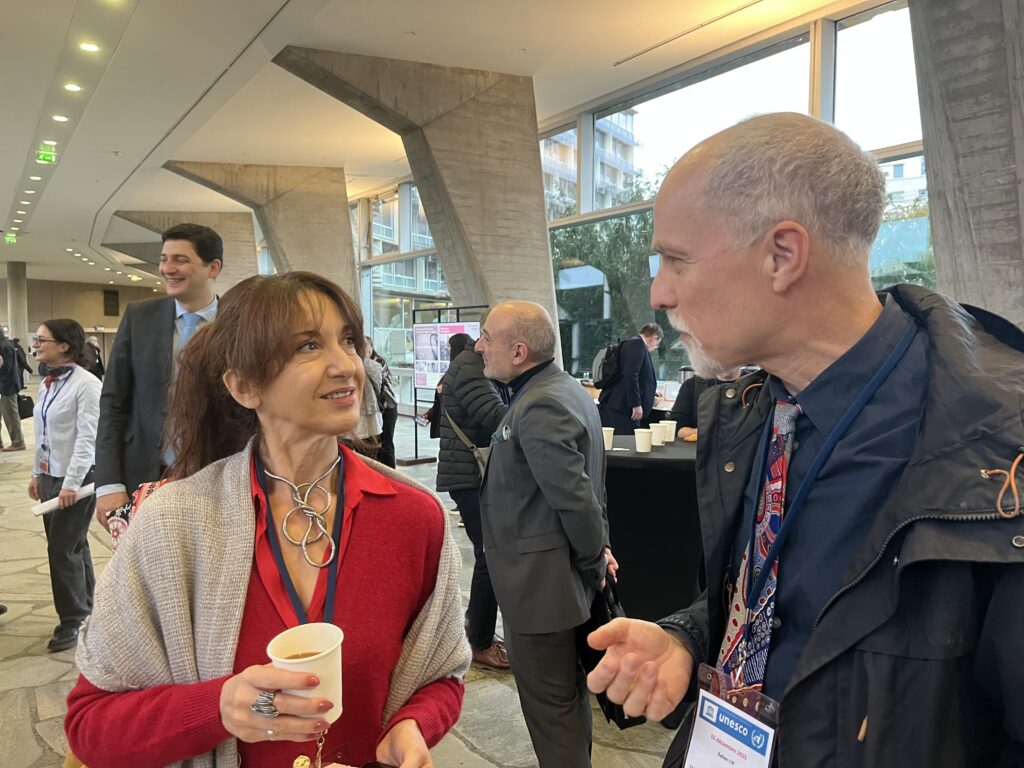
On 2 December, UNESCO hosted World Futures Day at UNESCO HQ in Paris under the theme “Anticipation in an Era of Volatility.” The event showcased UNESCO’s approach to addressing global challenges through futures thinking and foresight. It also highlighted the role of UNESCO’s network of over 1,100 University Chairs, including 35 focused on Futures Studies, in identifying emerging issues worldwide. Our Chair on Heritage Futures is one of them and was represented not only by Chairholder Cornelius Holtorf but also by affiliated researcher Claudio Pescatore and by Helena Rydén.
The event gathered around 700 registered participants—mainly from Europe, including many Paris-based attendees—from diverse backgrounds: academia, UNESCO Chairs, students, UNESCO staff, policymakers, and industry representatives. The venue itself, rich in history and adorned with works by among others Picasso and Giacometti, provided a cultural backdrop. Sessions alternated between French and English with simultaneous interpretation.
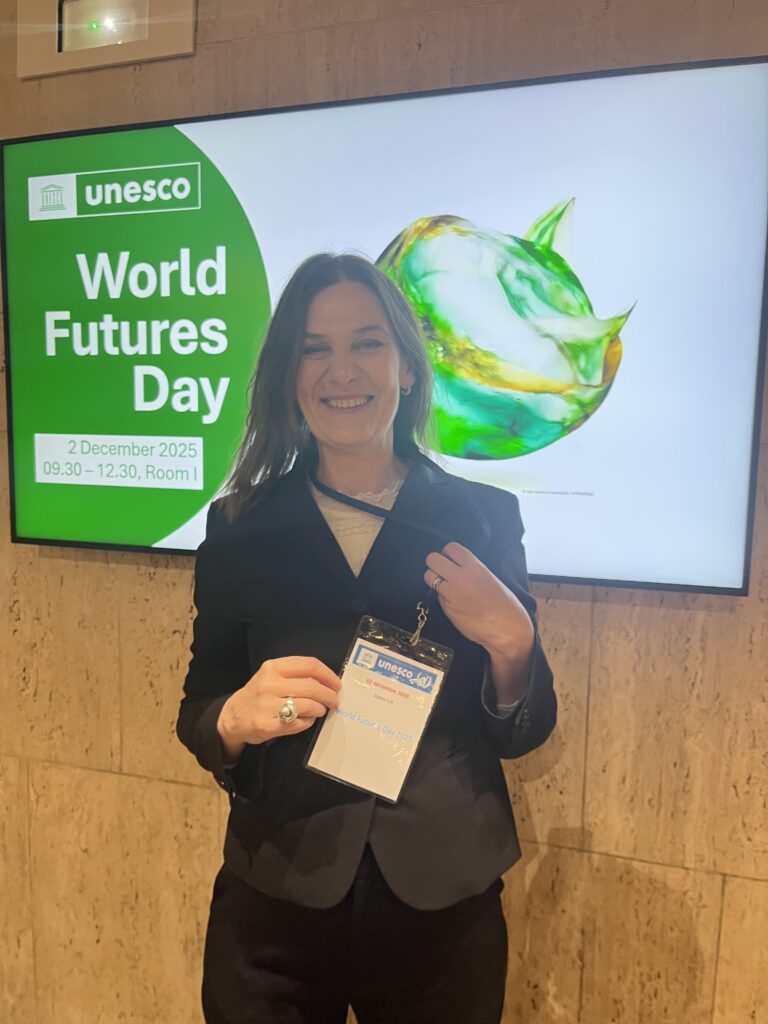
Helena Rydén, Assistant to the UNESCO Chair on Heritage Futures at Linnaeus University waiting for the World Futures Day to start!
A keynote lecture by French philosopher Éric Sadin “The Future of Humanity in an Era of Omniscient Artificial Intelligence,” argued that generative AI marks a turning point in human history. He warned of its social consequences, particularly in education, and urged critical reflection on what remains for humanity when learning and creativity are delegated to machines.
A panel followed, exploring how complex systems perspectives and education systems can help societies navigate AI-driven futures while safeguarding humanity and planetary well-being. Speakers included Rosa Vásquez Espinoza, Tanja Hichert, Michael Shamiyeh, and François Taddei, moderated by Gustavo Merino, Director, Social Policies, UNESCO.
Other sessions addressed systemic change, resilience, and international cooperation, with contributions from global thought leaders and UNESCO senior officials. Closing remarks by UNESCO’s Gustav Merino reinforced UNESCO’s mandate to strengthen shared humanity through education, science, culture, and communication.
A digital exhibition, “Good Ancestors: Art & Culture for Future Generations,” ran in the Ségur Hall, linking art and culture across time. The original exhibit was organised by a team around Michael Münker and supported by two missions to the UN in support of the UN Declaration on Future Generations. The exhibit was proposed for this event at UNESCO by Cornelius Holtorf.
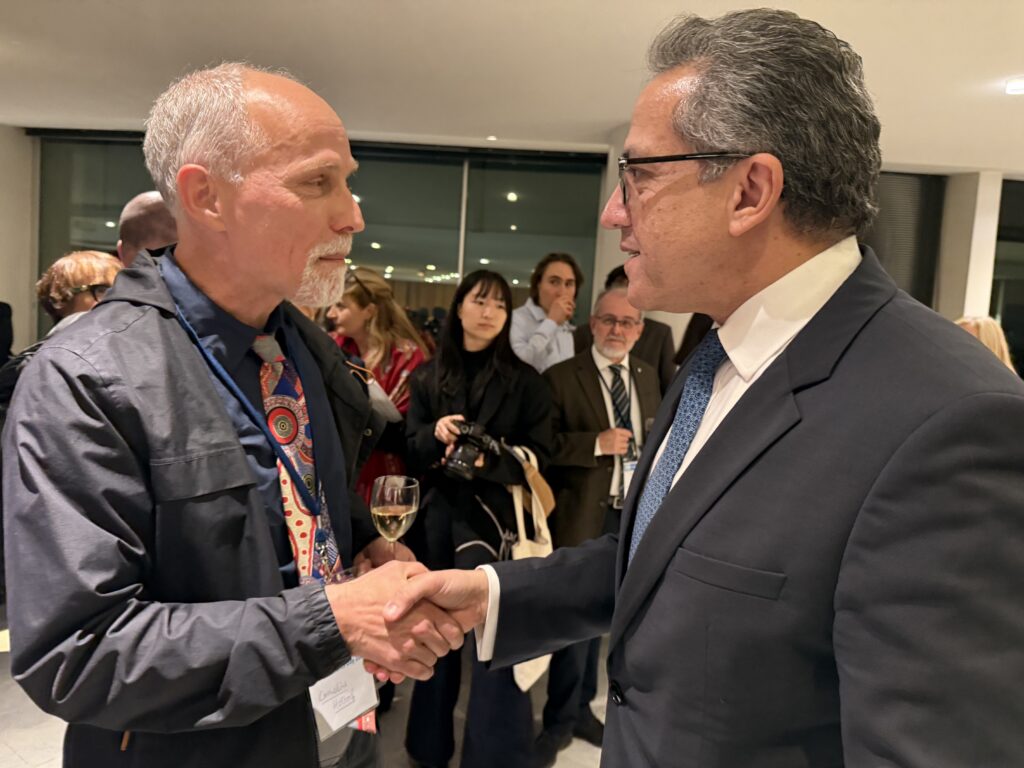
At the reception in the evening Cornelius Holtorf, holder of the UNESCO Chair on Heritage Futures at Linnaeus University and the new UNESCO Director-General, Dr Khaled El-Enany, an Egyptologist and former Egyptian Minister of Cultural Heritage, had the opportunity to shake hands and briefly discuss heritage futures. Photo Claudio Pescatore.
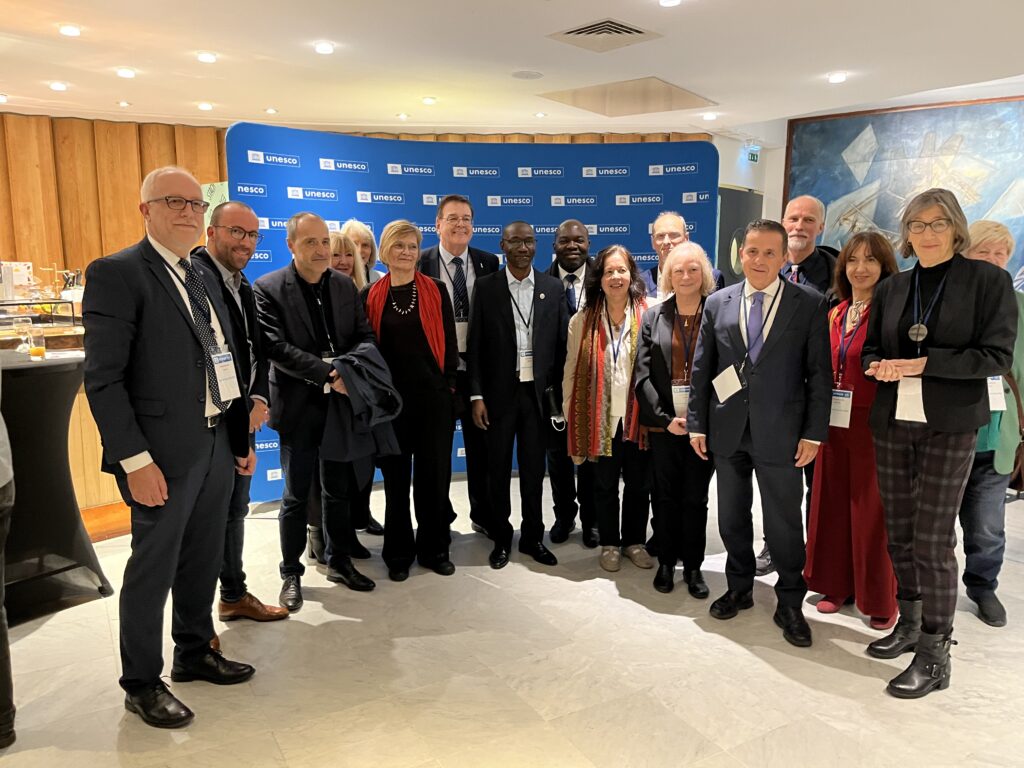
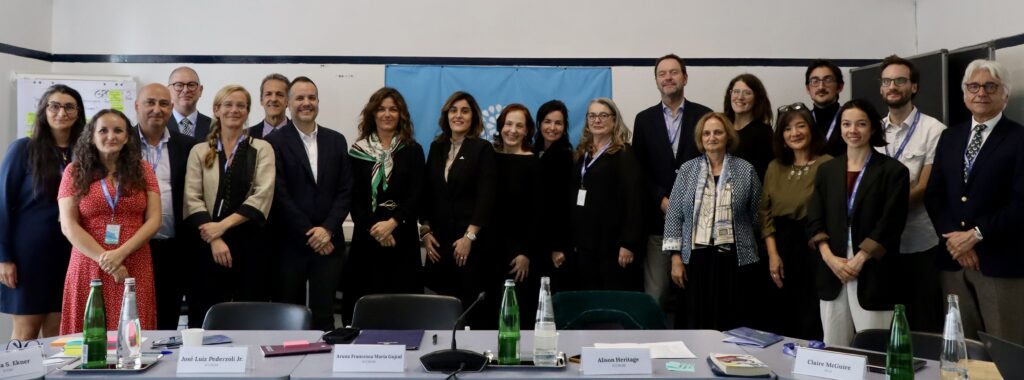
Some UNESCO Chairs on Futures Studies gathered at the reception in the evening.
Compiled by Helena Rydén, Assistant to the UNESCO Chair on Heritage Futures at Linnaeus University.
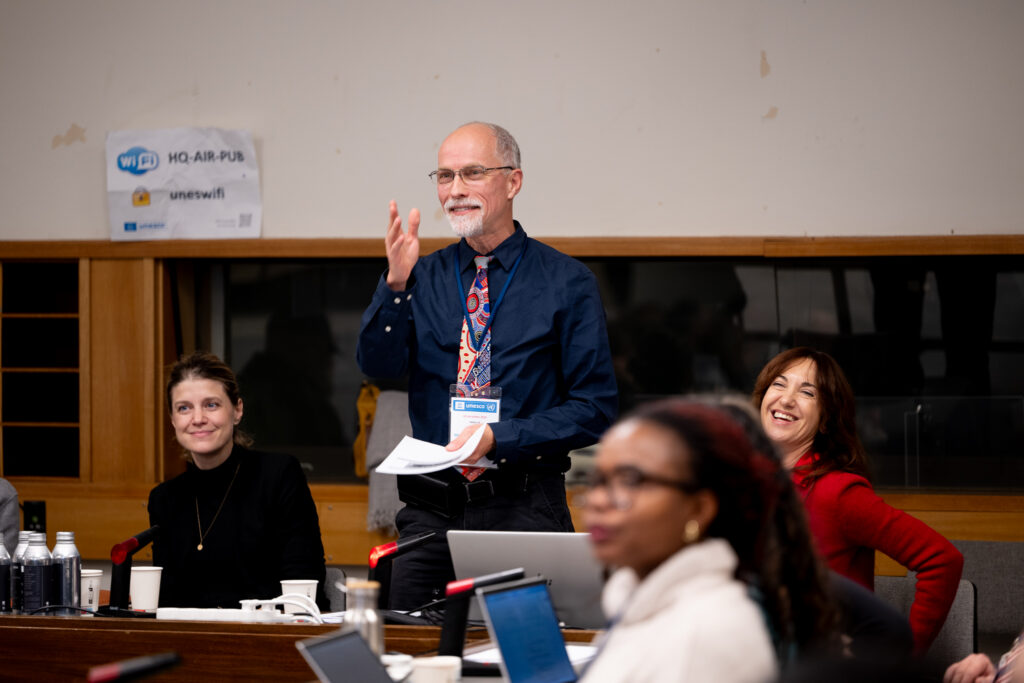
World Futures Day (WFD) on 2 December 2025 explored the theme “Anticipation in an Era of Volatility” at UNESCO Headquarters in Paris. One of the highlights was the afternoon futures workshop, “Crisis Preparedness and Beyond: Future-Making Through Culture and Heritage,” where Vicky Karaiskou and Cornelius Holtorf—both UNESCO Chairs—engaged a large (ca 50) and enthusiastic audience.
Vicky Karaiskou and Cornelius Holtorf at UNESCO HQ in Paris 2 December 2025 preparing for the afternoon session.
After statements by UNESCO, the European Commission and CrisisReady*, Vicky and Cornelius took the lead and guided us through the workshop. Both are deeply interested in the culture and values that shape us as human beings—Vicky focusing on the visual dimension.
Vicky Karaiskou explains: “I explore the profound implications of cultural visual narratives, shedding light on how they shape our individual and collective memory, as well as societal perceptions. Visuality examines the origins of our perceptions and assumptions because they deeply influence how we perceive the present, how we engage with the past, and how we envision the future.”
Cornelius Holtorf describes: “Heritage Futures are concerned with the roles of heritage in managing the relations between present and future societies, e.g. through anticipation, planning, and prefiguration.”
The workshop was truly engaging. We began by discussing what forms a collective identity: Who are we? How do culture and heritage make people who they are? Language, food, family and education were among the ideas raised. Next, we reflected on how our collective identities are relevant or affected in an anticipated crisis? We agreed that care—both as a human trait and as something that must be learned—was essential. Finally, we were asked to imagine future scenarios on how our collective identities could be used for crisis prevention, resolution, and recovery in the future?
The goal was to help us focus on the origins of our perspectives and assumptions, which deeply impact how we envision the future. Our group envisioned a natural disaster scenario where our collective identity, empathy, emotions, and local context were crucial for decision-making.
If the aim was to foster empathy, inspire positive change, and promote inclusiveness and social resilience for an equitable future, the workshop certainly succeeded. By envisioning the future beyond the uncertainty of the unknown, we learned how to mobilize and stimulate inspiring thinking, feeling, and acting—unlocking new ideas for creative solutions.
Several participants said this workshop was the highlight of the day, and some even asked to exchange contact details with us, expressing interest in visiting the Chairs for a period.
The UK National Commission for UNESCO has introduced a new Climate Action and Sustainability Framework alongside a Research Agenda, designed to leverage UNESCO sites as living laboratories for climate resilience and sustainable futures.
The publications align closely with the ARCHE (Alliance for Research on Cultural Heritage in Europe) Strategic Research and Innovation Agenda, the emerging Horizon Europe Resilient Cultural Heritage Partnership, and UNESCO’s global priorities on climate, culture, and sustainable development. They provide a ready-made platform for UK and international partners to collaborate on transdisciplinary research, Living Labs, open data infrastructures, and evidence-based policy.
Sarah May, affiliated with the Chair, serves as Co-Director at ButCH and is an active member of the UKNC Research & Innovation Group.
ButCH stands for Bureau for the Contemporary and Historic.
It is an organization involved in UNESCO-related climate and heritage research, and in this context, ButCH helps convene and manage the activities of the UKNC Research & Innovation Group, focusing on developing and delivering strategic research agendas around climate resilience and cultural heritage.
Claudio Pescatore explains why uranium’s chemical hazard is not a distant issue but a present debt — and why it will remain forever.
Not tomorrow, but today
When most people think of nuclear waste, they imagine glowing canisters buried in rock, hazards for a far-off future. The truth is different, and more unsettling. The greatest uranium problem is already with us now.
From the deserts of the American Southwest to abandoned mines in Central Asia, uranium residues contaminate soil, rivers, and aquifers. Communities live with the consequences today — kidney disease, unusable water.
Present-day scars
The Navajo Nation (U.S.) bears the legacy of Cold War uranium mining. Hundreds of abandoned mines and one out of four contaminated water-wells leave residents facing disproportionate health risks, needing endless cleanup.
Wismut (Germany), once the largest uranium mine outside the Soviet Union, has been under remediation since reunification. Billions of euros have been spent, yet groundwater plumes persist and treatment must continue indefinitely.
Mailuu-Suu (Kyrgyzstan), a former Soviet mining town, is home to dozens of unstable tailings piles above a river valley. Landslides and floods threaten to spread contamination widely.
UMTRA sites (U.S.), meant to stabilize mill tailings from past uranium production, continue to show uranium plumes exceeding drinking-water standards decades after closure.
These are not failures of engineering so much as reflections of uranium’s nature: a hazard that does not diminish on human timescales. Covers break, dams erode, pumps wear out. Each “remedy” is temporary, and each handoff pushes costs into the future.
We hardly use what we extract
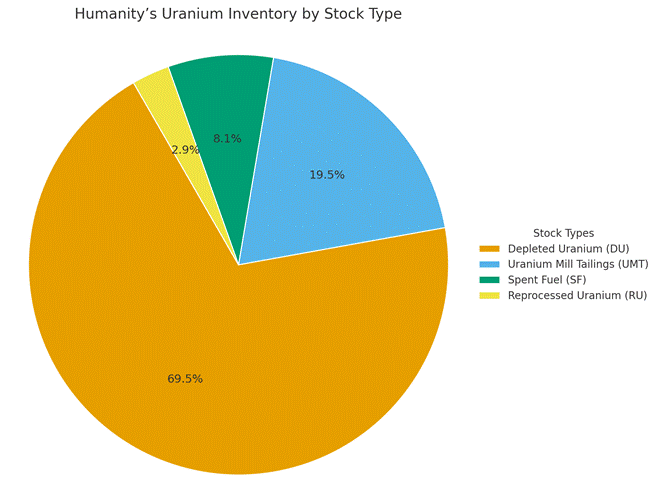
Of all uranium mined for the nuclear fuel cycle, less than 0.4% has been used in reactors. The other 99.6% remains as residues — mill tailings, depleted uranium, and reprocessed uranium (see Figure 1). Its inventory by stock type is shown in Figure 1. For each ton of Uranium is spent fuel, there will also exist an additional 9 tons as Depleted Uranium or Mill-tailings uranium.
Figure 1. Distribution of humanity’s uranium by stock type. Depleted uranium (≈69.5%) and uranium mill tailings (≈19.5%) dominate the global inventory, while spent fuel (≈8.1%) and reprocessed uranium (≈2.9%) make up the remainder.
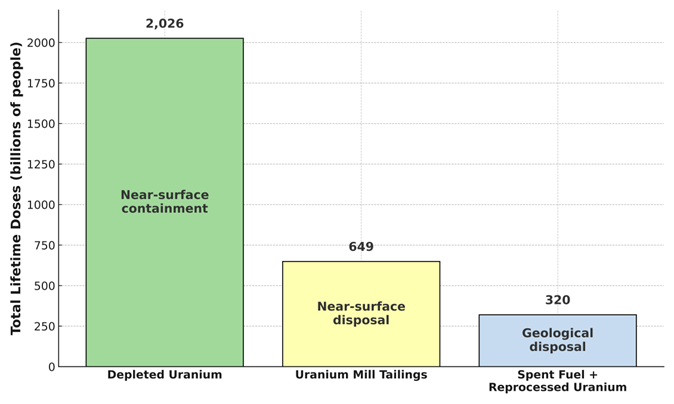
Figure 2 shows that the largest uranium stocks — DU and mill tailings — are exactly those left near the surface. In other words, the smaller share is given the world’s most advanced containment, while the larger share remains exposed. Put differently: a single metric ton of uranium represents hundreds of thousands of cubic meters of water needed for dilution, and millions of lifetime toxic doses. Multiplied by thousands of tons, the numbers are staggering.
Figure 2. A measure of the liability from managing uranium is the Total Lifetime Doses (TLD) indicator. Values associated with each stock represent the number of lifetime-equivalent chemo-toxic exposures, expressed in billions of people. As the largest stocks of uranium reside in Depleted Uranium and in Mill Tailings, there lies most of the uranium liability to the future. Yet they receive far less stringent containment.
A web of liabilities
Uranium’s hazard is not just technical. It is woven into a web of liabilities:
– Geographical liabilities: Uranium may be mined in one country, enriched in another, and its waste left in a third. Communities that never benefited from the electricity pay the price. The Navajo did not choose the bombs their ore fueled; Mailuu-Suu’s residents did not choose Soviet reactors.
– Temporal liabilities: Every cover or dam has a lifespan measured in decades or centuries. Uranium’s hazard lasts for billions of years. Each cycle of repair and neglect transfers liability to the next generation.
– Institutional liabilities: Regulators often focus on radium or radon, ignoring uranium itself. Mining laws may require closure plans but not perpetual stewardship. Health agencies emphasize chemical toxicity, while nuclear agencies emphasize radiation. No one body takes full responsibility.
The result is a system that allows uranium to slip through the cracks, its hazard passed along invisibly until it reemerges as a plume, a lawsuit, or an abandoned site.
Externalization of uranium costs
Uranium’s spread dismantles the idea of nuclear energy as “clean.” Yes, reactors emit little carbon dioxide. But the residue they generate — and the residues left by mining and enrichment — are anything but clean. Calling nuclear clean externalizes uranium’s costs onto:
– future generations, who will inherit broken dams and leaking piles; – local communities, often Indigenous or marginalized, who live with toxic water and unsafe lands; – other geographies, as uranium mined elsewhere, in Africa, Asia, Australia, Europe and North America leaves residues that outlast states and borders.
Nuclear power may be low-carbon, but when uranium’s chemical liability is ignored, it is not low-cost, low-risk, or clean.
As an example, countries like Finland or Sweden that only have spent fuel still carry an indirect liability ten times as large in terms of Total Lifetime Doses and Dilution Liability. This stems from the additional uranium mill tailings and depleted uranium left to others to manage. Unlike spent fuel, these vast residues remain in shallow sites, piles, or surface storage — often in jurisdictions with lower environmental standards and certainly facing the endless remediation that surface storage entails.
Toward accountability: a Uranium Liability Convention
How do we begin to govern such a debt? One step is recognition: uranium is the parent hazard. It should not be masked by proxies like radium or radon.
But recognition is not enough. Uranium is traded globally, yet its liabilities are stranded locally. This calls for a Uranium Liability Convention (ULC) — a framework to:
– Map liabilities: track where uranium has been mined, processed, stored, and abandoned. – Assign responsibility: link benefits and burdens so costs cannot be endlessly shifted. – Set binding obligations: require durable containment, including deep disposal for depleted uranium. – Integrate health and environment: recognize both chemical and radiological hazards.
Such a convention would not be a technical fix. It would be a moral and political acknowledgment that uranium’s hazard cannot be wished away, and that accountability must match the timescales of the debt.
What this means in human terms
– For communities now: remediation cannot be partial. The Navajo, Mailuu-Suu, Wismut, and countless others need more than fences and promises. They need durable remedies that reduce exposure and stop passing costs to their children.
– For nuclear debates: sustainability claims must account for uranium’s unresolved debt. Low-carbon is not clean when its waste contaminates forever.
– For future generations: memory and containment must last longer than institutions usually plan for. Passing the burden on is not stewardship; it is abandonment.
Takeaway
The uranium hazard is not a future scenario. It is present contamination, future inevitability, and permanent liability.
It is a web that links countries, generations, and institutions. And unless we confront it honestly — by recognizing uranium itself, containing it durably, and sharing responsibility globally — that web will only tighten.
Uranium is not just fuel or waste. It is an environmental debt. The question is whether we will keep externalizing it, or whether we will finally take responsibility for paying it down.
Further reading
– Claudio Pescatore (2025). Humanity’s Uranium Inventory: A Persistent Chemical and Ecotoxicological Liability. Energy Research & Social Science 127 (2025) 104298 in open access
Claudio Pescatore is a member of the UNESCO Chair on Heritage Futures at Linnaeus University
On the 16th of October 2025 ICCROM organized a workshop on Strategic Foresight in Heritage taking place in Rome, titled Anticipating Change: Exploring Long-term Futures for Heritage. The purpose of the workshop was to found a community for practice surrounding Strategic Foresight in heritage, to build resilience, relevance and agency among heritage organisations in the face of uncertainty and change.
Gustav Wollentz from the UNESCO Chair on Heritage Futures assisted in the organisation and facilitation of the workshop, contributing with a presentation on the value of Strategic Foresight in heritage and moderating parts of the agenda, which included both a hands-on Foresight exercise, the Futures Wheel, as well as a discussion on how to move forward together.
The goals of the newly established group are to:
Connect and amplify foresight and innovation efforts across the heritage sector.
Co-developing and testing foresight methods in real-world heritage contexts.
Building an open repository of trends, tools, and insights tailored to the sector’s needs.
Together vid ICCROM, the workshop gathered representatives from the International Council on Archives, ICOM (International Council of Museums), IFLA (International Federation of Library Associations and Institutions), NEMO (Network of European Museum Organizations), UNESCO, the French Ministry of Culture, the Swedish National Heritage Board, the Heritage Alliance, UK, the Fondation des Sciences du Patrimoine, France, the Getty Foundation, USA, and University College London, UK.
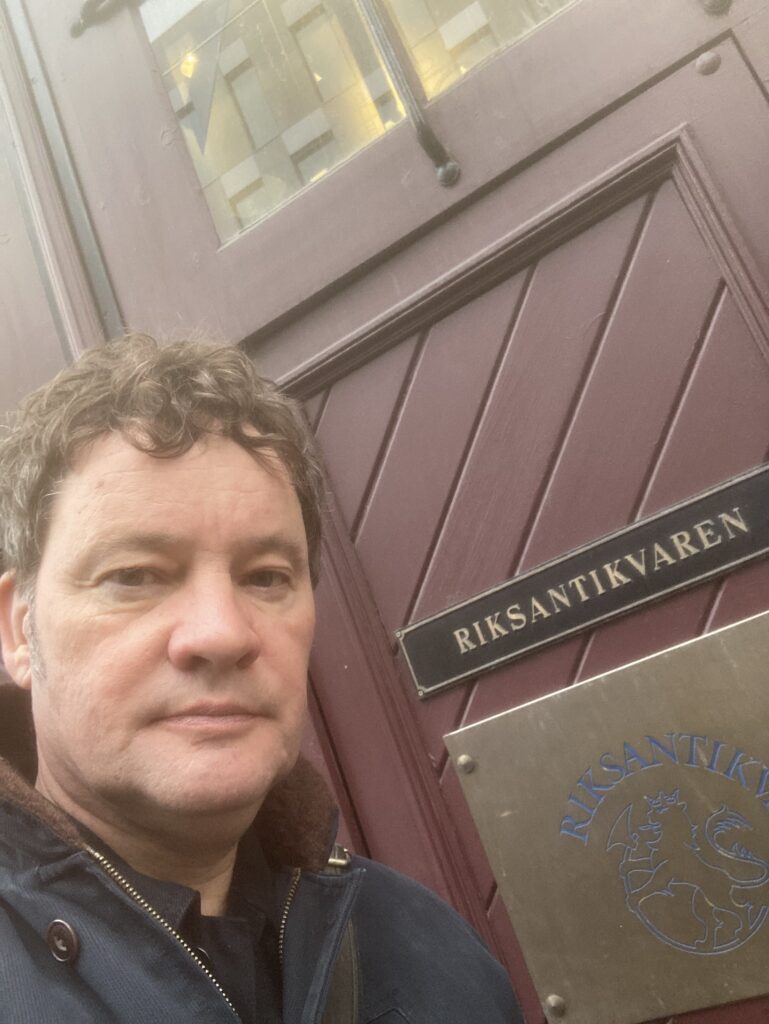
On Wednesday, 22 October, Anders Högberg was invited by the Norwegian National Heritage Board (Riksantikvaren) to give a presentation on Heritage Practices as Futures-Making Practices. The presentation was well received, and the subsequent discussion centred largely on the novelty of the future-oriented perspective that was introduced, as well as on how one might think in order to translate future-oriented ideas into more concrete heritage practices.
Anders Högberg, professor of Archaeology and member of the UNESCO Chair on Heritage Futures at Linnaeus University.
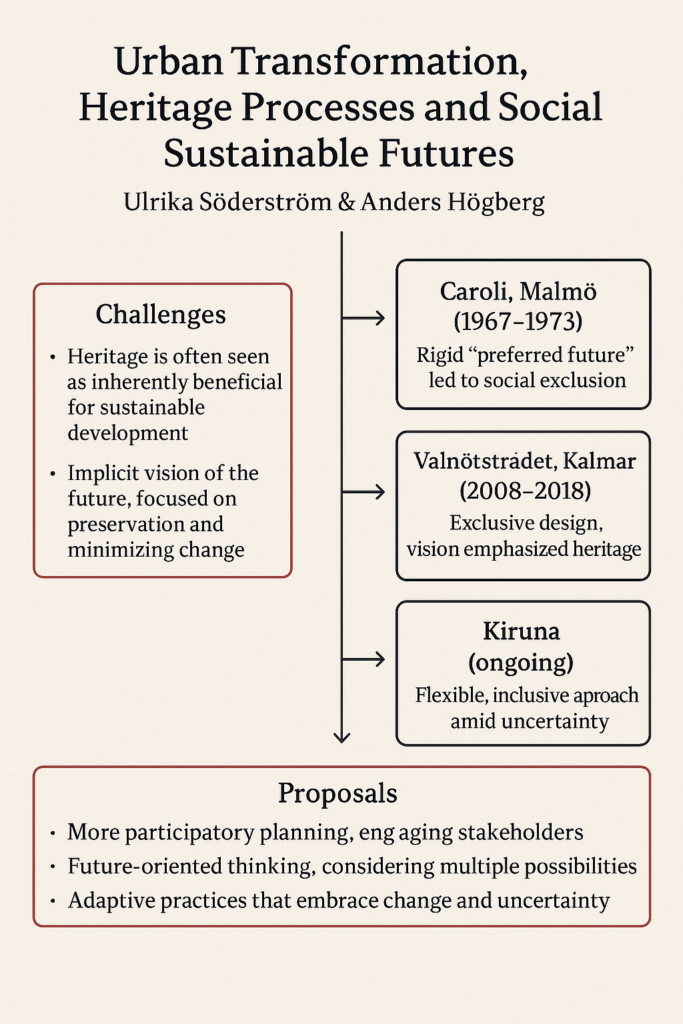
Bebyggelsehistorisk Tidskrift (Nordic Journal of Settlement History and Built Heritage): Urban transformation, heritage processes and social sustainable futures by Ulrika Söderström & Anders Högberg.
Short summary:
In this study, we use three case studies to discuss heritage processes as future-building practices. Through examples from urban regeneration processes in three Swedish cities, we discuss how these processes have contributed to social sustainability. The case studies are the Caroli neighbourhood in Malmö (transformed 1967-1973), the Valnötsträdet neighbourhood in Kalmar (transformed 2008-2018) and the ongoing transformation of Kiruna city. Our findings show that the cultural heritage processes activated in urban regeneration processes do not always promote socially sustainable future-making practices. We conclude that an engagement in different forms of future-making is crucial for heritage processes to contribute to long-term sustainable urban development. We suggest that this requires a way of thinking and acting that includes change and transformation. Our findings are conceptualised in a model that we hope can be used to understand heritage processes as future-making practices in urban transformation projects.
Bebyggelsehistorisk Tidskrift is a Nordic forum for research and debate on the history of the built environment. It is the Nordic region’s leading academic journal on the history of the built environment. The periodical presents the latest research on the history of the built environment, and also provides a forum for discussing the discipline in practice when buildings and heritage environments are being conserved.
Anders Högberg held a keynote lecture at the conference “Kulturarvsforskning i Sverige 2025” – Cultural Heritage Research in Sweden 2025, organised by the Swedish National Heritage Board 20-21 March 2025 in Stockholm. Keynote paper: ‘Cultural heritage research 2025 – some thoughts on where we stand and questions for the future’.
Ulrika Söderström also presented her dissertation at the conference: “Cultural heritage as a resource in socially sustainable urban development: A designed living environment for the future”.
Under veckan (5-8 februari) presenterar Helen Hägglund och Sanna Sjöö vårt samarbetsprojekt “Expedition framtiden” på konferensen Folk och kultur i Eskilstuna.




[…] The new funding for this and a number of additional smaller projects, means that the Climate Heritage Network is…
[…] Chair on Heritage Futures « Culture, cultural heritage and COP26 […]
[…] mer på Unescoprofessurens blogg http://blogg.lnu.se/unesco/?p=1061 Besök Öland 2050! […]