
Living Heritage in a Changing World
Postat den 21st December, 2025, 08:18 av Cornelius Holtorf
I argued recently, that cultural heritage has much to contribute to the world’s future agenda. In particular, it can help normalize transformation, in a world that changes and needs to change. Heritage sites like Stonehenge in England have been absorbing comprehensive transformations over longs period of time. Their story is not a story of conservation and continuity, whether of a monument or of a living tradition, but it is a story of managing and adapting to all kinds of changes, by again and again becoming something else.
A new book by Xuanlin Liu, significantly entitled Living Heritage in a Changing World and based on her PhD thesis at the University of York, shows that something similar can be said about a type of artefacts. In relation to the ger, or yurt, a traditional dwelling of nomadic communities in Mongolia and China, Liu shows how heritage is an evolving, adapting, and therefore dynamic process:
“The Mongolian ger, initially crafted from simple wooden frameworks, has undergone significant transformations due to cultural, industrial and environmental imperatives. Over time, it has incorporated new materials such as iron, concrete and hybrid steel-wood structures, reflecting shifting policy landscapes and environmental concerns.” (p. 175)
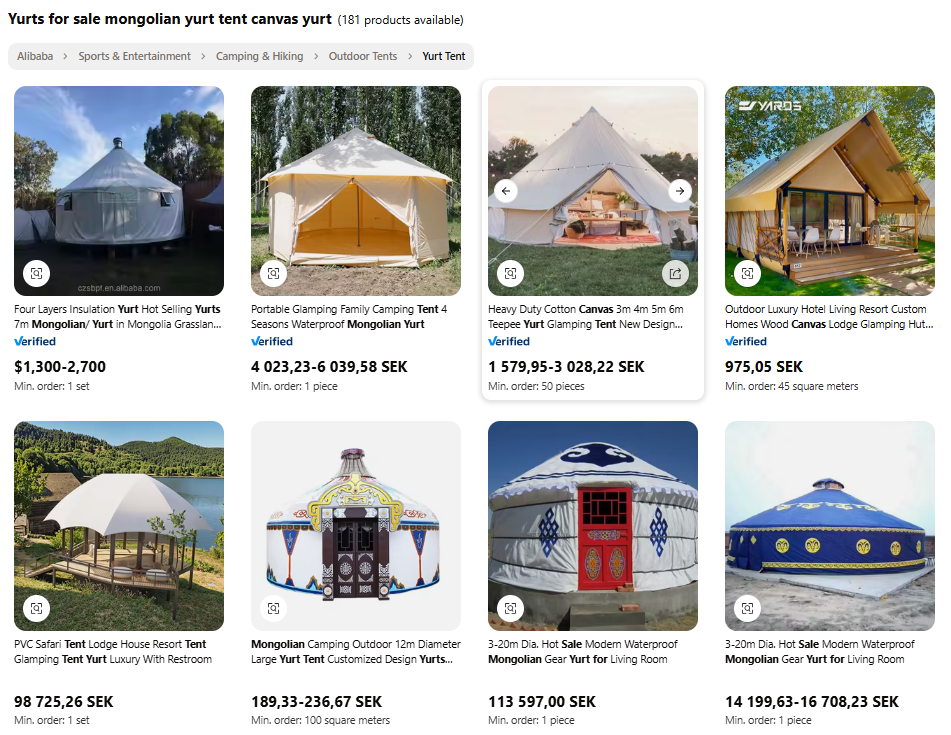
Figure: some modern gers for sale on the internet.
In Liu’s analysis, these adaptations underscore the inherently fluid nature of heritage. She considers such continuous transformations as “instrumental in ensuring that heritage endures across diverse cultural and societal landscapes” (p. 177). Such an “inclusive, dynamic and comprehensive” understanding of the ger and, by implication, of other objects, is what makes heritage into “living heritage”.
This is a welcome and timely argument, reminding me of the wider implications of what I once argued in my own PhD thesis about the life histories of prehistoric monuments in Northeast Germany, written during the 1990s. It also links the study of movable heritage to ongoing discussions in other sections of Heritage Studies and heritage management, including those dealing with the preservation of historic buildings and the management of intangible heritage. Heritage policy and legislation will need to find more ways of accommodating these views, embracing change, adaptation and creation—ultimately increasing the benefits of heritage for living and future generations in changing societies.
Liu concludes: “In this new framework, the essence of cultural heritage is no longer limited to the preservation of its material form but centres on the creative transformation of its cultural logic.” This perspective, for her, makes heritage management “a creative, forward-looking cultural practice” (p. 182), and I agree.
Det här inlägget postades den December 21st, 2025, 08:18 och fylls under blogg