
Humanity’s Uranium
Postat den 24th February, 2026, 14:40 av Cornelius Holtorf
Claudio Pescatore gave a research seminar for 20 staff and students at the Linnaeus University Centre for the Environment (CENWIN) in Kalmar, Sweden.
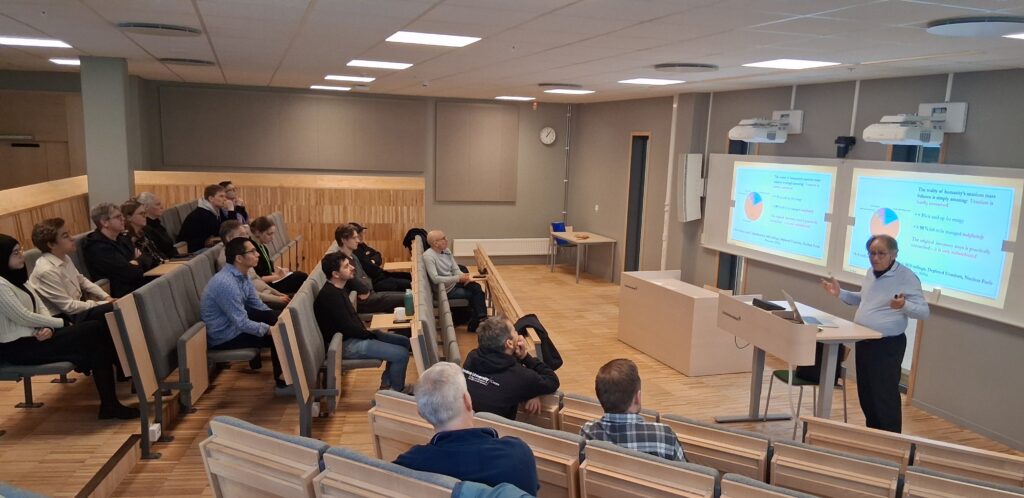
The title of his talk was “Humanity’s Uranium as a Planetary Liability – Its Chemical and Radiological Toxicity, Ecological Debt, and the Governance Gap.” Here is a 10-point summary:
- Uranium in the Earth’s crust belongs to geology: dispersed, buffered, and governed by natural timescales.
- Once extracted, it leaves geology and enters history — becoming part of human systems, decisions, and liabilities.
- Less than 1% is fissioned for energy; more than 99% remains as a long-lived material stock.
- Uranium is not consumed — it is redistributed into tailings, depleted uranium, fuels, and wastes.
- Its decay chain regenerates over time, while the uranium parent remains essentially undepleted.
- The hazard is therefore persistent, combining chemical mobility and radiological renewal.
- Remediation can manage flux and exposure, but it does not erase the underlying inventory.
- Dilution depends on finite environmental buffering capacity and cannot be a durable solution.
- Long-term safety requires working with natural processes — containment, geochemical stability, and stewardship — rather than assuming closure against them.
- A sustainability debate that ignores this enduring, mobilised uranium inventory rests on an incomplete material accounting.
Det här inlägget postades den February 24th, 2026, 14:40 och fylls under blogg