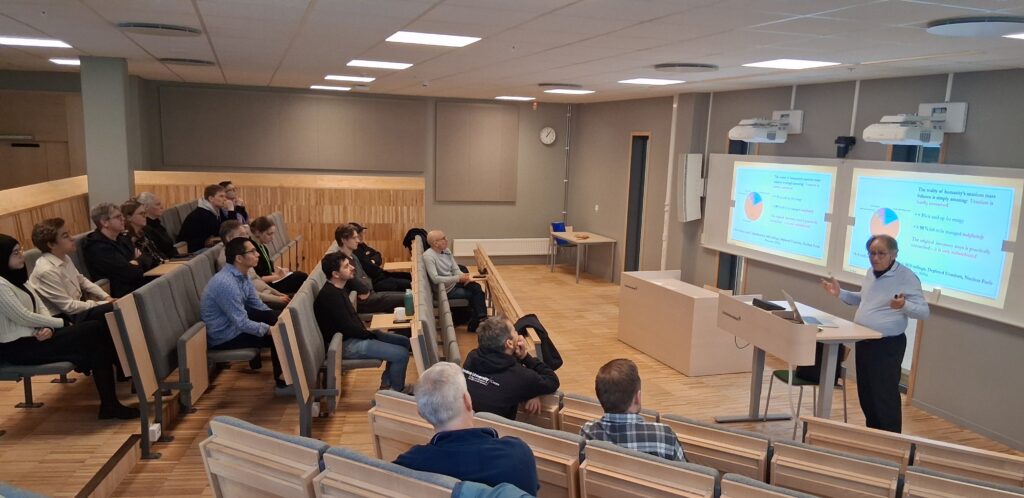
The title of his talk was “Humanity’s Uranium as a Planetary Liability – Its Chemical and Radiological Toxicity, Ecological Debt, and the Governance Gap.” Here is a 10-point summary:
Uranium in the Earth’s crust belongs to geology: dispersed, buffered, and governed by natural timescales.
Once extracted, it leaves geology and enters history — becoming part of human systems, decisions, and liabilities.
Less than 1% is fissioned for energy; more than 99% remains as a long-lived material stock.
Uranium is not consumed — it is redistributed into tailings, depleted uranium, fuels, and wastes.
Its decay chain regenerates over time, while the uranium parent remains essentially undepleted.
The hazard is therefore persistent, combining chemical mobility and radiological renewal.
Remediation can manage flux and exposure, but it does not erase the underlying inventory.
Dilution depends on finite environmental buffering capacity and cannot be a durable solution.
Long-term safety requires working with natural processes — containment, geochemical stability, and stewardship — rather than assuming closure against them.
A sustainability debate that ignores this enduring, mobilised uranium inventory rests on an incomplete material accounting.
Cornelius Holtorf was invited to present the 9th Annual Heritage Lecture at the Cambridge Heritage Research Centre, University of Cambridge, UK (20 February 2026). In front of an audience of 60+ students and researchers in cultural heritage he gave a lecture on decolonising the future. The lecture was recorded and can be watched here on Youtube.
Decolonising the Future: From Preserving Memory across Generations to Sustaining the (Re-)Generation of Memory
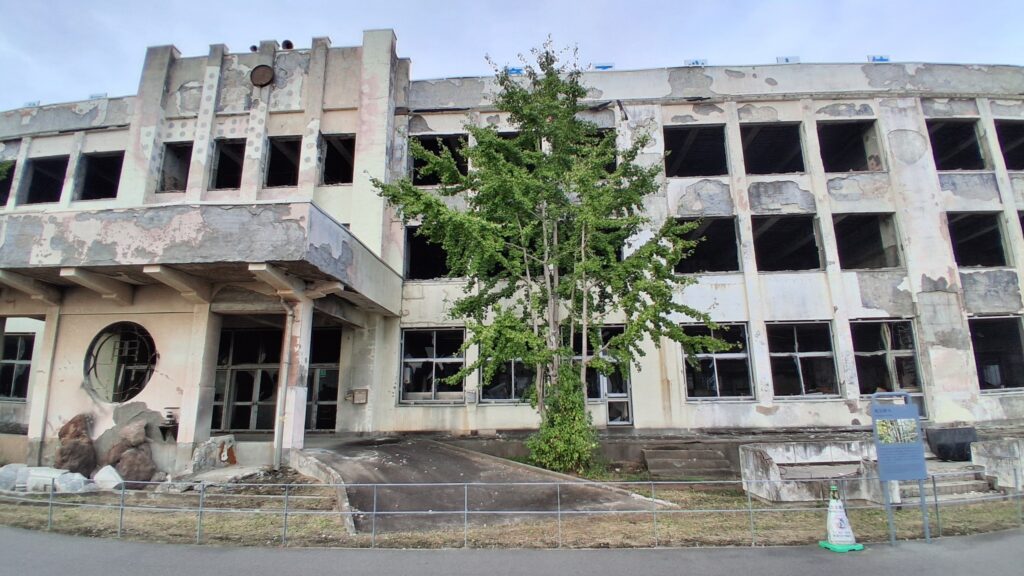
Resprouting tree in front of the Ishinomaki Kadonowaki Elementary School
The field of ‘heritage futures’ explores the roles cultural heritage plays in negotiating relations between present and future societies. In many contemporary contexts, cultural heritage is to be preserved explicitly for the benefit of future generations. Such efforts are typically grounded in the assumption that present-day values and narratives of heritage will be shared and appreciated in the future. The preservation of cultural heritage may indeed create benefits, much as a less polluted, better preserved, and more sustainable natural environment is likely to benefit those who come after us. Implicitly, we expect our preservation practices to ensure that we will be remembered as good ancestors.
Yet to what extent do the tangible and intangible legacies we leave behind constitute attempts to establish control over future human (and indeed some non-human) beings? Does heritage preservation inadvertently colonize those who will live in the future by imposing our present-day values and priorities upon them? If so, is this problematic in ways comparable to the colonisation of living peoples in the past, a legacy with which we are still grappling today? Do we therefore need to decolonize the future?
I address this challenge by asking how we might make sense of the past through memory in a world where the future is not what it used to be. Two case-studies will help me to explore what this shift may entail. Both concern forms of memory and heritage created in the present to benefit the future, and both relate to nuclear power, a domain that has long provoked existential questions about the future of humanity. First, I examine the memorialisation of the 3/11 disaster, following the major earthquake and tsunami that struck Japan’s northeastern coast in 2011 and led to the nuclear meltdowns at the Fukushima Daiichi Nuclear Power Plant. Second, I consider strategies designed to preserve awareness of nuclear waste repositories across many generations and for up to one million years.
In conclusion, I invite the audience to consider an alternative approach to heritage futures that may, in fact, reflect how memory has always functioned (because the future may never have been what it used to be). I propose moving away from present-day strategies aimed at transmitting memory unchanged across generations, towards an acceptance of continuous processes of (re-)generating memory and the changes this entails. My point is that it may not be the values we currently ascribe to heritage that endure over time, but rather the processes through which heritage is continually revalued. Can and should such a post-preservational approach contribute to decolonizing the future?
Uranium, heritage futures, and environmental assessment
When uranium is discussed, the conversation usually starts with risk: toxicity, radiation, standards, limits. But risk is not the beginning of the story.
Before uranium becomes a health concern, it becomes something else: ◻︎ a long-lived inheritance.
Heritage is whatever persists beyond us and must be dealt with by those who follow. Some of it is chosen. Much of it is not. Industrial societies, in particular, generate large amounts of unintentional material heritage: substances, residues, and infrastructures that remain active long after their usefulness — and often their caretakers — are gone. Uranium belongs squarely in that category.
Long before we calculate doses to people or compliance margins, uranium has already become a durable inheritance that future societies must manage. This is where heritage futures and environmental assessment intersect.
Why Risk Frameworks Matter — but Come Later
Because uranium persists, institutions attempt to manage it through risk frameworks.
Historically, these frameworks have made a clear division:
▸ uranium → treated mainly as a chemical toxicant ▸ radium → treated as the radiological concern
This separation is deeply embedded in regulations, monitoring programs, and safety assessments. It has also shaped how responsibility is understood and communicated across time. But it carries an implicit assumption:
▹ that radium, not uranium, controls radiological ingestion risk.
What the Research Shows
In my latest paper, published in Science of the Total Environment, I tested this assumption directly. Two key results emerge:
▸ Uranium is not radiologically negligible, even where international guideline values are fully respected.
▸ Dose delivery is controlled by mobility, and groundwater systems are typically charged far more with uranium than with radium.
In other words, although radium is more radiotoxic per decay, uranium often dominates radiological ingestion risk simply because there is much more of it dissolved in water.
Why This Matters for Heritage — Not Just Compliance
Seen through a heritage lens, this result has a deeper meaning. The continued use of radium as a universal proxy for uranium-related radiological risk is not just a technical shortcut. It is a legacy assumption, inherited from earlier regulatory cultures.
That assumption:
▸ fragments what is chemically and physically unified, ▸ hides part of the long-term burden, and ▸ narrows how responsibility is framed across generations.
Turning the Perspective Around
The main message is not that past frameworks were wrong. It is that the material heritage we have created no longer fits comfortably within them.
Uranium is not just the parent of radium in a decay chain. In water-mediated environments, it often becomes the parent of dose — and therefore of risk.
Recognizing this does not overturn radiological protection. It strengthens its internal coherence. And, more importantly, it clarifies what kind of heritage we are actually passing on — material, persistent, ethical, and administrative, and inescapably shared with the future.
Further Reading
C. Pescatore (2026). Integrating uranium radiological ingestion risk into environmental safety assessment alongside radium. Science of the Total Environment, 1011, 181055. https://doi.org/10.1016/j.scitotenv.2025.181055
Claudio Pescatore is a member of the UNESCO Chair on Heritage Futures at Linnaeus University
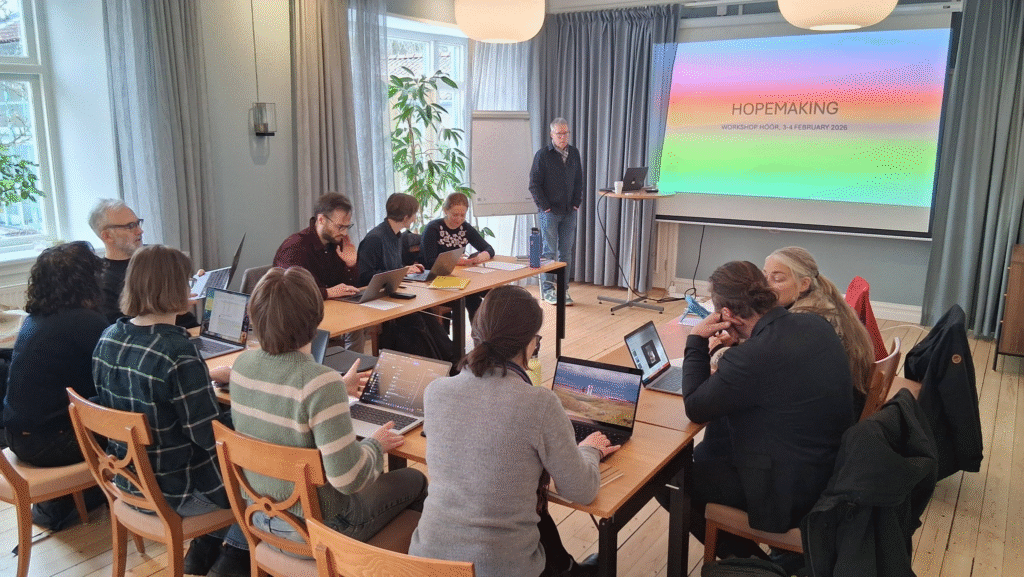
As many as four of us (Emily Hanscam, Gustav Wollentz, Marcy Rockman and Cornelius Holtorf) participated actively in a stimulating workshop in Höör (Scania, Sweden) on Hopemaking, bringing together artists, an art curator, and scholars at Linnaeus University in English Literature and us in Archaeology with different agendas exploring common ground.
The project explores hopemaking as a way of countering the paralyzing predisposition to imagine future disaster as inevitable and of nurturing alternative cultures of hope and resilience. In the project, we collaborate with three local artists and Kalmar Art Museum in the context of their exhibition entitled “Survival Kit”.
Particularly exciting was to meet the two artists behind Kultivator, Malin and Mathieu. In their experimental work, they combine art with agriculture. For our project, they are keen to contribute to hopemaking by visualizing different futures. We are very excited! 🙂


[…] The new funding for this and a number of additional smaller projects, means that the Climate Heritage Network is…
[…] Chair on Heritage Futures « Culture, cultural heritage and COP26 […]
[…] mer på Unescoprofessurens blogg http://blogg.lnu.se/unesco/?p=1061 Besök Öland 2050! […]