“Given the state of the world today, the many crises that we face …we need to be talking about existential things, if you like. And we need to talk about existential things in ways that become relatable in everyday terms. And heritage gives us the language to do that.” (Nick Shepherd, Aarhus University)
“Over the past two days we’ve very much been focusing on what it means to be a human and be a researcher at the same time. So it’s about bringing our personal experiences into conversations of heritage and climate change. And I think that is something I will definitely take back with me.” (Hana Morel, Historic England).
The workshop Climate, Heritage, and Policy: Dialogues in Learning held 27-29 May 2026 at Linnaeus University in Kalmar, Sweden (Kalmar Dialogues) brought together the vast scope and urgency of climate change with ideas and activities that engaged participants in learning and collaborating as their whole human selves. Twenty researchers and practitioners in heritage and climate from across Sweden and from Norway, Denmark, the UK, and France used art, local exploration, the practice of dialogue, and many different conversations with each other to find new ways to talk about what is changing in environments around us and how we are experiencing and taking in these changes – and from all this, what new things we can see to do together next.
In this short film about the workshop, it is possible to see not only what participants did, but hear in their own words how this approach gave them new perspectives and energy for the work they do. Watch here.
This workshop was a project of the UNESCO Chair for Heritage Futures, led by Marcy Rockman with support of Cornelius Holtorf and funding from the Swedish Research Council and developed in collaboration with and moderated by Creative Futures. A full report on this workshop also has been prepared and is available here.
How do you learn an environment you don’t know? How do you see and understand change in an environment that you do know? And what do you do with this understanding – how do you act with it and how do you share it?
These questions were the foundation of the workshop Climate, Heritage, and Policy: Dialogues in Learning held 27-29 May 2026 at Linnaeus University in Kalmar, Sweden. It recognized that new environments have always challenged us to learn them. Now the many environments in which we live are changing rapidly. These include our physical environments of course, but also our social, cultural, economic, and technological environments. Which raises the question – how are we learning them? Twenty researchers and practitioners in heritage and climate change from across Sweden and from Norway, Denmark, the UK, and France used a framework of learning and dialogue to look beyond what is changing in our many environments to explore how we gather, manage, store, use, and share our experiences of these changes.
This workshop was a project of the UNESCO Chair for Heritage Futures, led by Marcy Rockman with support of Cornelius Holtorf, funding from the Swedish Research Council, and developed in collaboration with and moderated by Creative Futures. A report on this workshop is now complete and shared below.
Key findings include:
People matter: personal experience and identity are integral to professional practice and shape questions that are asked and how climate and heritage work are done.
Dialogue and play are underused but high-value tools for both collaboration and public engagement; participants ranked dialogic practice as the single most valuable skill to carry forward.
Collaboration was the most-requested resource (ahead of time or funding), signaling strong appetite for interdisciplinary and cross-institutional partnerships.
Landscape learning proved a useful lens for reframing climate change from a focus on measurements and damage to processes of adaptation and knowledge-building, and policy as a repository of environmental information everyone has a stake in updating.
Cultural heritage is an asset to responses to climate change — the many ways in which cultural heritage is approached, shared, and engaged are essential tools for advancing climate justice, beyond and in addition to what should be protected from climate impacts.
This Kalmar Dialogues workshop has already catalyzed new collaborations, including a peace-building grant proposal centered on the Struve Geodetic Arc, an invitation to join Sweden’s National Heritage Board climate expert group, and new museum-practice exchanges. This report recommends further developing dialogic skills as part of the program of the UNESCO Chair on Heritage Futures, and continuing to build a community of practice around the truth & reconciliation and landscape learning frameworks.
The outcomes of this workshop demonstrate that integrating climate change, cultural heritage, and policy needs more than data — it requires shared frameworks, dialogue, and trust-building across disciplines. This workshop offers an initial, replicable model for this work, with strong participant enthusiasm to extend it further.
The Climate, Heritage, and Policy: Dialogues in Learning Report is available here.
Heritage is often imagined as something we preserve for the future: we identify what matters, protect it from change, and hope it survives long enough for others to encounter it. That is the popular picture, at least.
But Nature suggests another way of thinking about continuity — and it may deserve a place in that conversation.
A soil, a sediment layer or a peat deposit can act as an environmental archive. It records traces of what has happened, yet it never stays untouched.
Material is deposited, transformed, mixed, eroded and redistributed; radioactive substances decay; new ones are formed.
The archive changes continuously — and still it keeps information about the past.
This made me wonder: could it be a useful way of thinking about heritage?
Nature does not preserve by standing still
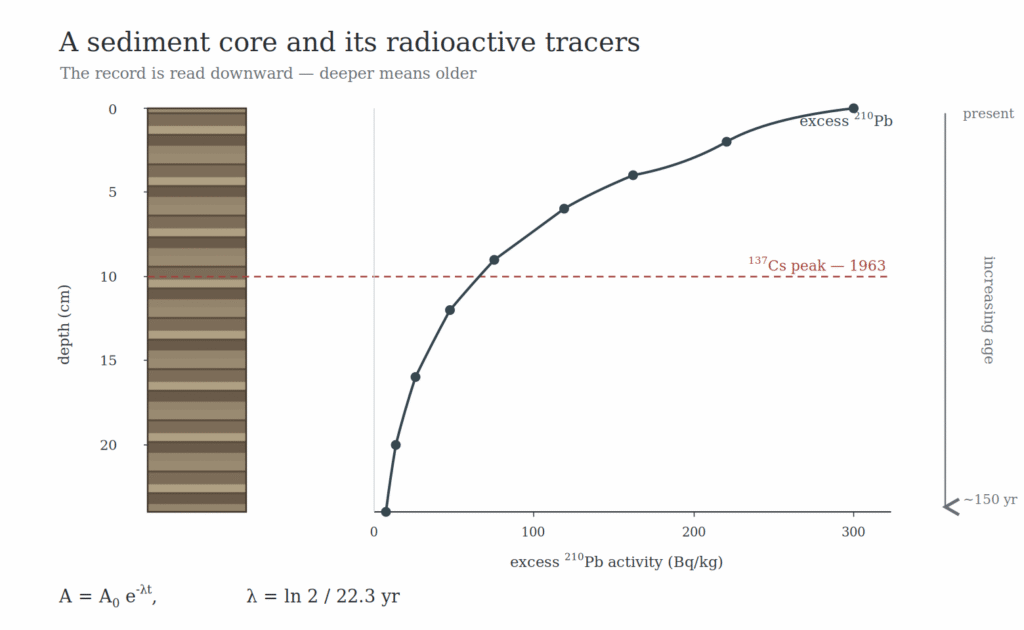
My recent work concerns a rather obscure radioactive isotope, lead-210 (210Pb), which environmental scientists use to study atmospheric fallout and to date relatively recent sediments, soils and peat.
The interesting point for me was not the isotope itself but the idea of the environment as an archive.
The 210Pb record is not a document filed away intact. It is produced by natural processes that never stop: material arrives, radionuclides transform, sediments shift, and the record that results has to be read and interpreted.
A sediment layer need not stay identical to its original state to tell us something about its history. In other words, the archive stays useful not despite change but through it.
The real question may be less whether something stays exactly as it was, and more whether, as it changes, it still holds on to a pointer to what came before.
This is not a new thought in heritage studies.
Cornelius Holtorf has argued for years that heritage strengthens cultural resilience precisely by helping us accept loss and transformation rather than resist them, and more recently that conservation itself can be understood as regeneration — ever changing, never less than whole. What the environmental sciences add is a very concrete example of the same idea.
Schematic: excess ²¹⁰Pb decays with depth while the ¹³⁷Cs peak fixes 1963 — a record that keeps time while never ceasing to change. (Illustration by the author)
What about human traces?
The uranium-mining landscapes that prompted my study make this more interesting still.
Mining leaves behind long-lived material: tailings, waste rock, stockpiles, open workings and other residues. These keep interacting with air, water, soil, plants and sediments long after the mining itself has stopped. Uranium mines also release radon gas, which travels in the air and, in turn, generates 210Pb.
This raised a specific worry. Most of the 210Pb in soils and sediments comes from radon gas emanating naturally out of the ground; the steady amount that settles each year is what lets scientists read the record, rather as one reads tree rings. Could that extra radon from uranium mines add enough 210Pb to distort the record?
For documented mine sizes, the answer is largely reassuring: the added radon is far too little to shift regional 210Pb levels in any measurable way. Close to a site the picture can differ, and there it is dust and eroded material that could disturb the record.
What I find more intriguing is what the question reveals.
Human activity does not only leave heritage objects behind. It also leaves materials that enter the ongoing processes of nature.
The landscape itself can become part of the recording mechanism.
What this really describes is archaeology — an archaeology that faces the other way. The archaeologist reads a record already deposited; here the record is still being laid down, as heritage or as mining residue, and the question is how some later present will read it.
Memory without stasis
This brings me close to an idea that seems important for heritage:
that keeping memory is about more than keeping things unchanged.
Something can change a great deal and still work as a memory, so long as it keeps some capacity to point beyond itself — to an event, a place, an action, a history.
The pointer may itself change. What matters is that the relationship holds.
Nature offers no end of examples. A landscape can be transformed and still carry traces of earlier uses. Sediments can be disturbed and still preserve a chronology. Material can move, decay and recombine while some trace stays legible.
The archive, in this sense, is not a container. It is a process.
Learning from Nature
The heritage sector will recognise all this; it has been working in this direction for some time. What Nature offers is a reminder of how ordinary the principle really is. It invites a small shift of emphasis — from asking only:
How do we preserve this for future generations?
to also asking:
How might this change through time and still point back — remaining a past that some future can still read?
That is a different kind of responsibility. It does not mean giving up on preservation, nor assuming that every trace will survive.
It means only that continuity and sameness are not the same thing.
Nature does not keep its records by stopping time. It keeps them while time is passing — and culture, in its own way, does much the same.
That is less a lesson Nature teaches heritage than a resemblance worth sitting with: good company, perhaps, for a field already moving this way.
Further reading
Pescatore, C. (2026) An upper bound on uranium-mining radon contributions to regional environmental 210Pb inventories. Journal of Environmental Radioactivity 299, 108143. https://doi.org/10.1016/j.jenvrad.2026.108143
Pescatore, C. (2026) When Nuclear Waste Becomes Archaeology. UNESCO Chair on Heritage Futures blog, Linnaeus University, 25 August 2026. https://blogg.lnu.se/unesco/?p=4834
Holtorf, C. (2018) Embracing change: how cultural resilience is increased through cultural heritage. World Archaeology 50(4), 639–650. https://doi.org/10.1080/00438243.2018.1510340
Cornelius Holtorf and Gustav Wollentz were invited speakers at the Nordic World Heritage Conference 2026 attended by about 200 World Heritage managers and policy-makers from all the Nordic countries and held in Karlskrona and on Öland (15-16 October 2026). The theme was “World Heritage and Sustainable Development.”
The conference was officially opened by H.R.H. Prince Carl-Phillip.
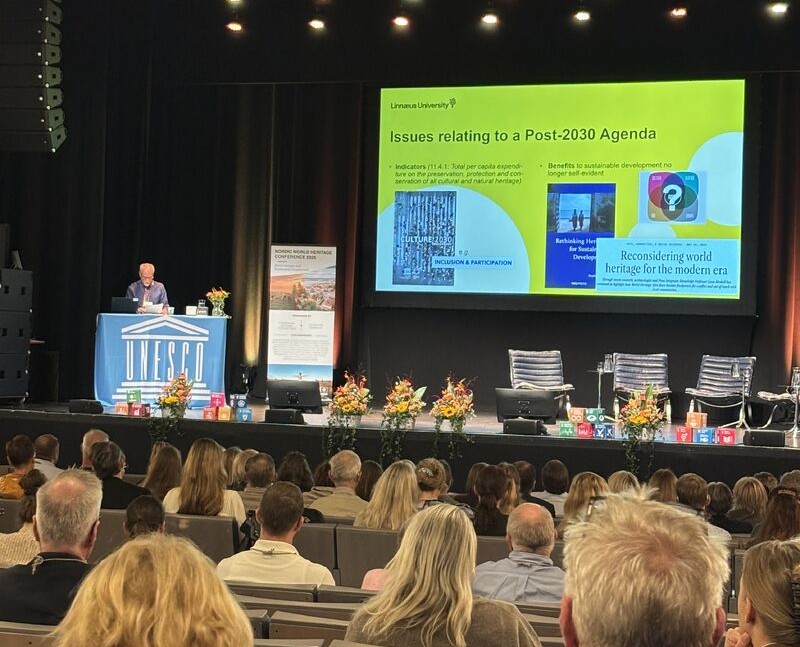
Cornelius Holtorf presented a keynote entitled “World Heritage in a Post-2030 Agenda”. He explored the ongoing international dialogue around a post-2030 agenda and its implications for World Heritage. The session highlighted how heritage can relate to future frameworks for sustainable development.
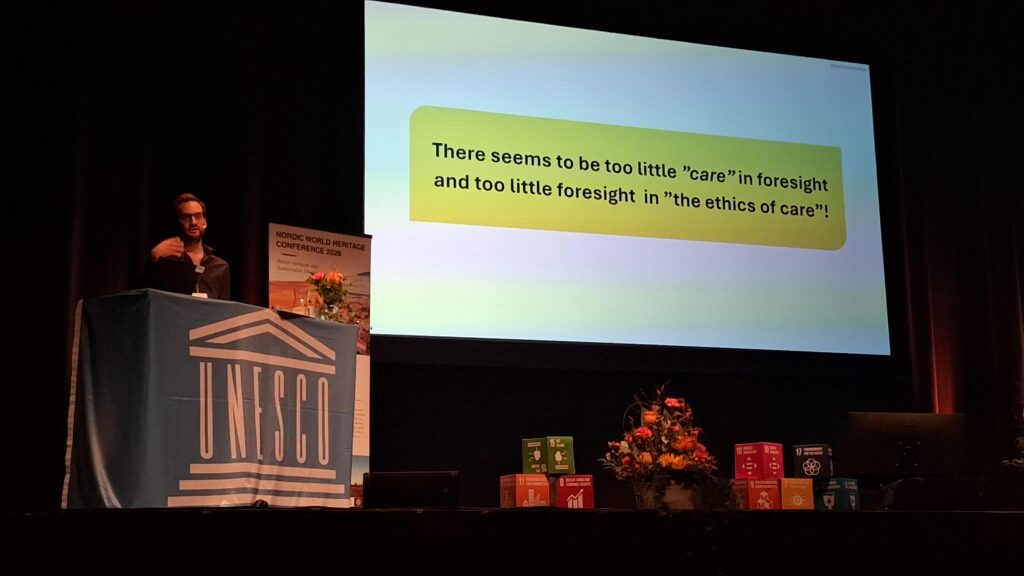
Gustav Wollentz talked about “The value in futures thinking for World Heritage”. He reflected on how future perspectives can—and should—be integrated into World Heritage work.
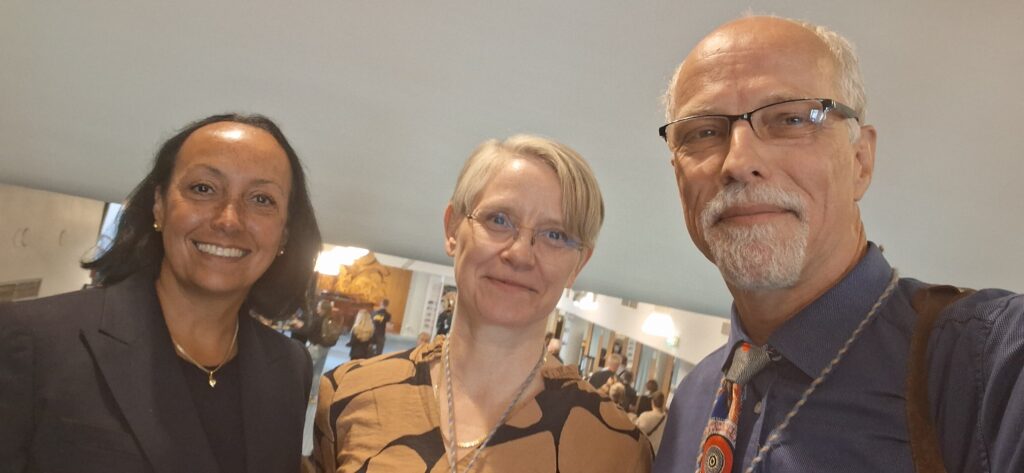
The meeting also provided an opportunity for meetings with colleagues from near and far. Here, from left to right: Elene Negussie (World Heritage Coordinator, Swedish National Heritage Board), Maria Wilenius (Secretary General, Swedish UNESCO Commission, and Cornelius Holtorf).
Most archaeological sites are places where the past resurfaces. Nuclear waste repositories may become places where the future does.
Deep geological repositories are usually described as engineering projects designed to isolate radioactive waste for hundreds of thousands of years. But from a heritage perspective, they are also something else:
deliberate structures meant to outlast civilizations
physical archives of technological activity
long-lived material inheritances left by the present for societies that may no longer remember why they were created.
The repository is not an archaeological site in the ordinary sense. It is not a ruin, a monument, or a cultural treasure. Yet it shares one troubling feature with archaeology: it depends on the survival, loss, and possible reconstruction of meaning over long periods of time.
Future societies may not recognise these sites as we intend. They may intersect them through mining, drilling, construction, land use, or curiosity. What was meant to remain isolated may be brought back into history.
1. The paradox of disposal
Geological disposal promises closure. Once a repository is sealed, the waste is meant to disappear from human affairs. The site is meant to pass from politics into geology.
Yet this aspiration sits uneasily with human history. Buried things do not always remain buried. Mines are reopened. Landscapes are reworked. Ancient structures are excavated, misread, reused, damaged, or turned into resources. The surface and the subsurface are repeatedly reconnected by human action.
This is the paradox of disposal. The repository is designed to leave history, but history has a way of rediscovering what was placed underground.
The safety case therefore depends not only on geology and engineering, but also on memory, meaning, and the possibility that future societies may no longer understand what lies below.
2. The drilling scenario: when isolation is bypassed
In nuclear safety assessments there is a scenario called inadvertent human intrusion. A future driller accidentally intersects the repository and brings radioactive material to the surface.
Technically, this scenario is treated as a test of repository robustness. It asks whether a localised disturbance would compromise the disposal system as a whole. From a heritage-futures perspective, however, it also marks something else: the point at which a deliberately isolated material inheritance is reactivated.
This is not archaeology in the narrow professional sense. The future actor may not be an archaeologist at all, but a driller, miner, builder, land user, or technician. The analogy lies elsewhere. Archaeology reminds us that buried human traces do not necessarily remain outside history. They can return under new conditions, with meanings very different from those intended by their creators.
Human intrusion is therefore not simply an encounter with the past. It is a bypass of isolation. It is the moment when material intended to remain outside surface life is brought back into soil, water, work practices, land use, and possible future memory.
And this moment may be closer to us than the phrase “deep future” suggests. In safety assessments, loss of memory is often assumed, for modelling purposes, only a few centuries after closure.
3. Where the safety model stops
In current safety assessments, the drilling scenario is usually resolved through a short-term radiological exposure calculation for selected receptors. The model may estimate the dose to drilling workers, residents, farmers, or other stylised individuals.
But the material brought to the surface does not disappear when the calculation ends. It remains present. It can be dispersed, diluted, leached, handled, forgotten, remediated, reused, or incorporated into the landscape.
At that point, the waste is no longer only an isolated technological object within a repository model. It has become surface material again: part of soils, waters, biota, land use, and possible future stewardship.
This is where the safety model often stops precisely as environmental history begins.
4. Continuity with nature
Heritage scholars often think about the continuity of human traces through time. Nuclear waste asks us to think about another kind of continuity: the continuity of hazardous materials within Earth systems.
Once brought to the surface, substances such as uranium, plutonium, neptunium are not only entries in a dose model. They are persistent materials. They can remain in soils and waters for very long periods, interact with living systems, and raise chemical as well as radiological concerns.
The issue is therefore not only whether the repository remains robust after a local disturbance. It is also what happens to the material that has crossed the isolation boundary.
This is what I call continuity with nature: the need to follow the material beyond the repository model, into the ordinary environmental systems from which geological disposal was meant to isolate it.
5. What this means for heritage thinking
Seen from this perspective, nuclear waste is not only a technological problem. It is also a cultural and temporal one. It raises questions about:
how societies transmit knowledge across generations
how responsibility persists when institutions disappear
how material traces of the present shape distant futures
how hazardous materials may re-enter landscapes and ecologies
how future societies may interpret, ignore, disturb, or inherit what we have buried.
Geological repositories may therefore become among the most consequential heritage sites humanity leaves behind. Unlike most archaeological sites, however, this inheritance would not only tell the story of our civilization. It could continue to shape the environments encountered by those who rediscover, disturb, or live with it.
Thinking about nuclear waste therefore requires more than engineering foresight. It invites a broader reflection on heritage, responsibility, environmental continuity, and the material traces we leave to the deep future.
For readers interested in the technical and social sciences dimension of this question — particularly how nuclear safety assessments model future drilling scenarios and where those models end — I explore the issue in more detail in my recent paper, “From Model Closure to Continuity with Nature: Reframing Safety in Deep Geological Disposal.”
Pescatore, Claudio (2026) From model closure to continuity with nature: Reframing safety in deep geological disposal. Energy Research & Social Science 138, 104810. https://doi.org/10.1016/j.erss.2026.104810
Meaningful dose in geological disposal safety cases: human intrusion and normal evolution as competing exposure pathways
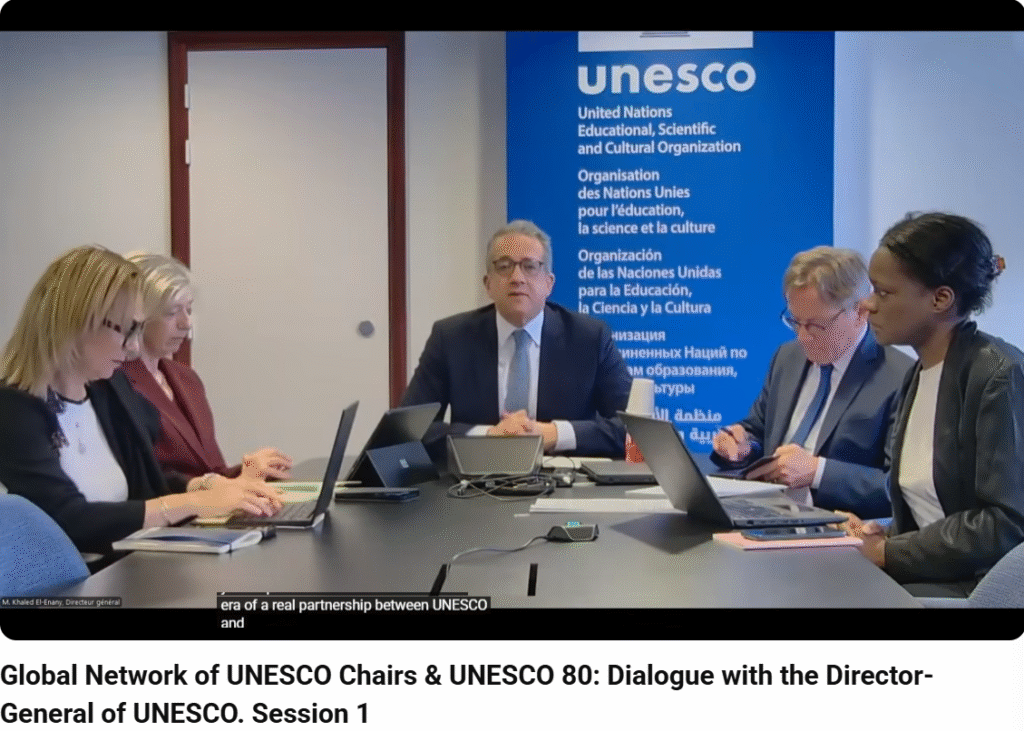
Cornelius Holtorf listened to a first dialogue of the Director-General (DG) of UNESCO, Professor Khaled El-Enany with some 600 UNESCO Chairs (more than half of the total!), held in two sessions on 29 January 2026. El-Enany emphasized the significance of the UNESCO Chairs and UNITWIN networks as well as the need for UNESCO of utilizing the “priceless” expertise, knowledge, and research of the UNESCO Chairs and UNITWIN networks. This important meeting was intended as the beginning of a series of meetings during the DG:s entire mandate. In the framework of the UNESCO80 initiative: Shaping UNESCO’s Future Together, El-Enany asked the Chairs for observations, aspirations, ideas and suggestions to build together the strategy for the future of UNESCO, at the same time identifying or improving synergies between UNESCO and the Chairs. The DG concluded by calling for a more efficient and better coordinated way of collaborating with the UNESCO Chairs and UNITWIN networks, offering them a win-win deal: “Lets start a new era of a real partnership between UNESCO and every one of the Chairs.”
I submitted the following suggestions:
To Professor Khaled El-Enany Director-General of UNESCO
7 July 2026
Dear Professor El-Enany,
During your first dialogue as DG with UNESCO Chairs at the end of January, you invited Chairholders, in a spirit of intellectual collaboration, to contribute ideas and aspirations for UNESCO’s future role in an evolving world. You encouraged us to reflect on how UNESCO can respond to emerging realities, including climate change, digital inequalities, threats to human rights, and other global challenges.
Since 2017, I have held the UNESCO Chair on Heritage Futures at Linnaeus University in Sweden. The Chair explores the role of heritage in shaping relationships between present and future generations. I was also pleased to meet you briefly during your much appreciated participation in the Chair’s reception on World Futures Day in Paris on 2 December 2025.
In response to your invitation, I would like to offer a few reflections that may contribute to UNESCO’s work in the context of UN80 and support greater effectiveness, coherence, and impact across the United Nations system.
1. Strengthening long-term thinking
The 2024 UN Pact for the Future highlighted the importance of long-term thinking in addressing global challenges. UNESCO is uniquely positioned to advance this agenda. The cultural heritage sector as well as the humanities and social sciences offer rich resources for understanding long-term societal change, while futures literacy and foresight provide tools for imagining and preparing for alternative futures.
Closer collaboration between these domains could strengthen UNESCO’s contribution to anticipatory governance and intergenerational fairness, while also fostering synergies across the UN system. The UNESCO Chair on Heritage Futures would be pleased to contribute to such efforts.
2. Understanding our shared human heritage
Culture shapes how people make sense of the world and relate to one another. Addressing global challenges, including climate change, emerging technologies, pandemics and nuclear risks, requires trust, solidarity, and a sense of shared responsibility.
UNESCO could further strengthen its leadership by promoting awareness of humanity’s common heritage and shared destiny, complementing its important work on cultural diversity. Greater attention to what unites human beings across cultures, histories, and regions may help foster mutual understanding and strengthen global cohesion for the benefit of people living now and in the future. This effort could draw productively on expertise from both the social and natural sciences, including research on our shared human origins and our genetic heritage.
3. Reimagining heritage and change
In a world increasingly characterized by rapid change and transformation, heritage remains an important resource for individuals and communities seeking continuity and resilience. Yet heritage is not only something to be safeguarded against identified threats; it can also be a catalyst for desirable positive change and transformation.
UNESCO could lead a broader conversation on how changing and emerging heritage practices can contribute to human happiness, equality, justice, and human rights. This may involve complementing traditional preservation approaches with perspectives that recognize heritage as a dynamic concept reflecting past and present people’s choices while informing future ones in pursuit of both human well-being and people’s own aspirations.
4. Expanding UNESCO’s leadership on human–environment relations
UNESCO emerged from intellectual traditions grounded in humanism and cooperation between peoples. Today, all of humanity faces planetary challenges associated with environmental degradation, biodiversity loss, and climate change that affect both human and non-human life.
Building on UNESCO’s recent leadership in areas such as the ethics of artificial intelligence, the Organization could further advance reflection on human–environment relations through fields such as the environmental humanities and interdisciplinary approaches on planetary cohabitation, interspecies care, and related topics. UNESCO is exceptionally well placed to foster dialogue on the wider implications of post-human thinking.
I would be pleased to elaborate on any of these ideas, adapt them in light of UNESCO’s priorities, or contribute to future initiatives in these areas.
Thank you for inviting UNESCO Chairs to share their perspectives and suggestions in the framework of UN80. I greatly appreciate this opportunity to contribute to UNESCO’s future work.
Yours sincerely,
Cornelius Holtorf Chairholder, UNESCO Chair on Heritage Futures, Faculty of Arts and Humanities, Linnaeus University, Kalmar Sweden, http://lnu.se/en/unescochair
P.S. As a Chairholder based at a university, I may not always be fully aware of the institutional and political considerations that shape UNESCO’s priorities and programmes. It is therefore possible that some of the ideas outlined above overlap with ongoing initiatives. If so, I would welcome opportunities for stronger communication and exchange between UNESCO and its Chairs, helping us better understand and contribute to the Organization’s work.
Anders Högberg, Gustav Wollentz and Cornelius Holtorf, among others, took place in an informal meeting with the national organizers of “Collection Forum 2026. Visions and Innovations”, a conference attracting ca 150-200 participants and taking place in November 2026 in collaboration with Kalmar County Museum in Kalmar (7 April 2026).
Cornelius Holtorf briefly presented some theoretical perspectives on time travel in different formats for the emerging internal Centrum for living and embodied history at Linnaeus University. Even Gustav Wollentz participated in the meeting (8 April 2026).
Cornelius Holtorf was interviewed by a group of students at Sciences Po Paris, reading the course Policy Making Initiative for Sustainability, about various issue concerning future generations and long-term memory in the context of nuclear waste (9 April 2026).
Cornelius Holtorf took place in the regular meeting of the International Scientific Committee on AeroSpace Heritage of the International Council of Monuments and Sites (ICOMOS) which discussed, among others, including a presentation on Space Law at the UN Committee on the Peaceful uses of Outer Space’s 65th Legal Sub Committee’s meeting in Vienna (10 April 2026).
Cornelius Holtorf had an informal discussion with Sarah Thomas and Zoe Tcholak-Antitch on continuing collaboration regarding their Future Generations Communications Playbook (13 April 2026).
Cornelius Holtorf presented an invited online lecture entitled “Nuclear Waste as Heritage of the Future: What Archaeology Teaches Us About 100,000-Year Communication” for ca 20 participants in the NewComers4Nuclear Global lecture series (14 April 2026).
Cornelius Holtorf had an informal meeting, discussing future collaboration, with Mathias Lafolie, Head of Culture at the municipality of Kalmar (16 April 2026).
Cornelius Holtorf co-presented a talk on “Thinking with Soil in Heritage Matters” for an audience of 20 students and researchers at the Green Zone Higher Seminar in Environmental Humanities at the University of Stockholm, Sweden (23 April 2026).
Anders Högberg, Cornelius Holtorf, and Gustav Wollentz, among others, took part in an informal virtual meeting with Chiara Bortolotto, UNESCO Chairholder in Intangible Cultural Heritage and Sustainable Development in Paris, discussing future research needs concerning the contribution of intangible cultural heritage to social sustainability (30 April 2026).
Cornelius Holtorf was among ca 90 participants from the global region of Europe and North America in a meeting by the Sustainable Development Goals Working Group (SDGWG) of ICOMOS on “Integrating Culture and Cultural Heritage into Sustainable Development” (19 May 2026).
Cornelius Holtorf attended a Briefing on Culture, Heritage and Adaptation related to the forthcoming UNFCCC intersessional meeting known as SB64 and organized by the Heritage Adapts to Climate Alliance (HACA) (20 May 2026).
Cornelius Holtorf presented a talk on “Heritage Futures – how cultural heritage can make us hopeful” for the K3 Heritage Research Seminar at the University of Malmö, Sweden (25 May 2026).
Anders Högberg, Cornelius Holtorf, Gustav Wollentz and Marcy Rockman participated in a working meeting with Philip Buckland, Umeå University, and Marcus Fjellström, University of Stockholm, on synergies regarding the project on sustainable heritage funded by the Swedish National Heritage Board (27 May 2026).
Several members of the Chair digitally attended a lecture by Kim Stanley Robinson on “Designing a Just Climate Future”, held in the UNESCO Thought Leaders series in Paris (3 June 2026). Robinson is the author of “The Ministry of the Future”, among other novels. UNESCO stated: “His body of work explores the long-term future of humanity through a blend of scientific rigor, ecological awareness, and socio-political imagination. His novels examine how collective choices shape possible futures, often presenting multiple pathways rather than fixed outcomes. This approach aligns closely with the goals of the UNESCO MOST Programme and its emphasis on anticipatory, evidence-based policy for social transformations, using Futures Literacy and Foresight to enhance our capability to use the future to shape the present. Robinson’s speculative scenarios help readers and policymakers alike imagine alternative systems, anticipate challenges, and cultivate the capacity to navigate uncertainty—core principles in contemporary futures and foresight methodologies.”
Cornelius Holtorf participated actively updating progress in regarding our working group on heritage processes and futures literacy in the second Plenary Meeting of the Expert Group on Archiving and Awareness Preservation (EGAAP-2) of the Nuclear Energy Agency held at the OECD in Paris (11-12 June 2026).
Cornelius Holtorf attended a virtual UNESCO Futures Dialogue on “Time and Possibilities: Governing and researching time in new ways for transformative futures”. Among the speakers for an audience of cirka 170 , including many UNESCO Chairs, were Keri Facer and Michelle Bastian (24 June 2026).
Cornelius Holtorf (and Marcy Rockman??) made suggestions for an update of the 2008 ICOMOS Charter on the Interpretation and Presentation of Cultural Heritage Sites, responding to a call members of the ICOMOS International Scientific Committee on Interpretation and Presentation (ICIP) (27 June 2026)
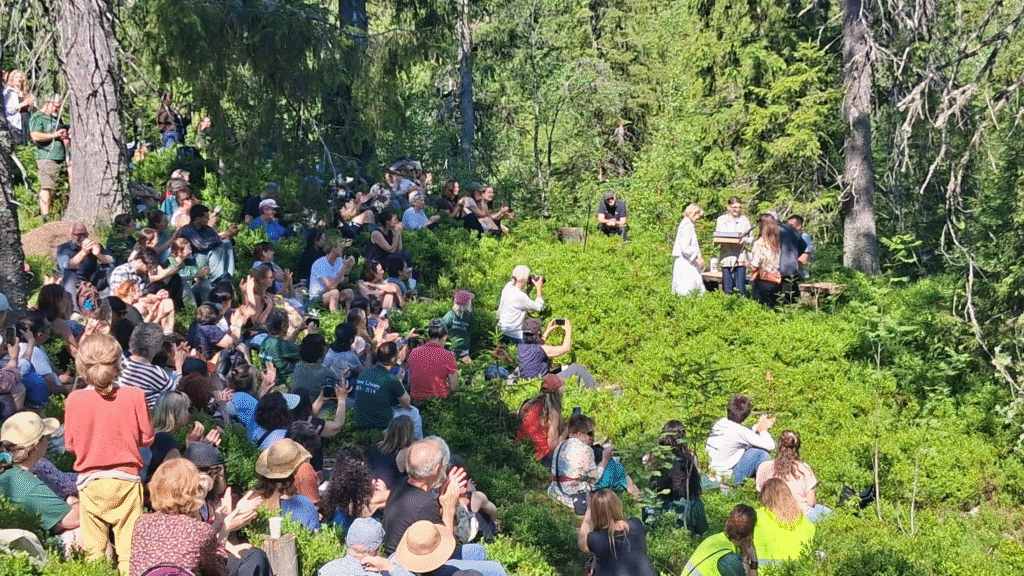
I participated 27-29 June 2026 in a weekend with the Future Library project in Oslo. The occasion was the handover of the manuscripts of Tommy Orange and Amitav Ghosh to this 100-year project created by Katie Peterson in 2014. All three were present. On the main day, some 150 people participated: from Norway, many other European countries, Mexico, and the US.
The handover ceremony on 28 June 2026 in the Future Library forest.
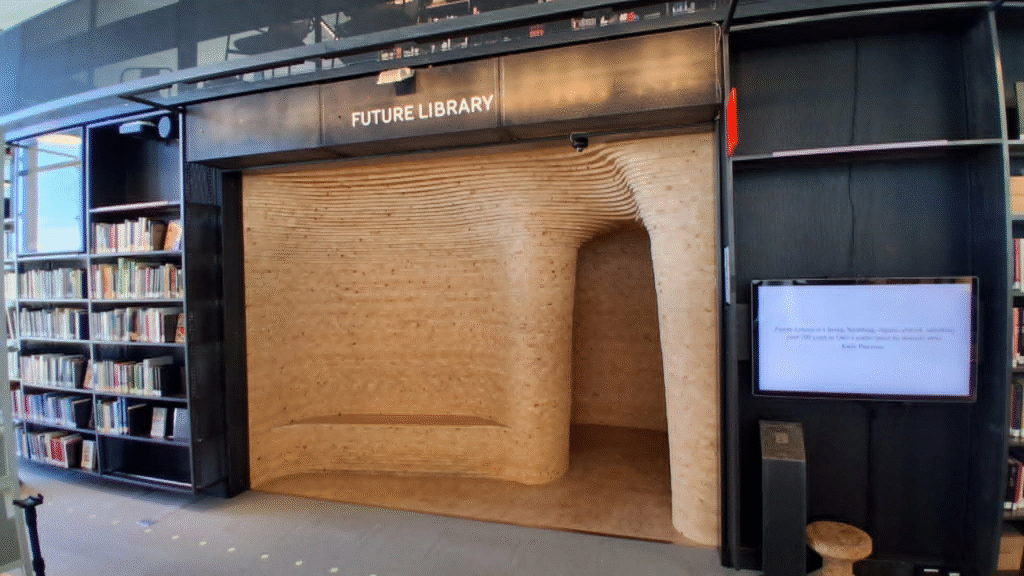
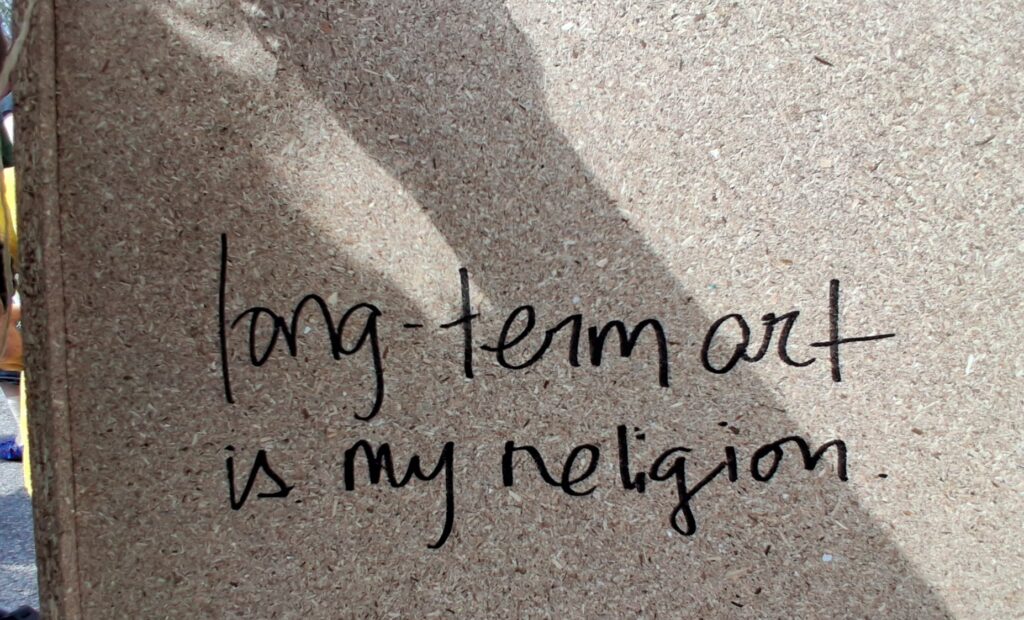
The weekend involved various performances including a handover ceremony in the Future Library forest north of Oslo (see picture above), the placing of the unread manuscripts until 2114 into the Future Library room in the Deichman Bjørvika Public Library in Oslo (see picture below), and a Symposium of the Long-Term Art Projects (LTAP) initiative entitled “What Can Art Do for the Future?”. I contributed by co-chairing (with Richard Sandford, UCL) a panel offering “Perspectives on a Long Future”, with three present custodians of long-term art projects from Germany, the Netherlands, and Austria.
Among the participants of the Symposium were Marianne Borgen (former Mayor of Oslo), Anne Beate Hovind (curator of the Future Library project), Michael Münker (founder and co-ordinator of LTAP) and Lydia Caldana (Foresight Policy Analyst at EU Policy Lab).
I like to see the Future Library project in Oslo, as many of the other long-term art projects elsewhere, as an exercise in practicing heritage futures.
The heritage is in this case is both natural and cultural. The natural heritage is the Future Library forest where in 2014 the trees have been planted that in 2114 are anticipated to be used to produce the paper on which the manuscripts of the (by then) 100 manuscripts will be printed. The cultural heritage are not only the unread texts, the public library where they will be stored until 2114, and the books then to be printed, but also the annual public handover and placing rituals in which many people participate, celebrating the power of art and culture.
The Future Library room, eventually containing 100 unread texts to be printed after 2114.
This heritage is negotiating the relations between present and future societies in several ways. On one level, it transmits texts for up to one century into the future. On another level, it involves a community of authors and project facilitators in the present that takes on a commitment for the future and in doing so spreads hope and trust in many uncertain events and processes that lie ahead of all of us.
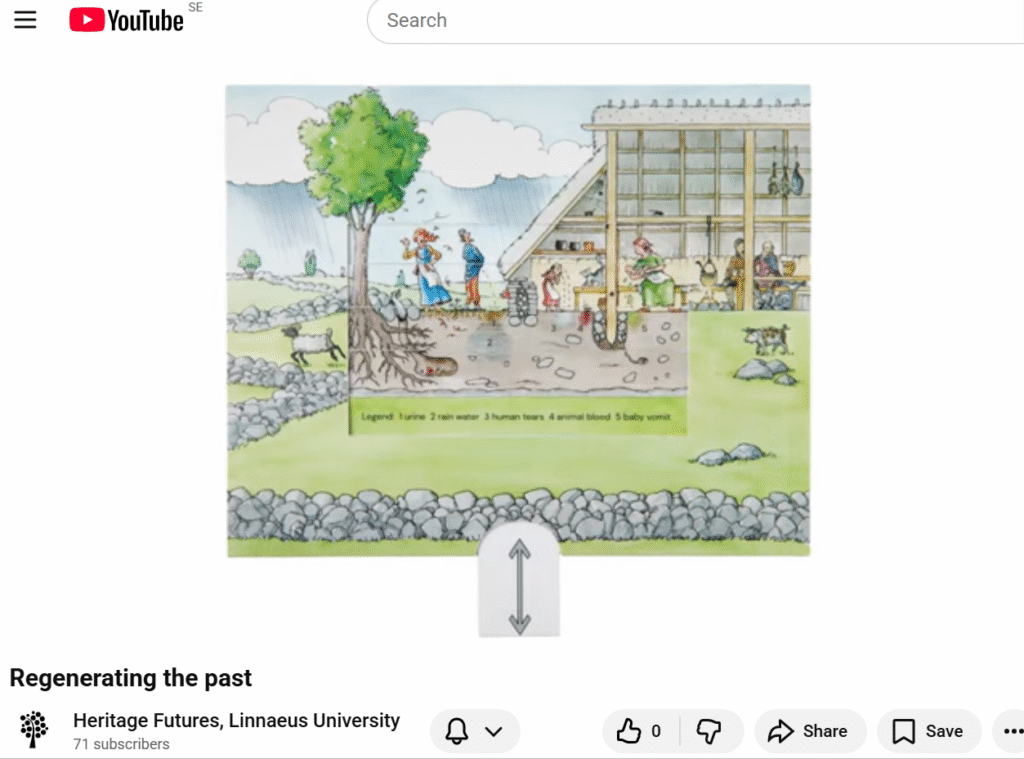
Our movable card only exists in a very limited edition in print but is now available on Youtube:
It depicts the scenery in an Iron Age village—and what ended up enriching the soil, feeding life to this day and into the future (click on the image to see the moving bit):
The scene was inspired by recent archaeological excavations conducted by Linnaeus University at Gamla Skogsby in Mörbylånga on the island of Öland in Sweden.
For more details, inspiration and sources of this project see here. A broader theoretical discussion linked to this work is available in this new paper:
At Nordic TAG in May 2026 in Kalmar, I presented on “Devouring the Iron Age: A Life-Centred and Culinary Approach to the Soil” in the session “Soil as Archive, Actor and Ally: Rewilding Archaeological Practice” (which I had co-organised with Ewa Domanska and Christina Fredengren). I served cheese crackers with wild oregano grown in the very soil shown on the card above.
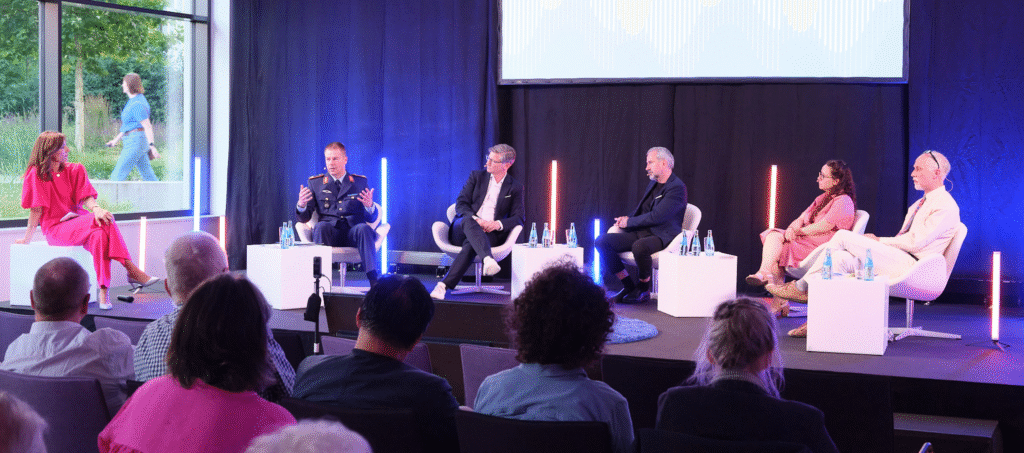
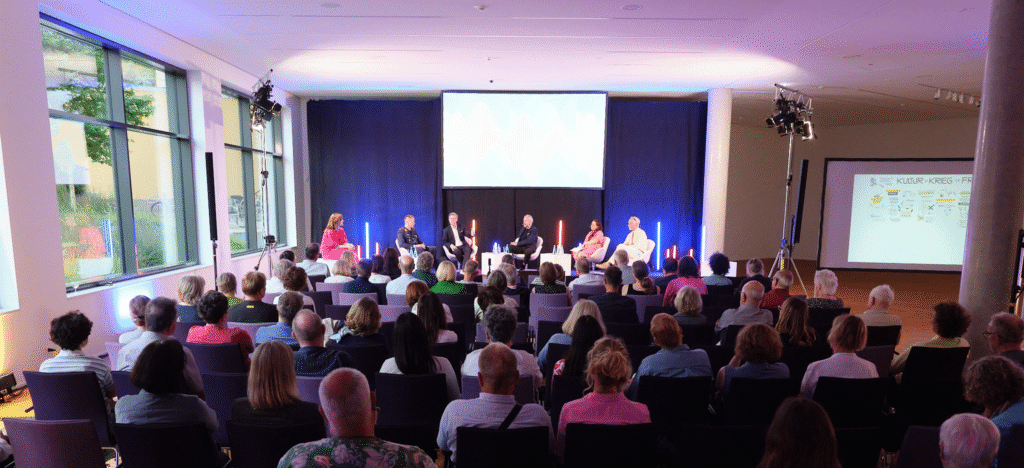
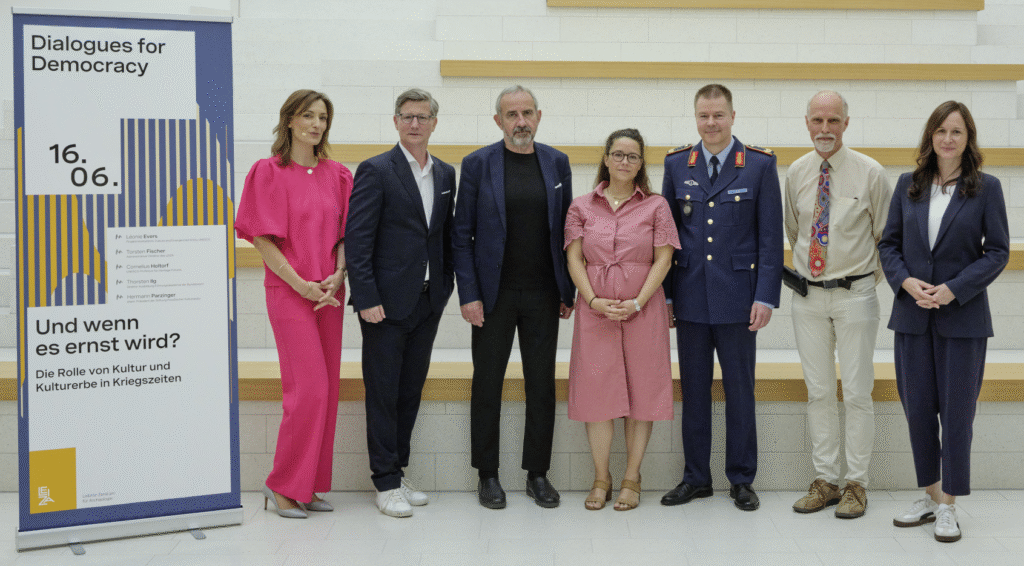
The evening attracted an audience of about 100, which engaged actively with an expert panel consisting of
Léonie Evers, Project Officer, Culture in Emergencies, Emergency Preparedness and Response Unit, UNESCO
Torsten Fischer, Administrative Director, LEIZA
Cornelius Holtorf, UNESCO Chair in Heritage Futures, Linnaeus University, Kalmar, Sweden
Thorsten Ilg, Brigadier General, Deputy Commandant and Director of Training, Bundeswehr Command and Staff College
Hermann Parzinger, Former President of the Prussian Cultural Heritage Foundation and Executive President of Europa Nostra.
In my own short opening statement, I emphasized the high number of about two million war casualties in the war in Ukraine to date, reminding us that in a war there are only losers. We therefore have to prevent war. Culture and cultural heritage have a particular responsibility since, as is often said, culture and cultural heritage is what people tend to be fighting for in military conflicts. Indeed, according to the famous statement in the 1945 Constitution of UNESCO, war and peace begin in the minds of people. Culture and heritage do not only express shared values but also collective identities: they define “my people” and thus who is particularly worth defending. I quoted a Swedish official stating that “Cultural heritage gives the nation its flesh and blood.”
In short, I suggested that without culture playing that role there may be fewer wars. We should work towards a cultural heritage that serves human wellbeing and co-existence rather than the interests of competing nation-states for which their citizens are sacrificed. I concluded by calling for the creation of Ministries of Peace in addition to Ministries of Defense.
In the subsequent discussion, we talked, among others, about the need to see the gruel reality of human war victims and the inspiration of successful peace processes such as the steps taken after World War II towards the EU. Also discussed was the significance for human beings of a sense of collective belonging. I emphasized that Russia is part of Europe, European history and European culture. It was suggested that cultural institutions like LEIZA could work for peace by increasing understanding in Germany of contemporary thinking among Russians, for example. Generally, we should appreciate that we have so much more in common with people anywhere on Earth than what ultimately divides us.
The audience was particularly taken by my discussion of the sudden turn in Sweden in recent years towards rapid rearmament and the ongoing militarisation of the entire country. Particular astonished was the audience to learn that in expectation of a coming war, spaces for war graves for 5% of the population are being prepared across Sweden. They were also stunned by the propaganda statement printed in a recent information brochure produced on behalf the Swedish government and distributed to all households:
Brigadier General Ilg suggested in the discussion that in case of war, he would either be fighting at NATO’s Eastern Front or already be dead.
The aims of the event, which I had initiated and co-organised with LEIZA, included to
increase the importance and visibility of culture and cultural heritage in society and politics,
make multilateral and supranational levels of discussion more visible and thereby strengthen them,
encourage processes of reflection among visitors/audiences,
provide ideas and inspiration for how individuals can become involved in culture and cultural heritage themselves, and
strengthen dialogue between the cultural sector, politics, and defense.
For a full discussion of similar issues as those addressed by the panel see the recent debate in Forum Kritische Archäologie.



[…] The new funding for this and a number of additional smaller projects, means that the Climate Heritage Network is…
[…] Chair on Heritage Futures « Culture, cultural heritage and COP26 […]
[…] mer på Unescoprofessurens blogg http://blogg.lnu.se/unesco/?p=1061 Besök Öland 2050! […]