UNESCO

Chair on Heritage Futures

Keynote lecture on Heritage Futures and Futures Literacy

2023-12-15

On Wednesday 13 December 2023, Anders Högberg was invited by University of Ferrara to give a keynote lecture on the topic “Heritage Futures and Futures Literacy. New roles for heritage in managing the relations between present and future societies”.

The keynote was presented at the Kaleidoscope of Sustainability, 5th Annual Kick-off Symposium of the PhD programme Environmental Sustainability and Wellbeing. It is a program that focuses on the research and training of young scholars interested in a multidisciplinary approach to sustainability and wellbeing. It is an impressive inter-disciplinary research school set-up be the University of Ferrara in co-operation with a wide range of universities from around the globe. It attracts PhD-students from the Humanities, Social Science, Economics, Law, Architecture, Urban Planning, Engineering, Chemical Sciences, and Biomedical Sciences.

Anders Högberg

Anders Högberg, Professor of Archaeology UNESCO Chair on Heritage Futures


World Futures Day 4 December UNESCO

2023-12-07

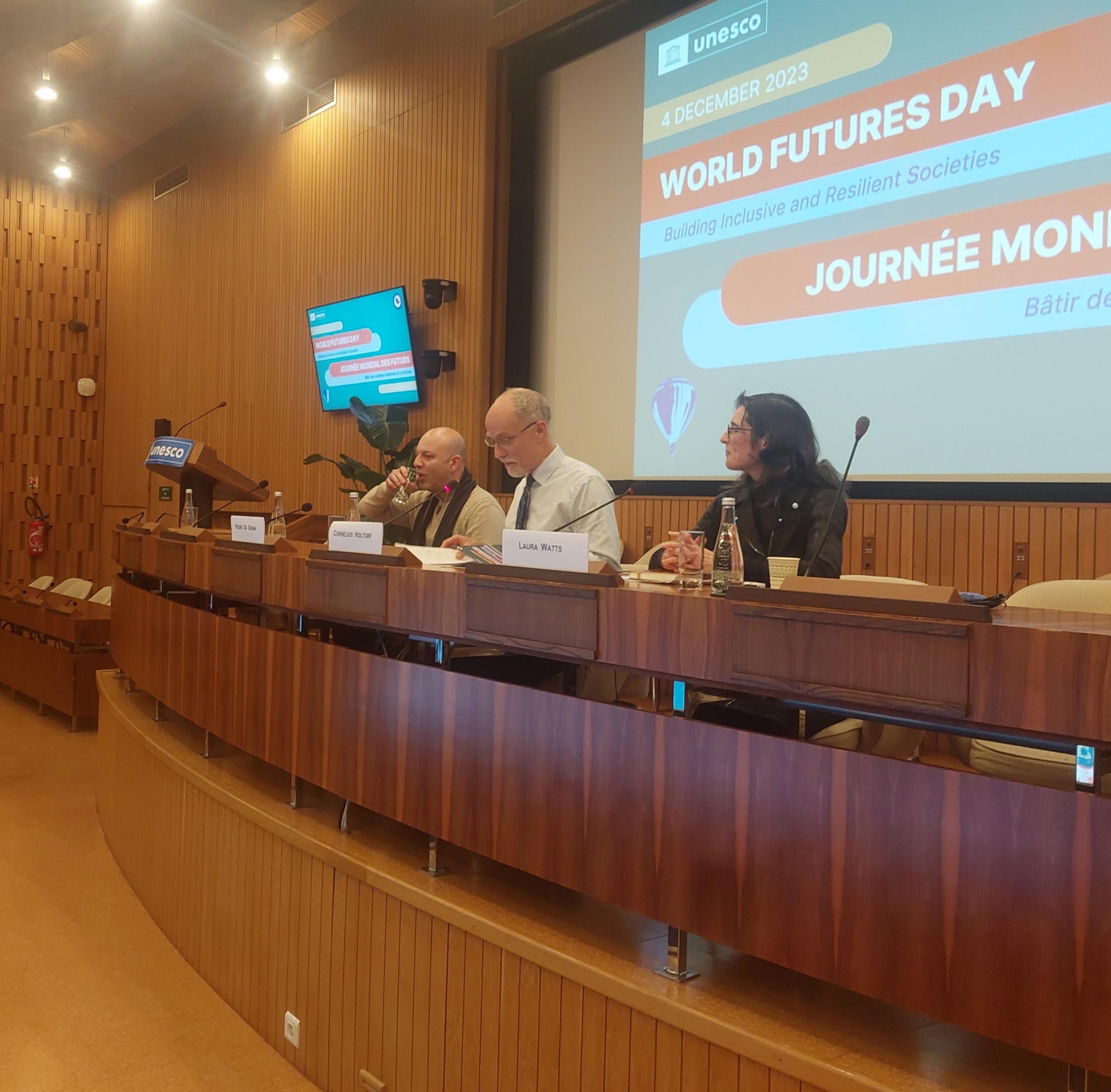
Cornelius Holtorf and Helena Rydén celebrated UNESCO World Futures Day 2023 #FuturesDay at UNESCO Headquarters in Paris, by joining the global conversation on futures and foresight: Building Inclusive Societies through Futures Literacy & Foresight.

https://www.unesco.org/…/celebration-world-futures-day…

The event was well attended, both in Paris and online.

WFD Paris 2023

World Futures Day in Paris, UNESCO 2023. The day ended with experimental future-oriented approaches, by Pedro De Senna, Cornelius Holtorf and Laura Watts. You can see the recording here https://webcast.unesco.org/events/2023-12-WFD/ (starts at ca 3:23:00). 

WFD 2023 Paris

Linnaeus University made an impact!

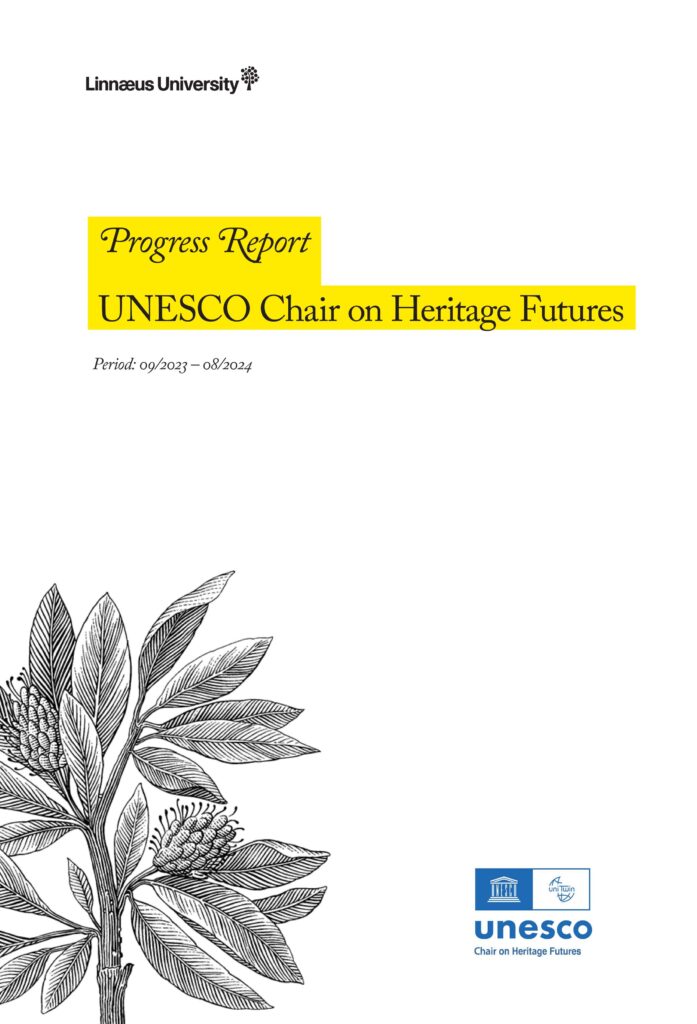
Progress Report 2022/2023

2023-11-27

This report covers the sixth year of the UNESCO Chair on Heritage Futures at Linnaeus University. Among the highlights of the year were several global initiatives which our Chair could influence with its distinctive perspective on heritage futures that becomes ever better known. This included the UNESCO World Conference on Cultural Policies and Sustainable Development MONDIACULT 2022 in Mexico City at the end of September. The conference established the significance of culture as a global public good and called for the inclusion of culture as a stand-along goal in the post-2030 international development agenda.

Progress Report 2022/2023

Progress Report 2022/2023

View (issuu)

Download (DiVA)

Cornelius Holtorf

Cornelius Holtorf at UNESCO World Conference on Cultural Policies and Sustainable Development MONDIACULT 2022 in Mexico City. The conference was attended by more than 100 ministers of culture, but also representatives from over 150 intergovernmental organizations, UNESCO partners, civil society, and some of the other UNESCO Chairs in the field of culture.

A topic that remains significant in our work is memory across generations related to repositories of nuclear waste. In this context, Sarah May co-edited a new volume on Toxic heritage, and Anders Högberg and I published a paper on “Nuclear Waste as Critical Heritage” that in some ways constitutes a conclusion of our decade-long research on these issues. Among the research projects listed below is a range of exciting new empirical research Chair members have been involved in over the past year.

There were also several opportunities to meet and collaborate with other UNESCO Chairholders from different corners of the world. These are important occasions as they pave the way for global collaborations in new areas.

Please get in touch if you have any comments or suggestions!

Cornelius Holtorf, Professor of Archaeology, and holder of the UNESCO Chair on Heritage Futures


Why ‘Futures Literacy’ is important for museums and museum practices 

2023-11-13

Anders Högberg gave a keynote presentation at ”Museenes forskerkonferanse 2073”, arranged by Norske Museumsforbundet and Oslo Museums:

Futures Literacy, Why it is important for museums and museum practices. https://www.oslomuseum.no/aktivitet/museenes-forskerkonferanse/

If you are interested in learning more, you can read this information as well about future consciousness at some Swedish County Museums:

Högberg, A., Wollentz, G., Holtorf, C. (2022)
Framtidsmedvetande på museer: Några svenska länsmuseer i fokus
Nordisk Museologi, 34(2): 5-22
https://doi.org/10.5617/nm.10068


Anders Högberg

Anders Högberg, Professor of Archaeology UNESCO Chair on Heritage Futures

The team gathered in Malmö

2023-10-23

Anders Högberg

Anders Högberg (UNESCO Chair on Heritage Futures) presenting a project at Malmö University (17 October ) that he and Gustav Wollentz from NCK, The Nordic Centre of Heritage Learning & Creativity, are making together. Gustav Wollentz is conducting a series of interviews with young people in the Araby district in Växjö. The work is part of a research project between Linnaeus University and Växjö Municipality.


From left Carolina Jonsson Malm, Anders Högberg, Emily Hanscam, Sarah may, Anna Bruun Månsson, Kristina Lindström, Per-Markku Ristilammi, Helena Rydén

From left Carolina Jonsson Malm (Malmö University), Anders Högberg, Emily Hanscam and Sarah May (UNESCO Chair on Heritage Futures), Anna Bruun Månsson, Kristina Lindström and Per-Markku Ristilammi (Malmö University), Helena Rydén (UNESCO Chair on Heritage Futures)

Thank you Malmö University for interesting discussions, and for hosting the team of the UNESCO Chair on Heritage Futures!


UNESCO Chairs met in Copenhagen

UNESCO Chair on Heritage Futures and Unesco Chair in Anticipatory Leadership and Futures Capabilities

UNESCO Chair on Heritage Futures at Linnaeus University and Unesco Chair in Anticipatory Leadership and Futures Capabilities at Aarhus University met in Copenhagen 16 October for discussions on a future collaborative project. From left Nick Larsen (Copenhagen Institute for Futures Studies), Sarah May, Cornelius Holtorf (holder of the UNESCO Chair on Heritage Futures), Emily Hanscam, Helena Rydén, Anders Högberg, Adam Gordon (holder of the UNESCO Chair in Anticipatory Leadership and Futures Capabilities).

Nick Larsen, Copenhagen Institute for Futures Studies

Nick Larsen, Copenhagen Institute for Futures Studies

Sarah May and Jonas Gissel Mikkelsen

Sarah May (UNESCO Chair on Heritage Futures) and Jonas Gissel Mikkelsen (Copenhagen Institute for Futures Studies)

From left Sarah May, Nick Larsen, Anders Högberg, Helena Rydén, Adam Gordon, Emily Hanscam

From left Sarah May, Nick Larsen, Anders Högberg, Helena Rydén, Adam Gordon, Emily Hanscam

Young people’s thoughts about the future

2023-08-18

Gustav Wollentz from NCK, The Nordic Centre of Heritage Learning & Creativity, is conducting a series of interviews with young people in the Araby district in Växjö. The work is part of a research project between Linnaeus University and Växjö Municipality.

On August 18, Anders Högberg presented the project to Växjö Municipality, commenting:

“We are happy that this was received so well by politicians and officials at Växjö Municipality. We would like the result to eventually benefit cultural actors outside of Växjö as an inspiring example”.

Background

The project was planned at Linnaeus University’s Centre for Applied Heritage during the winter of 2021/2022. It will be carried out in 2022 and 2023, and the results will be presented in 2024. Funding is via the municipality of Växjö, under the project management of Anders Högberg at Linnaeus University. Gustav Wollentz, based at NCK, The Nordic Centre of Heritage Learning & Creativity, conducts the interviews. The project collaborates with a number of actors in the Araby district.

Read more (in Swedish):

https://lnu.se/mot-linneuniversitetet/aktuellt/nyheter/2023/arabyprojekt/

Gustav Wollentz

Gustav Wollentz, UNESCO Chair on Heritage Futures

Anders Högberg

Anders Högberg,  UNESCO Chair on Heritage Futures

“Being at Linnaeus University has been a great experience!”

2023-07-05

INTERVIEW | When the Italian doctoral student Elena Maria Cautis had the opportunity to spend time at a foreign institution, her eyes fell on Linnaeus University. Or more precisely: The Centre for Applied Heritage and the UNESCO Chair on Heritage Futures. This was exactly in line with her own research on cultural heritage. 

In the spring of 2023, she left the University of Ferrara, where she normally works, and moved to Kalmar to spend three months of exploring heritage research. In addition, she discovered birdwatching and floorball.

What do you think of your time at Linnaeus University?
– Being at Linnaeus University has been a great experience! Besides the importance for my research, it also was a period of reflection for what kind of professional environment I would like to be part of in the future. Everyone was very friendly and attentive to my needs. The facilities at the campus were great, since I was able to work both from the office and the library, which holds relevant works for my research. I’ve also experienced playing “innebandy” (floorball) with colleagues, which was super fun!

– Overall, I think that when I will be looking back years from now, I will identify this period as a turning point for me. As a person and as a professional.

What made you decide for Linnaeus University?
– Within my PhD programme, we are encouraged to spend time at a foreign institution. Given this, I had been looking for some time at the Centre for Applied Heritage at Linnaeus University and at Anders Högberg’s and Cornelius Holtorf ’s work related to heritage futures. After some Zoom meetings with them, I understood that this environment would be a great opportunity for me to explore more in depth the idea of heritage as resource.

– The key components that transpired in the various research projects taking place, were enthusiasm and curiosity towards looking at heritage differently. This is precisely the kind of environment I wanted to be in at that stage of my research, since I was feeling a bit stuck and unmotivated. The main motivation for coming to Linnaeus was a perceived feeling of freedom of thought and enthusiasm for exploring what some might consider ”crazy ideas”. I think this is what innovative thinking is all about!

What did you do during your 3 months here?
What I mainly wanted to do was to meet with people and discuss some of the themes of my research. I had the opportunity to do this, within seminars and workshops. I was also able to get a glimpse at futures literacy within workshops by the UNESCO Chair. Aside from these activities, the most important was being in a continuous dialogue with Anders and Cornelius. They offered me all the assistance and motivation that I needed in my research.

What did you think about living in Sweden?
– This was my first time in Sweden, and was nice to see that people are open, friendly and really keen to support you. Kalmar was just lovely, although at the beginning I had a bit of a weather shock! Being there was a great opportunity to also get more in touch with nature. And after countless walks I decided I am forever hooked with birdwatching! The most important though, was that I felt secure. Although I only had a glimpse at how the Swedish society is, and that there might be issues here and there, the glimpse was that it’s a society where you can flourish.

What do you want to do after you have finished your PhD?
– I would like to continue doing research, while also offering consultancy for heritage projects and international bodies in the field. I am not sure exactly where. But I am sure that I would like to work in an environment similar to the one that at Linnaeus University.

Elena Maria Cautis

Elena Maria Cautis

Elena Maria Cautis at Linnaeus University in Kalmar

Listening – important skill for the future

2023-04-17

Listening as an essential skill for future heritage practices

Diana Policarpo, Ciguatera [Installation], The Soul Expanding Ocean #4 [Exhibition]. Chiesa di San Lorenzo, Ocean Space, Venice. Seen on 30.04.2022.

Diana Policarpo, Ciguatera [Installation], The Soul Expanding Ocean #4 [Exhibition]. Chiesa di San Lorenzo, Ocean Space, Venice. Seen on 30.04.2022.

Ever since the elaboration of the UN Agenda for 2030 and its SDgs, and even more so since the elaboration of ICOMOS’ International Policy Guidance, cultural heritage has been advocated as an essential asset for tackling issues related to the climate crisis, with social challenges identified as part of this process. The International Day for Monuments and Sites (IDMS) offers the ideal setting for reflecting on which types of values attached to official heritage are suitable for designing the futures envisioned within these strategies. Or else, which hidden values might offer equal if not better support in designing these futures.

This year’s theme of the IDMS reflects on Heritage Changes and alternative sources of knowledge for welcoming our uncertain futures. It emphasizes Indigenous and traditional knowledge systems as valuable sources for finding solutions for meeting the SDGs and encourages heritage experts and institutions to open up dialogues at all levels of society and with other sectors in order to ensure representation in decision making processes with regards to the environment. 

This is a theme widely explored through the Panorama Platform within its Panorama Nature-Culture Community, which shares examples of good practices which seek to enhance the linkages between human communities and other-than-human communities and find solutions of co-existence and possibly flourishing together. Most of the explorations into these solutions are based on collaborations with Indigenous, traditional and local communities and the co-production of ecosystem management strategies, for ensuring the wellbeing of all types of communities and the conservation of heritage. When scrolling through the diverse case studies on the platform, one can come across approaches which touch upon diverse narratives which are usually woven into the “heritage for climate action” discourse: from indigenous healers engaged into actions aimed at saving tree species, to greening itineraries which lead to world heritage sites, to convincing people of the values of the conservation of their homes as an act of sustainability (just to name a few). Although all of these offer examples of action and therefore they create a sense of hopefulness, the common assumptions that seems to surface from these approaches, as well as those employed in similar actions in general,  are that:

  • Nature is an isolated object from ourselves, a realm to which we do not belong, and in need of our intervention in order to save it.
  • Indigenous Peoples and traditional communities are inherently willing to remain as they are (or as they are imagined) and offer solutions for environmental damages produced so far.
  • Cultural and Natural Heritage are static objects, which at best could be changed by bringing them into a state in which they were before (a “before” which is difficult to locate in time, although some might say “before the industrial revolution”).

This is not to say that such approaches are not useful in defining new models of interacting with our environments. Rather, these approaches touch upon the surface of the problem which lays at the heart of the current multiple crises we are experiencing. For tackling these, more powerful tools are needed which are able to decisively influence our very ways of envisioning ourselves as species within a broader context of an array of environments. Multispecies studies for example look at the multiple entanglements of livelihoods and of diverse communities of species and how these interact and influence each other, drawing also from Indigenous philosophies in this way. This might be an appropriate starting point for envisioning heritage practices as part of a management process of ecosystems and therefore bear in mind the impacts that our decisions related to heritage management have not just on humans but on other-than-humans as well. 

This becomes all the more important if we are to consider the power of heritage in shaping human values and behaviors and in defining our place in the world. In this case the following question arises: what is it that we bring with ourselves from our pasts that we would like to carry with us in the future? Reflecting upon the past in this case becomes not a nostalgic reflex, but rather identifying what it is that we’ve been carrying with us as societies. And in this sense, and keeping in mind the futures we envision for ourselves and for future generations, what is it that we might perhaps shed off as it will not be useful in these envisioned futures any longer? These are relevant reflections as we must acknowledge that, despite admirable efforts to slow down the rapid changes our worlds are undergoing, these changes in one form or another will happen and therefore the best we can do is to actually prepare. This means taking precautions, of course, but it also means that our very ways of relating to change, to uncertainty, to  our environments, must be steered towards acceptance and foresight equally. 

As much as we like to believe it, traditional knowledge is not static either. Surely if one were to document a traditional community across decades, they will notice changes in ways of perceiving and relating to the world, unless these lived completely isolated from other human communities (but even so might be influenced by changes in the rest of the environment). Too much tokenism has been expressed by outsiders in relation to Indigenous, traditional or local communities, and therefore when entering such a domain there is a need to proceed not just ethically, but also in attempts to establish genuine relationships in order to understand the other intimately. Too often, the sounding of these communities as sources of valuable knowledge for tackling the challenges we encounter is similar to that of careless extraction of resources from the rest of the environment. The first thing to keep in mind when seeking advice in such a context could be as simple as asking ourselves if these communities want to have anything to do with our actions. For this, heritage experts need to leave behind their desire to persuade people into values and actions and rather just listen.

Perhaps it all comes down to the simple act of listening carefully, to human worlds and other-than-human worlds as well. Not for replying, not for finding solutions, but just for the sake of listening. This is an act which heritage experts will need to acquire if they want to be prepared both for the changes within our worlds, and for the changing of the heritage sector as well. After all, when imagining diverse futures, we are in a position of envisioning different ways of relating to the past as well. 

Elena Maria Cautis

Elena Maria Cautis, PhD student

Elena Maria Cautis, PhD student with the Centre for Applied Heritage and the UNESCO Chair on Heritage Futures at Linnaeus University.
International Day for Monuments and Sites, ICOMOS

18 April is the International Day for Monuments and Sites, coordinated by ICOMOS. This year the theme is “Heritage Changes”.