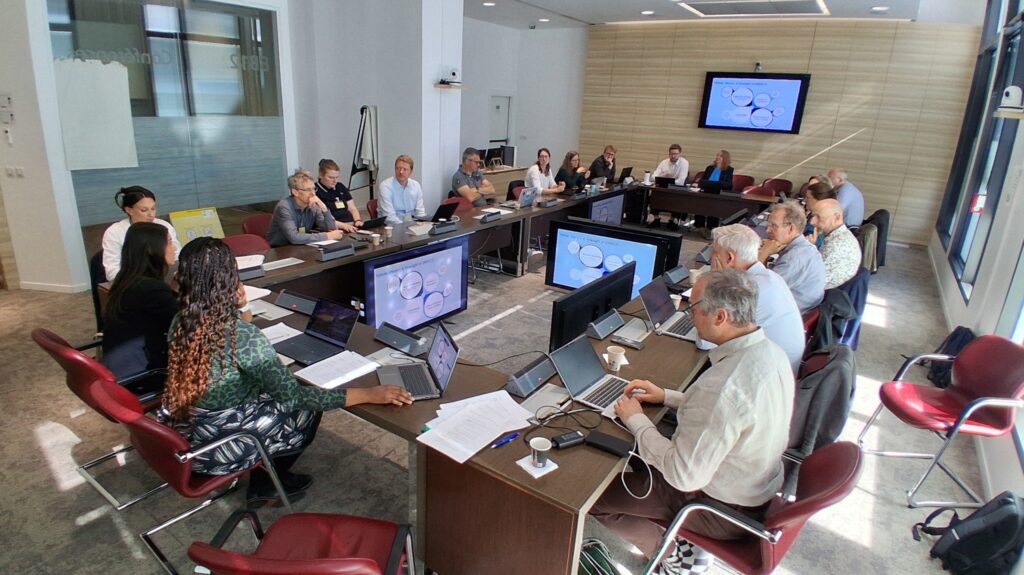
Cornelius Holtorf ran on 10 June 2026 a full-day workshop entitled “Futures Literacy Follow-Up Capacity-Building Session” which had been arranged for the international Expert Group on Archiving and Awareness Preservation (EGAAP) at the OECD’s Nuclear Energy Agency (NEA).
About 20 EGAAP members, representing Belgium, the Czech Republic, France, Germany, Norway, Sweden, Switzerland, and the U.K., participated in the workshop.
The workshop chose the so-called Key Information File (KIF) of repositories of nuclear waste as a concrete reference point for illustrating practical implications of the capability known as “futures literacy”. This capability was developed by UNESCO and during the workshop, the Organization was represented by Christine Kavazanjian.
One participant stated at the end that in his opinion, the KIF we design today would be entirely meaningless at the time of repository closure a minimum of ca 100 years ahead. What mattered was, however, the lessons learned during the process of designing it. Some such lessons were learned during the workshop today, e.g. about the need to take a broader range of possible futures and multiple truths about nuclear waste into account.
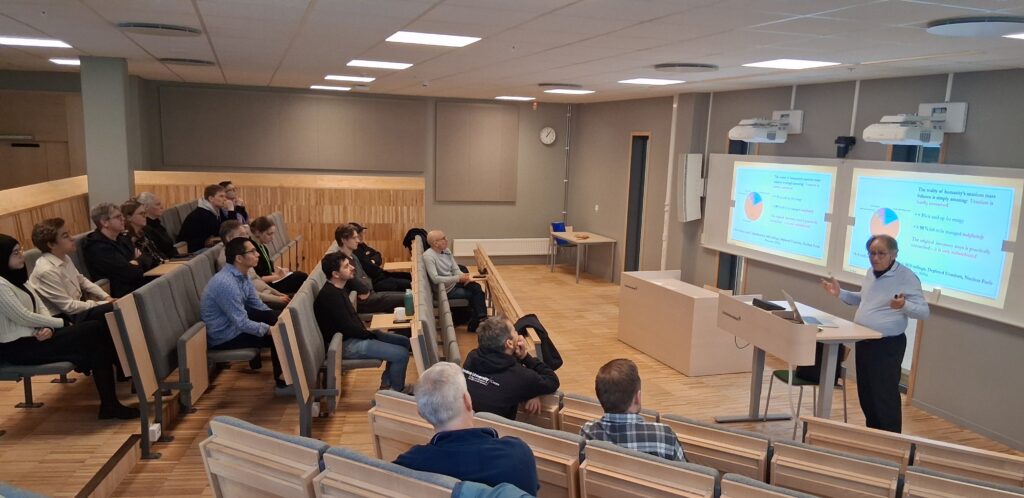
The title of his talk was “Humanity’s Uranium as a Planetary Liability – Its Chemical and Radiological Toxicity, Ecological Debt, and the Governance Gap.” Here is a 10-point summary:
Uranium in the Earth’s crust belongs to geology: dispersed, buffered, and governed by natural timescales.
Once extracted, it leaves geology and enters history — becoming part of human systems, decisions, and liabilities.
Less than 1% is fissioned for energy; more than 99% remains as a long-lived material stock.
Uranium is not consumed — it is redistributed into tailings, depleted uranium, fuels, and wastes.
Its decay chain regenerates over time, while the uranium parent remains essentially undepleted.
The hazard is therefore persistent, combining chemical mobility and radiological renewal.
Remediation can manage flux and exposure, but it does not erase the underlying inventory.
Dilution depends on finite environmental buffering capacity and cannot be a durable solution.
Long-term safety requires working with natural processes — containment, geochemical stability, and stewardship — rather than assuming closure against them.
A sustainability debate that ignores this enduring, mobilised uranium inventory rests on an incomplete material accounting.
Cornelius Holtorf was invited to present the 9th Annual Heritage Lecture at the Cambridge Heritage Research Centre, University of Cambridge, UK (20 February 2026). In front of an audience of 60+ students and researchers in cultural heritage he gave a lecture on decolonising the future. The lecture was recorded and can be watched here on Youtube.
Decolonising the Future: From Preserving Memory across Generations to Sustaining the (Re-)Generation of Memory
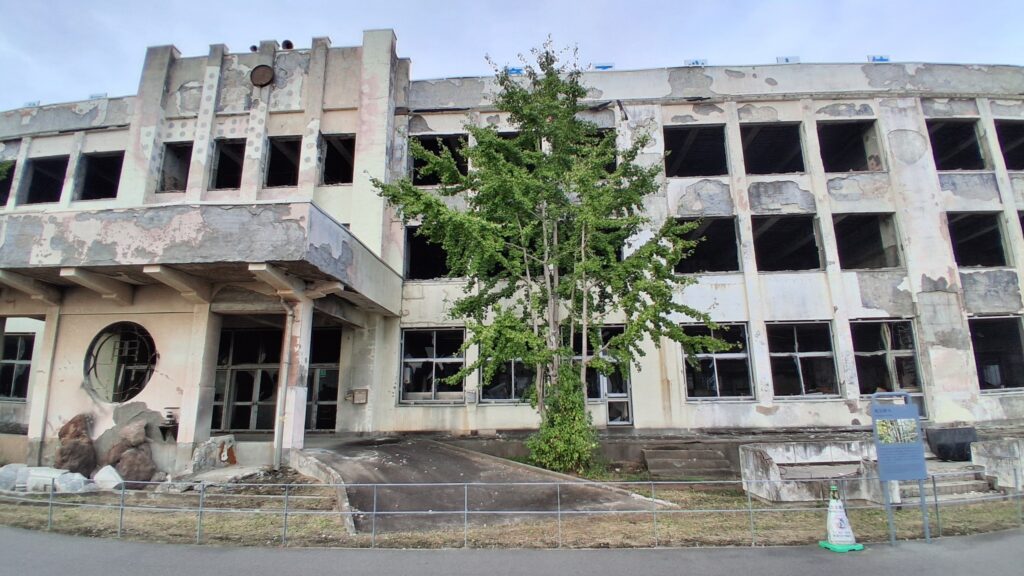
Resprouting tree in front of the Ishinomaki Kadonowaki Elementary School
The field of ‘heritage futures’ explores the roles cultural heritage plays in negotiating relations between present and future societies. In many contemporary contexts, cultural heritage is to be preserved explicitly for the benefit of future generations. Such efforts are typically grounded in the assumption that present-day values and narratives of heritage will be shared and appreciated in the future. The preservation of cultural heritage may indeed create benefits, much as a less polluted, better preserved, and more sustainable natural environment is likely to benefit those who come after us. Implicitly, we expect our preservation practices to ensure that we will be remembered as good ancestors.
Yet to what extent do the tangible and intangible legacies we leave behind constitute attempts to establish control over future human (and indeed some non-human) beings? Does heritage preservation inadvertently colonize those who will live in the future by imposing our present-day values and priorities upon them? If so, is this problematic in ways comparable to the colonisation of living peoples in the past, a legacy with which we are still grappling today? Do we therefore need to decolonize the future?
I address this challenge by asking how we might make sense of the past through memory in a world where the future is not what it used to be. Two case-studies will help me to explore what this shift may entail. Both concern forms of memory and heritage created in the present to benefit the future, and both relate to nuclear power, a domain that has long provoked existential questions about the future of humanity. First, I examine the memorialisation of the 3/11 disaster, following the major earthquake and tsunami that struck Japan’s northeastern coast in 2011 and led to the nuclear meltdowns at the Fukushima Daiichi Nuclear Power Plant. Second, I consider strategies designed to preserve awareness of nuclear waste repositories across many generations and for up to one million years.
In conclusion, I invite the audience to consider an alternative approach to heritage futures that may, in fact, reflect how memory has always functioned (because the future may never have been what it used to be). I propose moving away from present-day strategies aimed at transmitting memory unchanged across generations, towards an acceptance of continuous processes of (re-)generating memory and the changes this entails. My point is that it may not be the values we currently ascribe to heritage that endure over time, but rather the processes through which heritage is continually revalued. Can and should such a post-preservational approach contribute to decolonizing the future?
Uranium, heritage futures, and environmental assessment
When uranium is discussed, the conversation usually starts with risk: toxicity, radiation, standards, limits. But risk is not the beginning of the story.
Before uranium becomes a health concern, it becomes something else: ◻︎ a long-lived inheritance.
Heritage is whatever persists beyond us and must be dealt with by those who follow. Some of it is chosen. Much of it is not. Industrial societies, in particular, generate large amounts of unintentional material heritage: substances, residues, and infrastructures that remain active long after their usefulness — and often their caretakers — are gone. Uranium belongs squarely in that category.
Long before we calculate doses to people or compliance margins, uranium has already become a durable inheritance that future societies must manage. This is where heritage futures and environmental assessment intersect.
Why Risk Frameworks Matter — but Come Later
Because uranium persists, institutions attempt to manage it through risk frameworks.
Historically, these frameworks have made a clear division:
▸ uranium → treated mainly as a chemical toxicant ▸ radium → treated as the radiological concern
This separation is deeply embedded in regulations, monitoring programs, and safety assessments. It has also shaped how responsibility is understood and communicated across time. But it carries an implicit assumption:
▹ that radium, not uranium, controls radiological ingestion risk.
What the Research Shows
In my latest paper, published in Science of the Total Environment, I tested this assumption directly. Two key results emerge:
▸ Uranium is not radiologically negligible, even where international guideline values are fully respected.
▸ Dose delivery is controlled by mobility, and groundwater systems are typically charged far more with uranium than with radium.
In other words, although radium is more radiotoxic per decay, uranium often dominates radiological ingestion risk simply because there is much more of it dissolved in water.
Why This Matters for Heritage — Not Just Compliance
Seen through a heritage lens, this result has a deeper meaning. The continued use of radium as a universal proxy for uranium-related radiological risk is not just a technical shortcut. It is a legacy assumption, inherited from earlier regulatory cultures.
That assumption:
▸ fragments what is chemically and physically unified, ▸ hides part of the long-term burden, and ▸ narrows how responsibility is framed across generations.
Turning the Perspective Around
The main message is not that past frameworks were wrong. It is that the material heritage we have created no longer fits comfortably within them.
Uranium is not just the parent of radium in a decay chain. In water-mediated environments, it often becomes the parent of dose — and therefore of risk.
Recognizing this does not overturn radiological protection. It strengthens its internal coherence. And, more importantly, it clarifies what kind of heritage we are actually passing on — material, persistent, ethical, and administrative, and inescapably shared with the future.
Further Reading
C. Pescatore (2026). Integrating uranium radiological ingestion risk into environmental safety assessment alongside radium. Science of the Total Environment, 1011, 181055. https://doi.org/10.1016/j.scitotenv.2025.181055
Claudio Pescatore is a member of the UNESCO Chair on Heritage Futures at Linnaeus University
Claudio Pescatore explains why uranium’s chemical hazard is not a distant issue but a present debt — and why it will remain forever.
Not tomorrow, but today
When most people think of nuclear waste, they imagine glowing canisters buried in rock, hazards for a far-off future. The truth is different, and more unsettling. The greatest uranium problem is already with us now.
From the deserts of the American Southwest to abandoned mines in Central Asia, uranium residues contaminate soil, rivers, and aquifers. Communities live with the consequences today — kidney disease, unusable water.
Present-day scars
The Navajo Nation (U.S.) bears the legacy of Cold War uranium mining. Hundreds of abandoned mines and one out of four contaminated water-wells leave residents facing disproportionate health risks, needing endless cleanup.
Wismut (Germany), once the largest uranium mine outside the Soviet Union, has been under remediation since reunification. Billions of euros have been spent, yet groundwater plumes persist and treatment must continue indefinitely.
Mailuu-Suu (Kyrgyzstan), a former Soviet mining town, is home to dozens of unstable tailings piles above a river valley. Landslides and floods threaten to spread contamination widely.
UMTRA sites (U.S.), meant to stabilize mill tailings from past uranium production, continue to show uranium plumes exceeding drinking-water standards decades after closure.
These are not failures of engineering so much as reflections of uranium’s nature: a hazard that does not diminish on human timescales. Covers break, dams erode, pumps wear out. Each “remedy” is temporary, and each handoff pushes costs into the future.
We hardly use what we extract
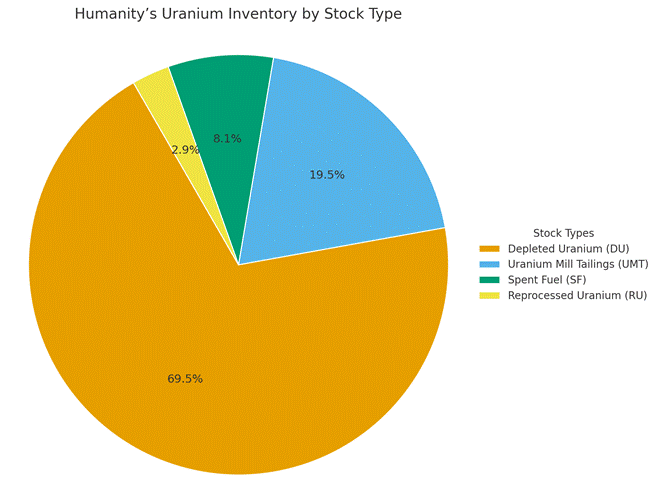
Of all uranium mined for the nuclear fuel cycle, less than 0.4% has been used in reactors. The other 99.6% remains as residues — mill tailings, depleted uranium, and reprocessed uranium (see Figure 1). Its inventory by stock type is shown in Figure 1. For each ton of Uranium is spent fuel, there will also exist an additional 9 tons as Depleted Uranium or Mill-tailings uranium.
Figure 1. Distribution of humanity’s uranium by stock type. Depleted uranium (≈69.5%) and uranium mill tailings (≈19.5%) dominate the global inventory, while spent fuel (≈8.1%) and reprocessed uranium (≈2.9%) make up the remainder.
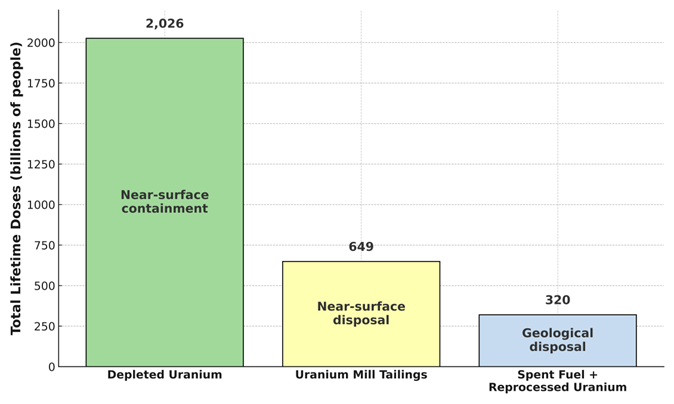
Figure 2 shows that the largest uranium stocks — DU and mill tailings — are exactly those left near the surface. In other words, the smaller share is given the world’s most advanced containment, while the larger share remains exposed. Put differently: a single metric ton of uranium represents hundreds of thousands of cubic meters of water needed for dilution, and millions of lifetime toxic doses. Multiplied by thousands of tons, the numbers are staggering.
Figure 2. A measure of the liability from managing uranium is the Total Lifetime Doses (TLD) indicator. Values associated with each stock represent the number of lifetime-equivalent chemo-toxic exposures, expressed in billions of people. As the largest stocks of uranium reside in Depleted Uranium and in Mill Tailings, there lies most of the uranium liability to the future. Yet they receive far less stringent containment.
A web of liabilities
Uranium’s hazard is not just technical. It is woven into a web of liabilities:
– Geographical liabilities: Uranium may be mined in one country, enriched in another, and its waste left in a third. Communities that never benefited from the electricity pay the price. The Navajo did not choose the bombs their ore fueled; Mailuu-Suu’s residents did not choose Soviet reactors.
– Temporal liabilities: Every cover or dam has a lifespan measured in decades or centuries. Uranium’s hazard lasts for billions of years. Each cycle of repair and neglect transfers liability to the next generation.
– Institutional liabilities: Regulators often focus on radium or radon, ignoring uranium itself. Mining laws may require closure plans but not perpetual stewardship. Health agencies emphasize chemical toxicity, while nuclear agencies emphasize radiation. No one body takes full responsibility.
The result is a system that allows uranium to slip through the cracks, its hazard passed along invisibly until it reemerges as a plume, a lawsuit, or an abandoned site.
Externalization of uranium costs
Uranium’s spread dismantles the idea of nuclear energy as “clean.” Yes, reactors emit little carbon dioxide. But the residue they generate — and the residues left by mining and enrichment — are anything but clean. Calling nuclear clean externalizes uranium’s costs onto:
– future generations, who will inherit broken dams and leaking piles; – local communities, often Indigenous or marginalized, who live with toxic water and unsafe lands; – other geographies, as uranium mined elsewhere, in Africa, Asia, Australia, Europe and North America leaves residues that outlast states and borders.
Nuclear power may be low-carbon, but when uranium’s chemical liability is ignored, it is not low-cost, low-risk, or clean.
As an example, countries like Finland or Sweden that only have spent fuel still carry an indirect liability ten times as large in terms of Total Lifetime Doses and Dilution Liability. This stems from the additional uranium mill tailings and depleted uranium left to others to manage. Unlike spent fuel, these vast residues remain in shallow sites, piles, or surface storage — often in jurisdictions with lower environmental standards and certainly facing the endless remediation that surface storage entails.
Toward accountability: a Uranium Liability Convention
How do we begin to govern such a debt? One step is recognition: uranium is the parent hazard. It should not be masked by proxies like radium or radon.
But recognition is not enough. Uranium is traded globally, yet its liabilities are stranded locally. This calls for a Uranium Liability Convention (ULC) — a framework to:
– Map liabilities: track where uranium has been mined, processed, stored, and abandoned. – Assign responsibility: link benefits and burdens so costs cannot be endlessly shifted. – Set binding obligations: require durable containment, including deep disposal for depleted uranium. – Integrate health and environment: recognize both chemical and radiological hazards.
Such a convention would not be a technical fix. It would be a moral and political acknowledgment that uranium’s hazard cannot be wished away, and that accountability must match the timescales of the debt.
What this means in human terms
– For communities now: remediation cannot be partial. The Navajo, Mailuu-Suu, Wismut, and countless others need more than fences and promises. They need durable remedies that reduce exposure and stop passing costs to their children.
– For nuclear debates: sustainability claims must account for uranium’s unresolved debt. Low-carbon is not clean when its waste contaminates forever.
– For future generations: memory and containment must last longer than institutions usually plan for. Passing the burden on is not stewardship; it is abandonment.
Takeaway
The uranium hazard is not a future scenario. It is present contamination, future inevitability, and permanent liability.
It is a web that links countries, generations, and institutions. And unless we confront it honestly — by recognizing uranium itself, containing it durably, and sharing responsibility globally — that web will only tighten.
Uranium is not just fuel or waste. It is an environmental debt. The question is whether we will keep externalizing it, or whether we will finally take responsibility for paying it down.
Further reading
– Claudio Pescatore (2025). Humanity’s Uranium Inventory: A Persistent Chemical and Ecotoxicological Liability. Energy Research & Social Science 127 (2025) 104298 in open access
Claudio Pescatore is a member of the UNESCO Chair on Heritage Futures at Linnaeus University
Heritage Futures: Archaeological Insights for the Long-term Management of Radioactive Waste
Cornelius Holtorf, UNESCO Chair on Heritage Futures, Linnaeus University
Managing radioactive waste is a challenge that extends across many generations, requiring long-term safety measures. Archaeologists, like myself, are familiar with time scales of thousands of years as we seek to understand the distant past. A key part of our work involves questioning assumptions rooted in the present and learning to imagine past worlds that were vastly different from today. This is very difficult, but only after doing so can we draw meaningful insights from the past to inform the present. The same principles should apply when communicating information, knowledge, and guidance about radioactive waste repositories to societies of distant futures. This calls for a strengthened capacity in ‘futures literacy,’ a concept developed and promoted by UNESCO.
Futures literacy consists of three core dimensions: 1. Becoming aware of the assumptions we hold about the future, 2. Learning to imagine multiple alternative futures, and 3. Reframing the original issue and developing new strategies to address it.
In this paper, I explore this argument and discuss its implications for a long-term, safe and responsible management of radioactive waste. The paper is based on extensive research conducted by the UNESCO Chair on Heritage Futures at Linnaeus University in Kalmar, Sweden. The research has been carried out in collaboration with the radioactive waste sector in Sweden and internationally, including through participation in several expert groups of the NEA.
From the conference blurb (shortened): radioactive waste is produced in all phases of the nuclear fuel cycle and from the use of radioactive materials in industrial, medical, defence and research applications. After creation and use, many countries have a policy of interim storage, followed by permanent disposal underground in engineered repositories located in suitable geological formations. Significant quantities of data and information are generated throughout this lifecycle with many countries now exploring the concept of a digital safety case. The operational period of nuclear generation facilities often covers several decades, while disposal facilities are designed to operate for even longer. This raises significant challenges as these timeframes span multiple generations of workers and are likely to see many changes in policy and technology. Moreover, even after disposal, there is now a consensus on the importance of adopting strategies to preserve awareness of waste and disposal facility for long periods of time. The NEA Working Party on Information, Data and Knowledge Management (WP-IDKM) [to which Anders Högberg and Cornelius Holtorf belong] aims to co-ordinate these activities in a more holistic way, considering cross-disciplinary approaches and cognizant of all timescales of the information cycle.
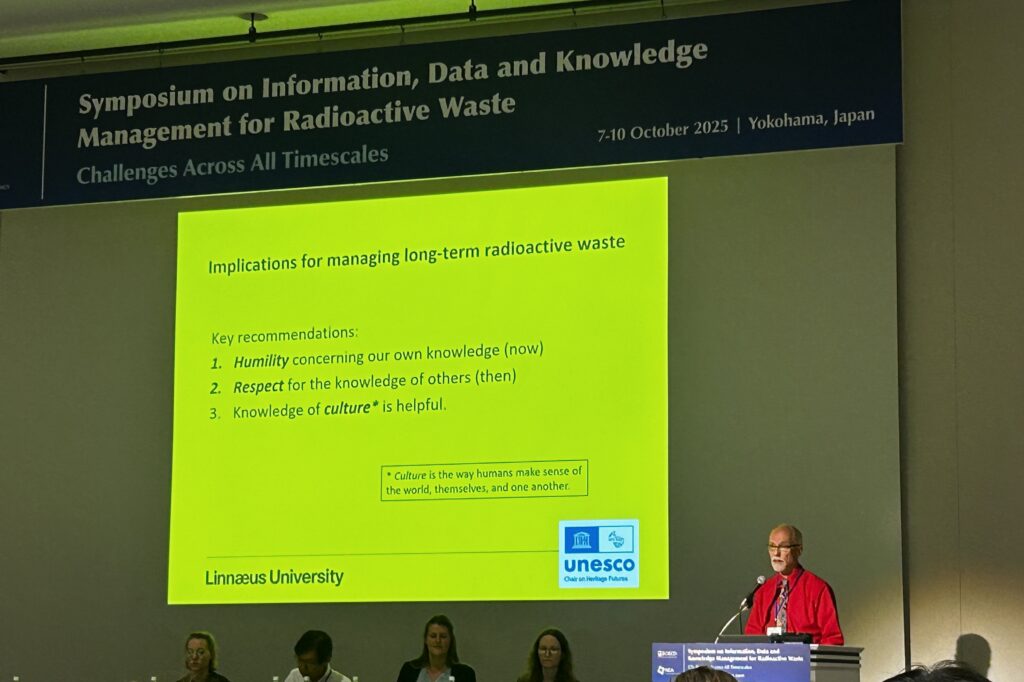
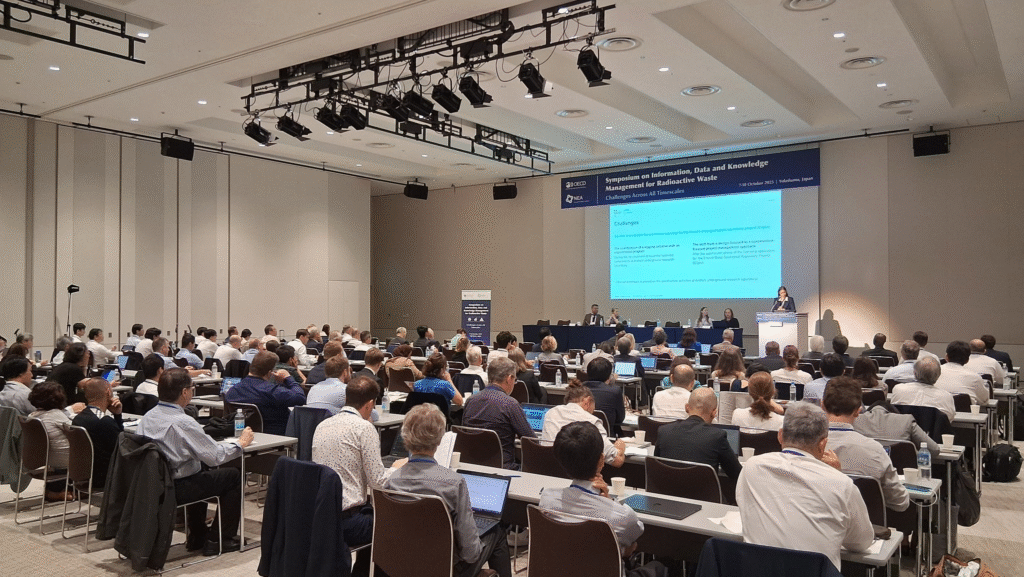
The conference addressed “Challenges Across All Timescales”, from imminent expert retirement to one million years and more in the future. This is about Heritage Futures for real!
I presented the following paper:
Heritage Futures: Archaeological Insights for the Long-term Management of Radioactive Waste
Managing radioactive waste is a challenge that extends across many generations, requiring long-term safety measures. Archaeologists, like myself, are familiar with time scales of thousands of years as we seek to understand the distant past. A key part of our work involves questioning assumptions rooted in the present and learning to imagine past worlds that were vastly different from today. This is very difficult, but only after doing so can we draw meaningful insights from the past to inform the present. The same principles should apply when communicating information, knowledge, and guidance about radioactive waste repositories to societies of distant futures. This calls for a strengthened capacity in futures literacy,’ a concept developed and promoted by UNESCO. Futures literacy consists of three core dimensions: 1. Becoming aware of the assumptions we hold about the future, 2. Learning to imagine multiple alternative futures, and 3. Reframing the original issue and developing new strategies to address it. In this paper, I explore this argument and discuss its implications for a long-term, safe and responsible management of radioactive waste. The paper is based on extensive research conducted by the UNESCO Chair on Heritage Futures at Linnaeus University in Kalmar, Sweden. The research has been carried out in collaboration with the radioactive waste sector in Sweden and internationally, including through participation in several expert groups of the NEA.
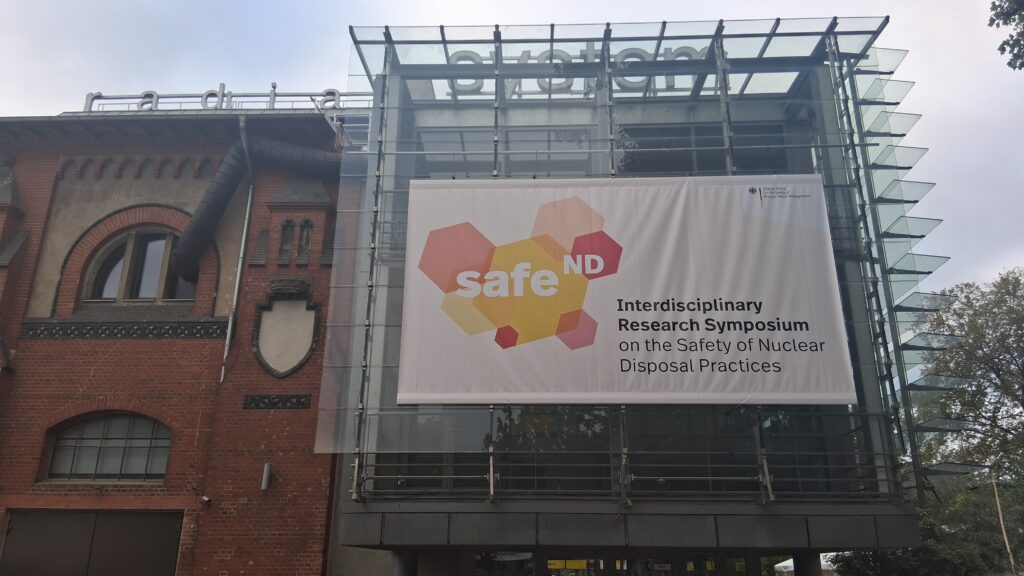
The overall theme was “Time as a safety factor: opportunities and challenges of timely nuclear waste disposal“. It quickly became clear that this focus was inspired by the perceived need to accelerate the decision-making process to identify the site location for Germany’s repository of high-level nuclear waste. But the topics discussed during the symposium were much wider and covered perspectives from many different disciplines bringing up a wide range of issues, not the least the issue of radioactive waste resulting from uranium mining that has not always been formally included into the discussions of nuclear waste. Claudio Pescatore led a workshop on this latter topic, based on his recent research.
One highlight was the keynote lecture by Andrew Stirling, University of Sussex and formally a Board Member of Greenpeace. It turned out he was originally an archaeologist! He also made a powerful argument suggesting that the objective of finding “the best possible” solution for safe nuclear waste disposal, which the German legislation requires, misses the question whether “the best possible” solution can ultimately be satisfactory.
In my talk (in front of cirka 50 participants), I adopted this question asking whether what many think is “the best possible” way to plan for uncertain future needs is ultimately satisfactory. My point was that taking a cultural perspective linked to the capability of futures literacy can get us further…
Nuclear waste disposal is not only about physical time, safety, technology and social and political acceptance but it is also about long-term thinking, embracing cultural change, and human values and identities that are shifting over time.
Holtorf, C.: Sustainability and long-term processes: a cultural perspective, Third interdisciplinary research symposium on the safety of nuclear disposal practices, Berlin, Germany, 17–19 Sep 2025, safeND2025-6, https://doi.org/10.5194/safend2025-6, 2025.
ABSTRACT
Culture is about how people make sense of the world, of each other, and of themselves. It is diverse in scale, across space, and over time. By implication, expertise on the world, its inhabitants, and ourselves is culturally relative. Indeed, culture is often about managing difference: different ideas, different people, different languages.
Applied to the need to sustain a body of knowledge and guidance for action over the long term, a cultural approach will (have to) embrace the need to adapt to cultural changes and developments. All this means that regarding nuclear waste, what we are tasked with today is transferring to future generations, who will be living in their own cultural contexts, knowledge and guidance for action that will make sense to them, not to us. Proposed messages that lack futures literacy merely perpetuate our own frameworks of meaning and eventually become irrelevant and unsustainable. There are thus good reasons why they say that nothing ages faster than the future, and nothing is more difficult to predict than the past. In this paper, I will discuss some implications of this theoretical argument for geological disposal of radioactive waste.
Claudio Pescatore explains why high-level waste still needs shields—and memory beyond a million years:
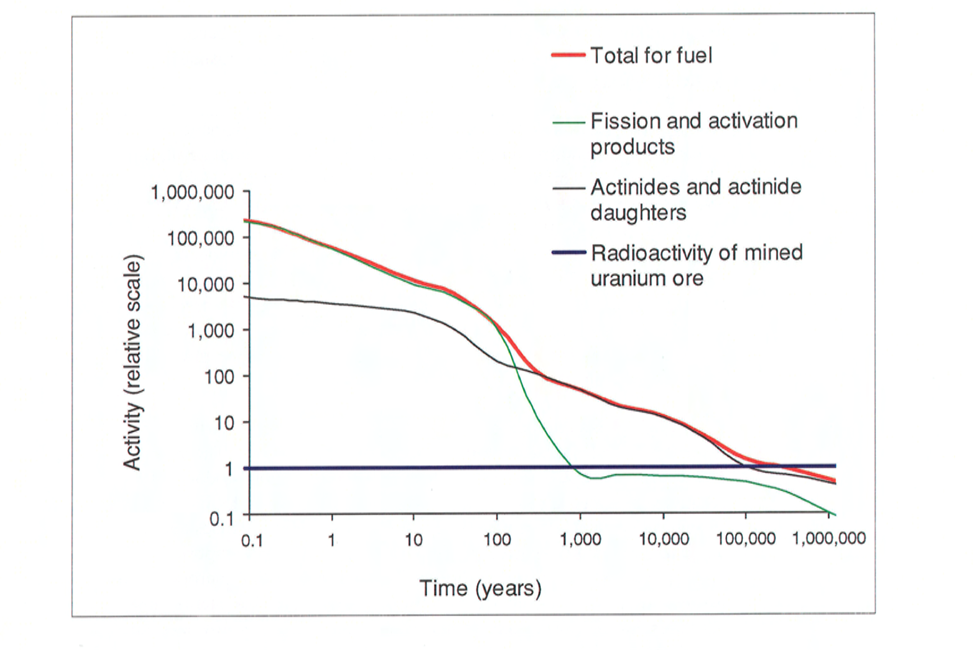
When it comes to high-level waste repositories, the old reassurance — “radioactivity falls back close to or below natural levels” — is misleading. Yes, if you total up all the radioactivity in a repository and compare it to the original ore, the sum may look modest after ten to a hundred thousand years, depending on waste type. But people (and animals) don’t meet sums. They meet things: individual containers, cores, and fragments that concentrate radioactivity. What matters—ethically and practically—is the radiation dose at the surface of each piece as time rolls on.
Total radioactivity vs original uranium ore in Swedish spent fuel. (Report SKB-TR-97-13)
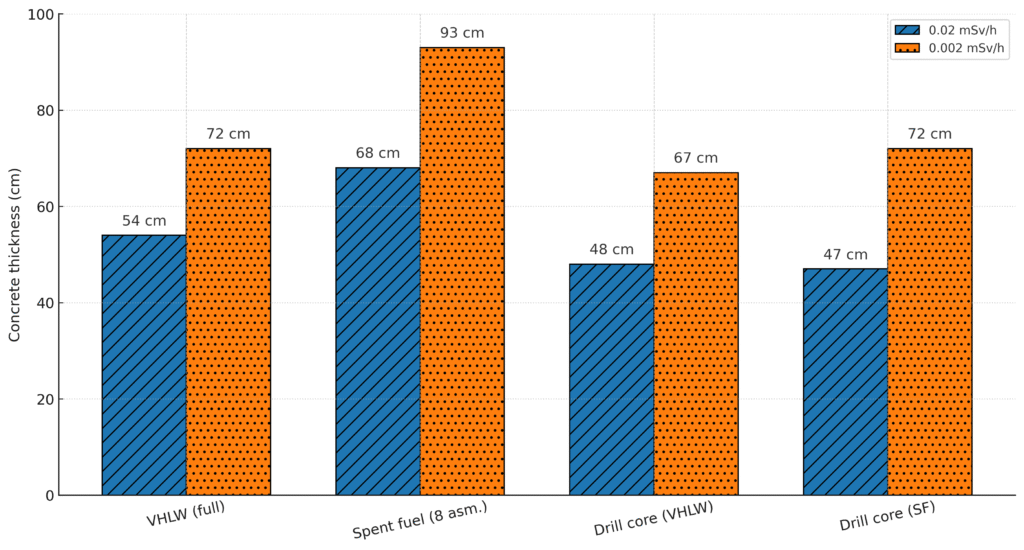
A new paper looks squarely at that reality. Rather than only computing dose, a concept for radiation specialists, it asks a tangible question: how thick must a shield be to meet modern radiation protection limit not just now, but at one million years and beyond? Using concrete as the reference, the answer comes in units anyone can picture: roughly 50–90 cmat a million years, depending on the waste and the protection target.
At one million years (and ignoring any container):
Spent fuel (SF) requires about 67–93 cm of concrete for a representative multi-ton package
Vitrified high-level waste(VHLW) requires about 53–72 cm of concrete for a full-size cylinder.
Beyond one million years, uranium-238 — lasting billions of years — makes the shielding requirement essentially constant: without containers, concrete thicknesses range from 7–42 cm for vitrified-waste cylinders and 62–87 cm for spent fuel.
Smaller isn’t safer. Even drill cores (say, 40 cm tall by 10 cm wide) or fragments still need shielding on the same order, because near-surface dose depends on what’s inside, not the item’s size. At a million years, unshielded drill cores still translate into about48–67 cm of required concrete for vitrified waste and about46–72 cm for spent fuel.
Scale matters. Numbers per item are only half the story. Program scale multiplies these requirements: for example, Sweden plans roughly 6,000 spent‑fuel canisters. In France, there will be more than 50,000 vitrified-waste cylinders.
Concrete shielding thickness at one million years for spent fuel (full canister and drill core) and vitrified high-level waste (full cylinder and drill core). Results are shown for two protection targets: 0.02 mSv/h (brief, one-hour exposure) and 0.002 mSv/h (background-like)—ballpark in the absence of project-specific requirements
What this means in human terms
Heritage, not waste alone. If descendants encounter these materials—by curiosity, drilling, erosion, or chance—they won’t face a vanishing hazard but an enduring one, beyond legal timeframes and planning horizons. Our commitment to protect future people “to levels comparable to today” becomes concrete—literally—in centimeters of real shielding.
Justice and foresight. Thinking “per item” reframes responsibility. Are we designing containers—and contingencies—that keep each piece safe, including broken pieces? The ambition is that we should.
Design humility. Landscapes move; encounters may occur. The ethical stance is not to promise a perfect fortress forever, but to equip future people with buffers that still work: robust, intelligible, possibly maintainable shields—and the memory provisions (institutional handovers, markers, archives, time capsules) to keep that knowledge alive. Also, acknowledge that these wastes never become harmless.
So what now?
Build for fragments. Don’t just model intact packages; assume cores, partial breaches, and erosion-revealed segments—and assign them shielding, too.
Specify the long-lived drivers. Make a standard reporting of the deep-time isotopic loadings, because they determine both the danger and the shield.
Design the message with the material. If safety demands 50–90 cm at a million years, our markings and archives should be designed to last—and be rediscoverable—on comparable horizons. Or that should be the ambition.
Expand the lens. Apply similar analyses to other long-lived wastes that carry significant uranium-238 loadings.
Takeaway: this isn’t a new fear; it’s a clearer ethic. We owe the future not only sealed vaults and clever signs, but credible buffers—thicknesses you can measure with a ruler—matched to how matter behaves over time. The shield is not a metaphor; it’s a promise we can make, and keep.
Further reading
Claudio Pescatore, Beyond a million years: Robust radiation shielding for high-level waste Nukleonika, 70(3): 87-93.
What if the true monuments of the nuclear age are not vaults, vitrified blocks, or warning markers—but fields of invisible light?
Gamma radiation is insidious. It leaves no ruin, no ash, no wound you can see. You don’t need to touch it. You don’t need to breathe it in. You simply pass by—and it passes into you. No trace is left on the soil. But a trace is left in you. And when the next person passes, they too receive the signal. Yet the source remains—unchanged, unweakened.
Most poisons are spent as they harm. Gamma radiation is not. It accumulates elsewhere, silently, without diminishing its source. A kind of ambient inheritance.
In a recent study, I calculated the gamma radiation field unleashed by humanity’s Uranium-238 (U-238) legacy. The results show that this field is not temporary. It is already present, slow to mature, but geologically assured and radiologically significant, beyond safety thresholds.
Mill tailings scattered across continents emit gamma radiation through uranium’s progeny. This signal will slowly fade over the next half a million years—but it will reach a baseline, unsafe value and will continue indefinitely.
Meanwhile, depleted uranium stockpiles—which emit almost no gamma today—are quietly maturing. From a few thousand years onward, their gamma output will rise steadily, eventually overtaking significantly that of tailings, peaking in two million years, and continuing unabated into geological time.
Most U-238 residues lie close to the surface—mill tailings, depleted uranium (DU) stockpiles, weapons testing sites, contaminated soils from mining and from exploded DU munitions. Even when their radiation does not cause immediate harm, it defines a long-term environmental signal whose meaning we have barely begun to grasp.
This raises questions not only of science, but of ethics, inheritance, and imagination:
What does it mean to leave behind a hazard that grows in potency over time?
How do we warn future beings of a danger concealed in ordinary soil or dust?
Should gamma radiation be seen not only as threat, but also as a marker of human agency?
Nuclear waste lasts a long time. But U-238 isn’t just persistent—it performs. It changes. It regenerates. It returns. And surprisingly, we don’t call it waste. We call it an industrial by-product.
And now we are not just leaving behind a signal—we are leaving a body.
About 4.5 million tonnes of U-238, mostly in oxide form, now reside in uranium tailings, DU, and spent fuel. It is a real, physical legacy—not symbolic, not speculative. This body must be put away—not forgotten, but deliberately placed and traced. Shielded, marked, and remembered.
We can still act. We can treat uranium’s gamma legacy not as an afterthought, but as a defining part of our industrial inheritance. This won’t undo the past—but it may shape how future generations understand what we’ve left them.
We often speak of the nuclear age as bracketed—confined by Cold War dates or the operational lifespan of reactors. But its material consequences are just beginning. Care begins by acknowledging and tending to what endures.
Claudio Pescatore is a member of the UNESCO Chair on Heritage Futures at Linnaeus University


[…] The new funding for this and a number of additional smaller projects, means that the Climate Heritage Network is…
[…] Chair on Heritage Futures « Culture, cultural heritage and COP26 […]
[…] mer på Unescoprofessurens blogg http://blogg.lnu.se/unesco/?p=1061 Besök Öland 2050! […]