A new publication focusing on the value of Foresight in heritage was just published with Gustav Wollentz from the UNESCO Chair on Heritage Futures as a co-author. The article is named “Foresight in heritage: fostering future consciousness to proactively face change”, by Hana Morel, myself, Sarah Forgesson, Amy Iwasaki and Alison Heritage.
It is the first academic publication coming out from our engagement with ICCROM’s Strategic Foresight initiative, which has been piloting Foresight in heritage on a global level. It is a collaboration that is important since very little has been done in this area, and so much remains to be done.
The paper introduces Foresight as a structured approach that is increasingly employed across industries and disciplines for anticipating future change and proposes its utility for the heritage sector. We illustrate how integrating greater Foresight into heritage practice can encourage proactive engagement with emerging trends; develop resilient strategies for heritage research, planning and management; and locate where heritage-based actions can bring transformative change.
Morel H, Wollentz G, Forgesson S, Iwasaki A, Heritage A (2025;), “Foresight in heritage: fostering future consciousness to proactively face change”. Journal of Cultural Heritage Management and Sustainable Development, Vol. ahead-of-print No. ahead-of-print. https://doi.org/10.1108/JCHMSD-12-2024-0298
Compiled by Helena Rydén, Assistant to the UNESCO Chair on Heritage Futures at Linnaeus University.
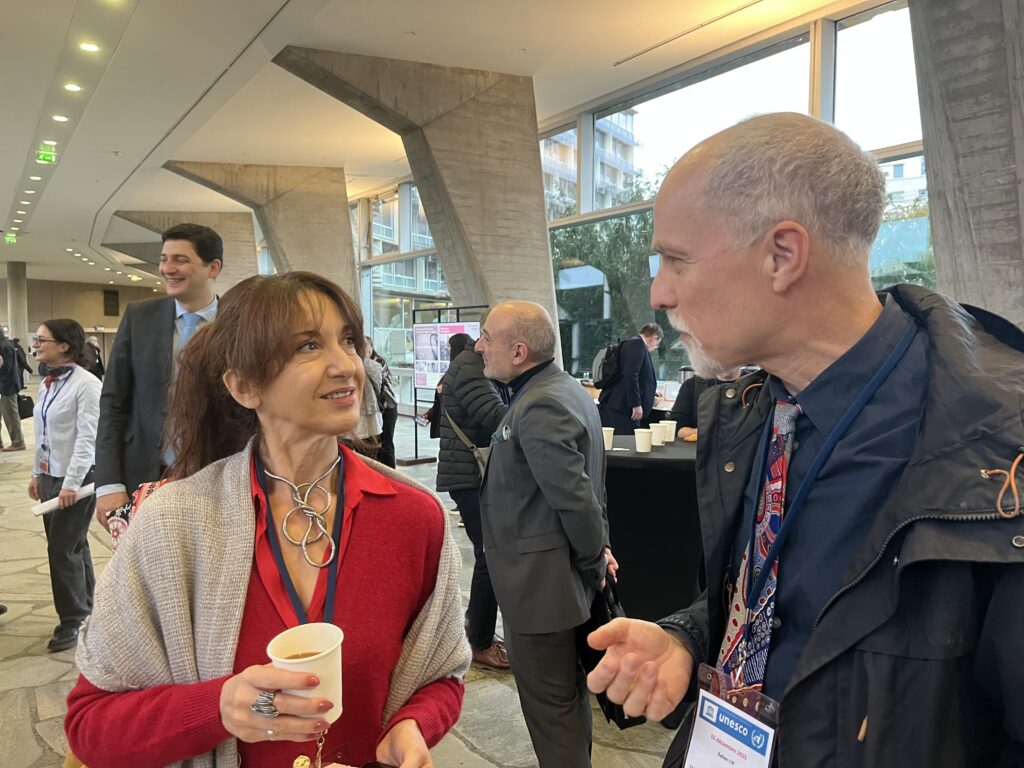
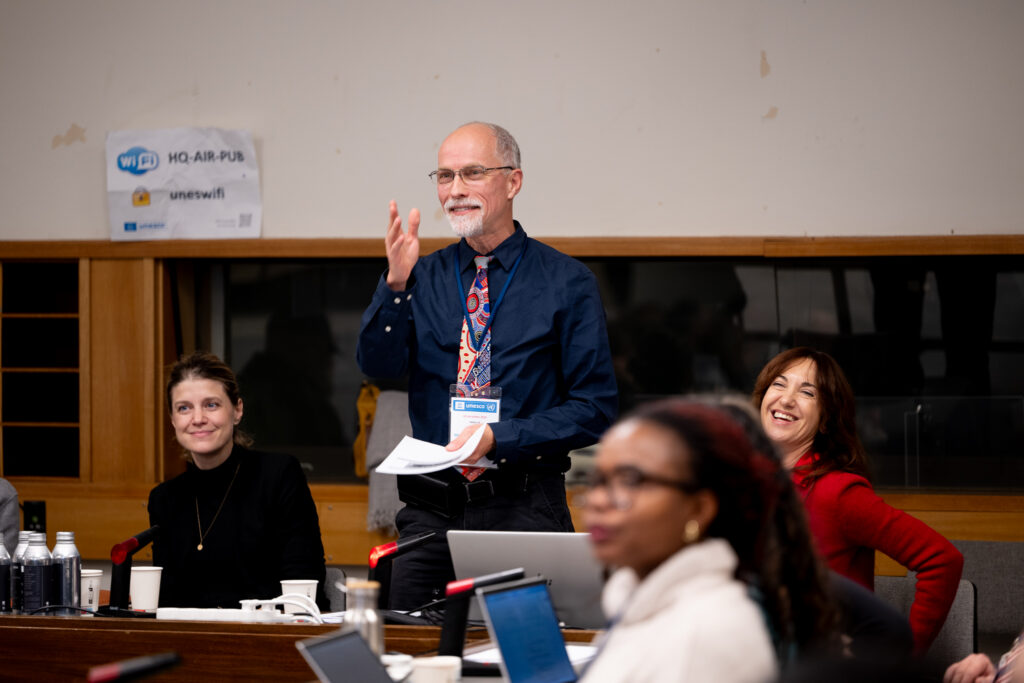
World Futures Day (WFD) on 2 December 2025 explored the theme “Anticipation in an Era of Volatility” at UNESCO Headquarters in Paris. One of the highlights was the afternoon futures workshop, “Crisis Preparedness and Beyond: Future-Making Through Culture and Heritage,” where Vicky Karaiskou and Cornelius Holtorf—both UNESCO Chairs—engaged a large (ca 50) and enthusiastic audience.
Vicky Karaiskou and Cornelius Holtorf at UNESCO HQ in Paris 2 December 2025 preparing for the afternoon session.
After statements by UNESCO, the European Commission and CrisisReady*, Vicky and Cornelius took the lead and guided us through the workshop. Both are deeply interested in the culture and values that shape us as human beings—Vicky focusing on the visual dimension.
Vicky Karaiskou explains: “I explore the profound implications of cultural visual narratives, shedding light on how they shape our individual and collective memory, as well as societal perceptions. Visuality examines the origins of our perceptions and assumptions because they deeply influence how we perceive the present, how we engage with the past, and how we envision the future.”
Cornelius Holtorf describes: “Heritage Futures are concerned with the roles of heritage in managing the relations between present and future societies, e.g. through anticipation, planning, and prefiguration.”
The workshop was truly engaging. We began by discussing what forms a collective identity: Who are we? How do culture and heritage make people who they are? Language, food, family and education were among the ideas raised. Next, we reflected on how our collective identities are relevant or affected in an anticipated crisis? We agreed that care—both as a human trait and as something that must be learned—was essential. Finally, we were asked to imagine future scenarios on how our collective identities could be used for crisis prevention, resolution, and recovery in the future?
The goal was to help us focus on the origins of our perspectives and assumptions, which deeply impact how we envision the future. Our group envisioned a natural disaster scenario where our collective identity, empathy, emotions, and local context were crucial for decision-making.
If the aim was to foster empathy, inspire positive change, and promote inclusiveness and social resilience for an equitable future, the workshop certainly succeeded. By envisioning the future beyond the uncertainty of the unknown, we learned how to mobilize and stimulate inspiring thinking, feeling, and acting—unlocking new ideas for creative solutions.
Several participants said this workshop was the highlight of the day, and some even asked to exchange contact details with us, expressing interest in visiting the Chairs for a period.
The UK National Commission for UNESCO has introduced a new Climate Action and Sustainability Framework alongside a Research Agenda, designed to leverage UNESCO sites as living laboratories for climate resilience and sustainable futures.
The publications align closely with the ARCHE (Alliance for Research on Cultural Heritage in Europe) Strategic Research and Innovation Agenda, the emerging Horizon Europe Resilient Cultural Heritage Partnership, and UNESCO’s global priorities on climate, culture, and sustainable development. They provide a ready-made platform for UK and international partners to collaborate on transdisciplinary research, Living Labs, open data infrastructures, and evidence-based policy.
Sarah May, affiliated with the Chair, serves as Co-Director at ButCH and is an active member of the UKNC Research & Innovation Group.
ButCH stands for Bureau for the Contemporary and Historic.
It is an organization involved in UNESCO-related climate and heritage research, and in this context, ButCH helps convene and manage the activities of the UKNC Research & Innovation Group, focusing on developing and delivering strategic research agendas around climate resilience and cultural heritage.
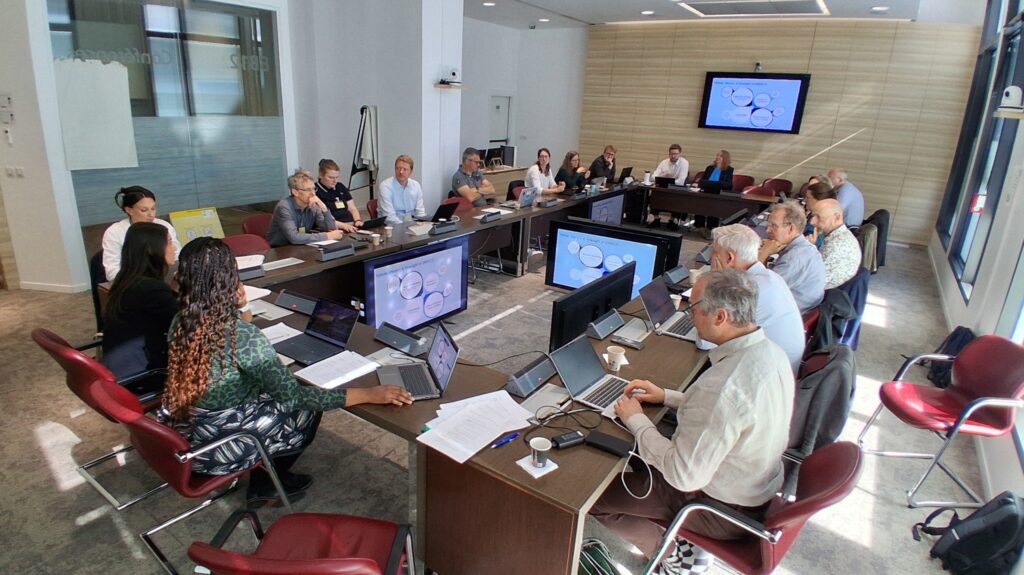
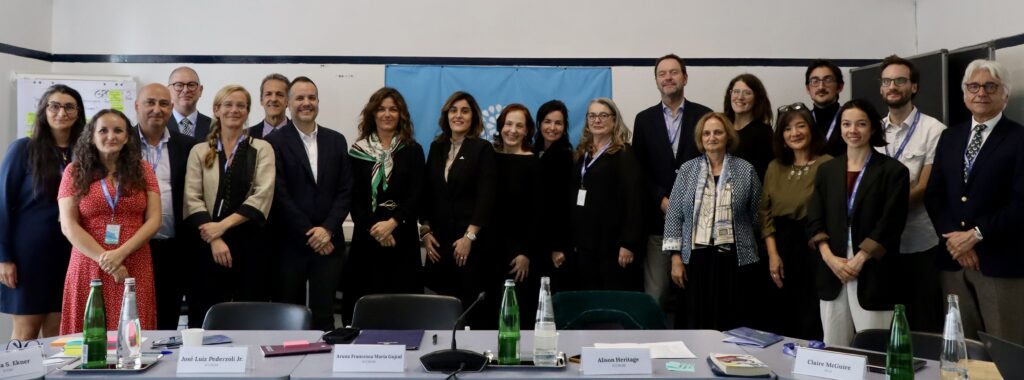
On the 16th of October 2025 ICCROM organized a workshop on Strategic Foresight in Heritage taking place in Rome, titled Anticipating Change: Exploring Long-term Futures for Heritage. The purpose of the workshop was to found a community for practice surrounding Strategic Foresight in heritage, to build resilience, relevance and agency among heritage organisations in the face of uncertainty and change.
Gustav Wollentz from the UNESCO Chair on Heritage Futures assisted in the organisation and facilitation of the workshop, contributing with a presentation on the value of Strategic Foresight in heritage and moderating parts of the agenda, which included both a hands-on Foresight exercise, the Futures Wheel, as well as a discussion on how to move forward together.
The goals of the newly established group are to:
Connect and amplify foresight and innovation efforts across the heritage sector.
Co-developing and testing foresight methods in real-world heritage contexts.
Building an open repository of trends, tools, and insights tailored to the sector’s needs.
Together vid ICCROM, the workshop gathered representatives from the International Council on Archives, ICOM (International Council of Museums), IFLA (International Federation of Library Associations and Institutions), NEMO (Network of European Museum Organizations), UNESCO, the French Ministry of Culture, the Swedish National Heritage Board, the Heritage Alliance, UK, the Fondation des Sciences du Patrimoine, France, the Getty Foundation, USA, and University College London, UK.
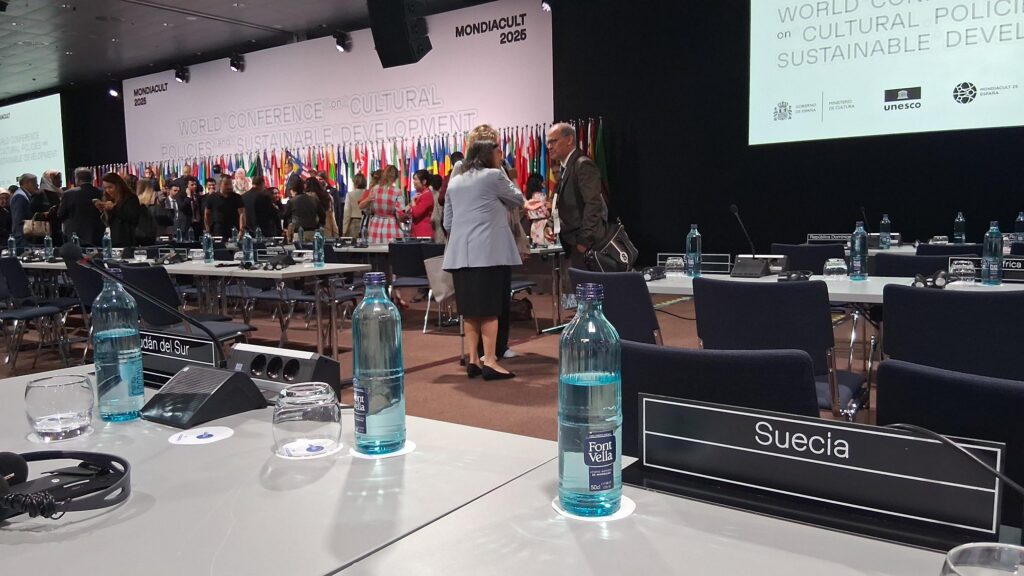
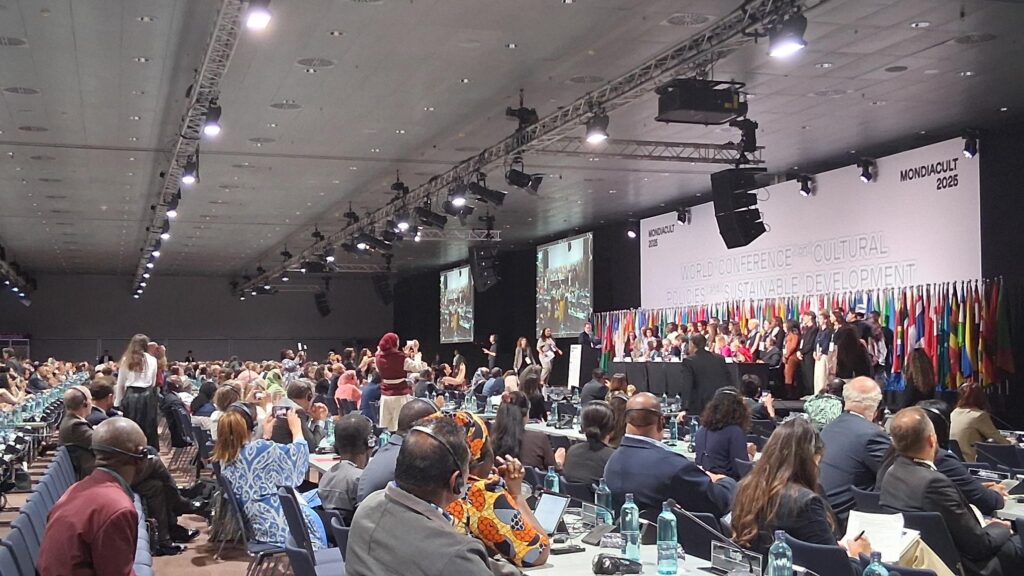
MONDIACULT – UNESCO’s World Conference on Cultural Policies and Sustainable Development took place in Barcelona (29 Sept-1 Oct 2025). UNESCO is the United Nations organization that promotes cooperation in education, science, culture and communication to foster peace, security and sustainable development worldwide. “Culture of Peace” has long been one of UNESCO’s most memorable concepts.
With this in mind, it was surprising that at MONDIACULT there were Ministers of Culture that emphasized culture as the soul of a country and an expression of national freedom, the need for cultural preparedness in the face of military threats, and cultural policy as a form of survival, security and defence strategy, not the least because foreign forces are known to attack first the cultural fabric that binds societies together.
Such language is very different from the general commitment of all states not only to UNESCO as such, including its Culture of Peace programme, but also to cultural rights as a part of global human rights. The logic of war must not trump culture. As Alexandra Xanthaki, the UN Special Rapporteur for Cultural Rights, emphasized several times during the conference, cultural rights are about the rights of individuals and groups: they oblige states to implement the rights of minorities, marginalized people and migrants, among others, not to foster or support majority state culture. I would add that culture should not be what sustains people when everything else is taken away from them, but what prevents states or anybody from taking away everything from anyone in the first place.
Similarly surprising to me was that some of the discussions were still about protecting and preserving cultural heritage or returning it to their rightful owners. This is a perspective of culture as a valuable resource and property, something you don’t want to be deprived of as that would mean, according to some, that you lost your “heartbeat” and your past. This is a familiar view that is sometimes also taken regarding cultural heritage. But it chimes poorly with the many statements we heard during the conference that culture is primarily about our common humanity. Indeed, UNESCO’s very constitution from 1945 discusses culture in the context of a general human (and not the nations’) dignity.
There is one additional aspect to this. When some policy makers declared in Barcelona that culture must be safeguarded because “culture is who we are”, I partly disagree. In many respects, the world is not in a good state because of who we were, and are. Culture is also about who we would like to be, or perhaps become, as human beings on our shared planet. That is why it was disappointing to see that MONDIACULT 2025 did not take up the spirit of the 2024 United Nations Summit of the Future and improve on the recognition of culture in the Pact for the Future.
Today, humanity is at a time of profound global transformation, requiring us to change course so that we do not risk tipping into a future of persistent crisis and breakdown. But what exactly does this mean for cultural heritage which is the way in which we today recall the past? After all, as the Spanish Minister of Culture had it at MONDIACULT, “culture is where all changes begin” – it is about transformation, innovation and creativity. In other words, the question is not how to safeguard culture and heritage ahead of threats that may be anticipated in an uncertain future. One key question is rather how we make sense of the past in a world where the future is not what it used to be (as Marek Tamm once wrote). Culture has some of the answers: long-term thinking, embracing change, and understanding what it means to be human.
Finally, what is the way forward? Senior decision-makers emphasized on several occasions the need of evidence-based policy and the benefits of culture for meeting indicators of environmental, economic, and social development as well as for fostering national identities and even as an asset for national defence. But this does not fit very well to Pedro Sanchez, Prime Minister of Spain, declaring in his Opening Speech that “culture invites us to dream”. Similarly, Octavio Paz was quoted as saying that the world is a projection of our images and, one might add, of our narratives and worldviews. Others talked in this context about a holistic perspective we need to take—one that not the least integrates culture and nature. According to that view, we do not benefit from culture when it is part of a fragmented and siloed view of the world, sought to be instrumentalized for various purposes, and regularly assessed for its value, in particular its contribution to gross domestic product (GDP).
Instead, the kind of culture that gives us hope in the present time is what provides happiness and wellbeing for people. That is why we need to develop and implement measures of progress for human work that go beyond GDP. Culture can be the place where such change begins.
Cornelius Holtorf, UNESCO Chair on Heritage Futures, Linnaeus University, Kalmar, Sweden
Both events provided many opportunities to learn about current developments in global cultural policy and also to talk to other UNESCO Chairs, senior politicians, policy makers, and representatives of NGOs about various dimensions of heritage futures.
MONDIACULT attracted more than 100 Ministers of Culture and overall more than 1,200 participants from around the world.
Highlights included several brilliant presentations by Alexandra Xanthaki, the UN Special Rapporteur for Cultural Rights. She emphasized the responsibility of states for cultural rights of individuals and groups, while criticizing states caring only about majority cultures and marginalising minorities and people at the margin of society.
Another highlight was the launch av Version 1 for aCulture Goal av Culture2030Goal campaign. Such a goal is very strongly supported by the Ministers of Cultures, and policy makers attending MONDIACULT, as reflected in the Outcome Document. Also significant was the launch of the UNESCO Global Report on Cultural Policies. These documents are the basis for further discussions among various NGOs over he coming years and will serve to influence the UN member states in favour of giving culture a strong position on the Post-2030 Agenda.
(Figure shows the Swedish Delegation incl Secretary of State)
I was able to have many conversations on heritage futures (short and long!), and will be following up many of them, including with the following people:
I was lecturing this week on ”The Climate Heritage Paradox – towards a paradigm shift in cultural heritage” for an audience of 70+ physical and online participants coming together for the 7th UNESCO MOST Winter School held at the Institute of Advanced Studies in Köszeg (iASK), Hungary.
On the same panel were also also Gábor Soós, Secretary-General of UNESCO Hungary, Klaus Wölfer, former Ambassador of Austria, Anna Zeichner of ICCROM, and Tamás Fejérdy of ICOMOS and iASK, among others
The meeting was organised in collaboration with the UNESCO Chair for Cultural Heritage Management and Sustainability held by Professor Ferenc Miszlivetz at the University of Pannonia, Hungary.
The Climate Heritage Paradox – towards a paradigm shift in cultural heritage
For the cultural heritage sector to address adequately the global challenges of climate change, it needs to resolve the Climate Heritage Paradox which consists of two conundrums. Firstly, in contemporary society, when humanity anticipates and prepares for climate change and associated transformations, cultural heritage predominantly looks backward and emphasizes identities and continuities over time. Secondly, when humanity on Earth needs panhuman solidarity, trust, and collaboration to be able to face enormous global challenges together, cultural heritage is still managed and interpreted within frameworks of regional/national governance. There is, therefore, a need for developing new understandings of cultural heritage that (a) are predominantly about stories of change and transformation rather than continuity and spatial belonging, and (b) express a need for humanity to collaborate globally and overcome national boundaries. Such a paradigm change in cultural heritage will protect and enhance the benefits of cultural heritage for the future in the age of climate change.
Cornelius Holtorf was among a team of international experts contributing to a UNESCO Guidance note on climate action for living heritage, passed recently at the 19th Intergovernmental Committee for the Safeguarding of the Intangible Cultural Heritage in Asunción, Paraguay, 2 to 7 December 2024.
Among others, the Note refers to the significance of futures thinking in stating that
“The network of UNESCO Chairs and accredited non-governmental organizations should also be engaged in promoting research and education objectives, and in advocating for research programmes as a source of funding. Specific priorities for research might address:
(…)
engagement with the new fields of artificial intelligence and futures thinking;”
Gradually, heritage futures makes its way into UNESCO thinking regarding major challenges ahead…
I have been invited by UNESCO to contribute to a meeting of nearly 40 international experts and UNESCO staff on Safeguarding intangible cultural and climate change, held on 19-20 June 2024 at UNESCO in Paris.
Among the attendents I was presenting for were Fumiko Ohinata, Secretary of the UNESCO 2003 Convention, Susanne Schnüttgen, Chief of Unit for Capacity Building and Heritage Policy, Culture Sector, UNESCO, and two more UNESCO Chairs: Heba Aziz, UNESCO Chairholder for World Heritage and Sustainable Tourism Management in the Arab region at the German University of Technology in Oman—GUtech, and Susan Keitumetse, UNESCO Chairholder for African Heritage Studies and Sustainable Development, University of Botswana.
Cornelius Holtorf and Helena Rydén celebrated UNESCO World Futures Day 2023 #FuturesDay at UNESCO Headquarters in Paris, by joining the global conversation on futures and foresight: Building Inclusive Societies through Futures Literacy & Foresight.
The event was well attended, both in Paris and online.
World Futures Day in Paris, UNESCO 2023. The day ended with experimental future-oriented approaches, by Pedro De Senna, Cornelius Holtorf and Laura Watts. You can see the recording here https://webcast.unesco.org/events/2023-12-WFD/ (starts at ca 3:23:00).
[…] The new funding for this and a number of additional smaller projects, means that the Climate Heritage Network is…
[…] Chair on Heritage Futures « Culture, cultural heritage and COP26 […]
[…] mer på Unescoprofessurens blogg http://blogg.lnu.se/unesco/?p=1061 Besök Öland 2050! […]