“We are interested in how heritage can shape the present and future. Mostly people think of heritage as something that ‘has been’, something in the past, but heritage is produced in the present and shapes the future. (…)
One of the debates that we want to engage is the emerging conversation around Heritage-based Solutions (HbS) to global challenges, like the climate emergency and social and economic inequality. For us, heritage is an important route towards social justice, hence the theme for the first year of the research programme is ‘Decolonial Futures’ in which we engage with difficult and contested questions of coloniality and its shaping effects in Denmark and more broadly. (…) In the second year we will explore the subject of utopia/dystopia. (…)
The emerging debate around Heritage-based Solutions understands heritage as a ‘solutions archive’ that we can draw on to address contemporary challenges. We are an ingenious species, and we have faced many challenges in the past, including the challenge of rapidly transforming climatic conditions. (…) In this moment of crisis, it makes sense to draw on the archive of heritage to find solutions and inspiration.
The audioguide was produced by Umami Productions and they describe the task as follows (automated translation of the Norwegian original):
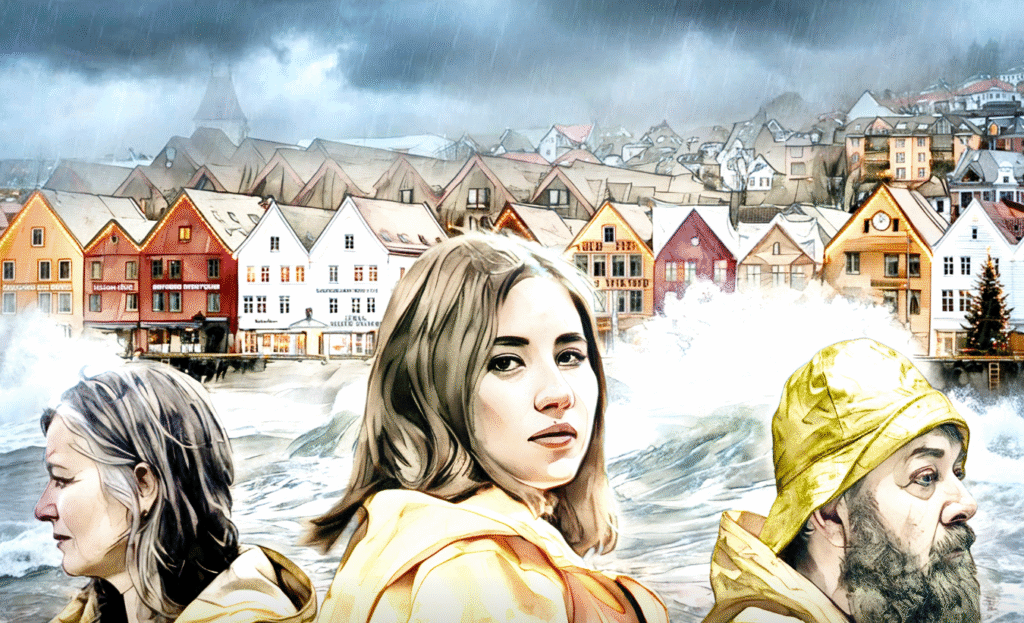
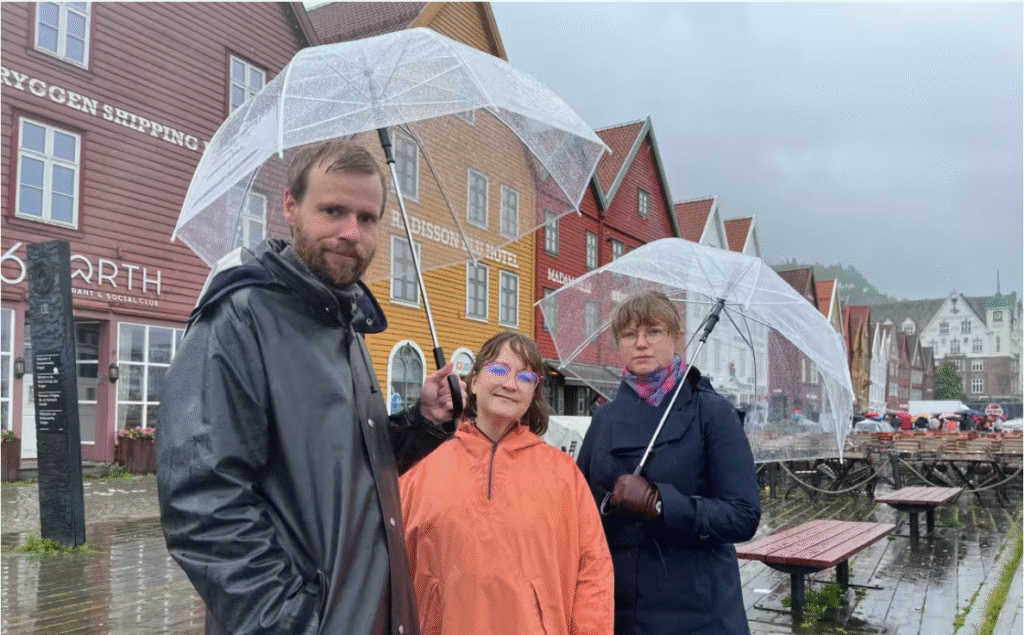
The World Heritage Site of Bryggen is located right by the water in Bergen, Europe’s rainiest city. What will happen to the World Heritage Site in the future is an open question, given that the problems caused by flooding and storm surges will become increasingly severe as the years go by. In Bergen, intensive work is underway to assess the future in order to make informed decisions about how infrastructure needs to change. However, the primary language of climate research is numbers and graphs—and it can be difficult to understand their real implications, even for experts working with future analyses.
To solve the task at hand, Umami wrote two stories based on very different scenarios. They describe the underlying key ideas as follows:
Bye Bye Bryggen is a fictional story about the lives of two siblings. They are born in the early 2020s and experience the great storm that hits Bryggen in 2072. Almost thirty years later, one of the siblings’ grandchildren is given a school assignment: go home and interview your relatives about something that has happened in their lives. Tonje, the granddaughter, has always wondered what really happened during the storm. The only thing she knows is that her grandfather, her mother, and her grandfather’s sister were at Bryggen when the storm struck, where the family had a shop. And that her grandfather and his sister have not spoken to each other since then.
Bye Bye Bryggen is based on the idea that all our decisions—both major political decisions and the small decisions we make in our everyday lives—affect the future. This is what we explore through the story of the siblings. Their private conflict mirrors larger conflicts in the society in which they live. The concept allows you to choose between two different futures. One takes place in a world where major conflicts have been resolved through various forms of agreement. The other is a future in which the conflicts remain unresolved. The idea is that the different versions will stimulate conversations about what kind of future we want, what we are prepared to sacrifice, and which values matter when we are forced to compromise because of climate change.
The project may be called Applied Heritage Futures: set in 2100, it makes audiences think about the role of cultural heritage in managing the relations between present and future societies. This is clearly expressed at the very end of the audioguide when the narrator gives this advice:
“Remember, there are endless possible futures, and whatever future may come, we create it together.”
You can listen to the two versions of the audioguide through The World Heritage of Bryggen at Bergen by downloading the Climaginaries app for free. Highly recommended!
“Given the state of the world today, the many crises that we face …we need to be talking about existential things, if you like. And we need to talk about existential things in ways that become relatable in everyday terms. And heritage gives us the language to do that.” (Nick Shepherd, Aarhus University)
“Over the past two days we’ve very much been focusing on what it means to be a human and be a researcher at the same time. So it’s about bringing our personal experiences into conversations of heritage and climate change. And I think that is something I will definitely take back with me.” (Hana Morel, Historic England).
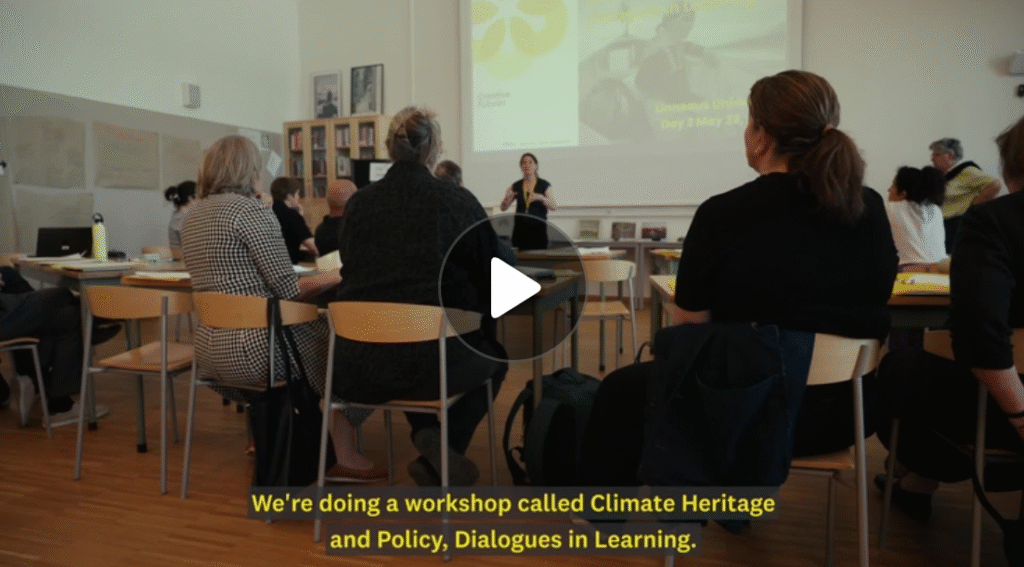
The workshop Climate, Heritage, and Policy: Dialogues in Learning held 27-29 May 2026 at Linnaeus University in Kalmar, Sweden (Kalmar Dialogues) brought together the vast scope and urgency of climate change with ideas and activities that engaged participants in learning and collaborating as their whole human selves. Twenty researchers and practitioners in heritage and climate from across Sweden and from Norway, Denmark, the UK, and France used art, local exploration, the practice of dialogue, and many different conversations with each other to find new ways to talk about what is changing in environments around us and how we are experiencing and taking in these changes – and from all this, what new things we can see to do together next.
In this short film about the workshop, it is possible to see not only what participants did, but hear in their own words how this approach gave them new perspectives and energy for the work they do. Watch here.
This workshop was a project of the UNESCO Chair for Heritage Futures, led by Marcy Rockman with support of Cornelius Holtorf and funding from the Swedish Research Council and developed in collaboration with and moderated by Creative Futures. A full report on this workshop also has been prepared and is available here.
How do you learn an environment you don’t know? How do you see and understand change in an environment that you do know? And what do you do with this understanding – how do you act with it and how do you share it?
These questions were the foundation of the workshop Climate, Heritage, and Policy: Dialogues in Learning held 27-29 May 2026 at Linnaeus University in Kalmar, Sweden. It recognized that new environments have always challenged us to learn them. Now the many environments in which we live are changing rapidly. These include our physical environments of course, but also our social, cultural, economic, and technological environments. Which raises the question – how are we learning them? Twenty researchers and practitioners in heritage and climate change from across Sweden and from Norway, Denmark, the UK, and France used a framework of learning and dialogue to look beyond what is changing in our many environments to explore how we gather, manage, store, use, and share our experiences of these changes.
This workshop was a project of the UNESCO Chair for Heritage Futures, led by Marcy Rockman with support of Cornelius Holtorf, funding from the Swedish Research Council, and developed in collaboration with and moderated by Creative Futures. A report on this workshop is now complete and shared below.
Key findings include:
People matter: personal experience and identity are integral to professional practice and shape questions that are asked and how climate and heritage work are done.
Dialogue and play are underused but high-value tools for both collaboration and public engagement; participants ranked dialogic practice as the single most valuable skill to carry forward.
Collaboration was the most-requested resource (ahead of time or funding), signaling strong appetite for interdisciplinary and cross-institutional partnerships.
Landscape learning proved a useful lens for reframing climate change from a focus on measurements and damage to processes of adaptation and knowledge-building, and policy as a repository of environmental information everyone has a stake in updating.
Cultural heritage is an asset to responses to climate change — the many ways in which cultural heritage is approached, shared, and engaged are essential tools for advancing climate justice, beyond and in addition to what should be protected from climate impacts.
This Kalmar Dialogues workshop has already catalyzed new collaborations, including a peace-building grant proposal centered on the Struve Geodetic Arc, an invitation to join Sweden’s National Heritage Board climate expert group, and new museum-practice exchanges. This report recommends further developing dialogic skills as part of the program of the UNESCO Chair on Heritage Futures, and continuing to build a community of practice around the truth & reconciliation and landscape learning frameworks.
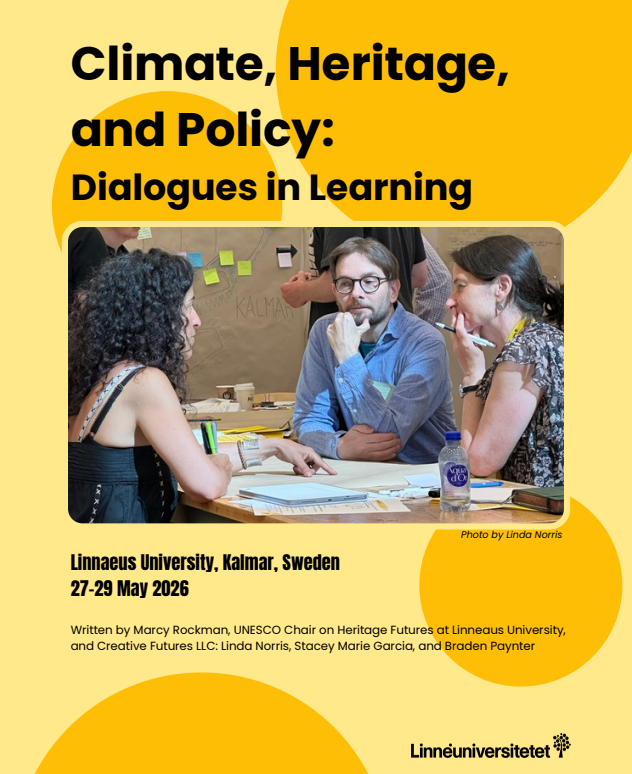
The outcomes of this workshop demonstrate that integrating climate change, cultural heritage, and policy needs more than data — it requires shared frameworks, dialogue, and trust-building across disciplines. This workshop offers an initial, replicable model for this work, with strong participant enthusiasm to extend it further.
The Climate, Heritage, and Policy: Dialogues in Learning Report is available here.
Heritage is often imagined as something we preserve for the future: we identify what matters, protect it from change, and hope it survives long enough for others to encounter it. That is the popular picture, at least.
But Nature suggests another way of thinking about continuity — and it may deserve a place in that conversation.
A soil, a sediment layer or a peat deposit can act as an environmental archive. It records traces of what has happened, yet it never stays untouched.
Material is deposited, transformed, mixed, eroded and redistributed; radioactive substances decay; new ones are formed.
The archive changes continuously — and still it keeps information about the past.
This made me wonder: could it be a useful way of thinking about heritage?
Nature does not preserve by standing still
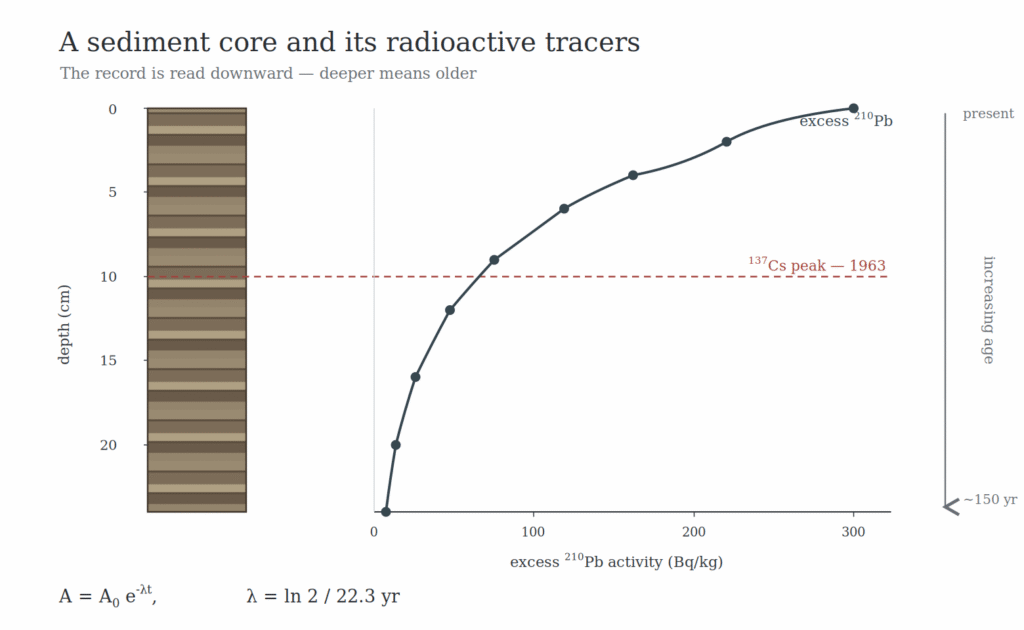
My recent work concerns a rather obscure radioactive isotope, lead-210 (210Pb), which environmental scientists use to study atmospheric fallout and to date relatively recent sediments, soils and peat.
The interesting point for me was not the isotope itself but the idea of the environment as an archive.
The 210Pb record is not a document filed away intact. It is produced by natural processes that never stop: material arrives, radionuclides transform, sediments shift, and the record that results has to be read and interpreted.
A sediment layer need not stay identical to its original state to tell us something about its history. In other words, the archive stays useful not despite change but through it.
The real question may be less whether something stays exactly as it was, and more whether, as it changes, it still holds on to a pointer to what came before.
This is not a new thought in heritage studies.
Cornelius Holtorf has argued for years that heritage strengthens cultural resilience precisely by helping us accept loss and transformation rather than resist them, and more recently that conservation itself can be understood as regeneration — ever changing, never less than whole. What the environmental sciences add is a very concrete example of the same idea.
Schematic: excess ²¹⁰Pb decays with depth while the ¹³⁷Cs peak fixes 1963 — a record that keeps time while never ceasing to change. (Illustration by the author)
What about human traces?
The uranium-mining landscapes that prompted my study make this more interesting still.
Mining leaves behind long-lived material: tailings, waste rock, stockpiles, open workings and other residues. These keep interacting with air, water, soil, plants and sediments long after the mining itself has stopped. Uranium mines also release radon gas, which travels in the air and, in turn, generates 210Pb.
This raised a specific worry. Most of the 210Pb in soils and sediments comes from radon gas emanating naturally out of the ground; the steady amount that settles each year is what lets scientists read the record, rather as one reads tree rings. Could that extra radon from uranium mines add enough 210Pb to distort the record?
For documented mine sizes, the answer is largely reassuring: the added radon is far too little to shift regional 210Pb levels in any measurable way. Close to a site the picture can differ, and there it is dust and eroded material that could disturb the record.
What I find more intriguing is what the question reveals.
Human activity does not only leave heritage objects behind. It also leaves materials that enter the ongoing processes of nature.
The landscape itself can become part of the recording mechanism.
What this really describes is archaeology — an archaeology that faces the other way. The archaeologist reads a record already deposited; here the record is still being laid down, as heritage or as mining residue, and the question is how some later present will read it.
Memory without stasis
This brings me close to an idea that seems important for heritage:
that keeping memory is about more than keeping things unchanged.
Something can change a great deal and still work as a memory, so long as it keeps some capacity to point beyond itself — to an event, a place, an action, a history.
The pointer may itself change. What matters is that the relationship holds.
Nature offers no end of examples. A landscape can be transformed and still carry traces of earlier uses. Sediments can be disturbed and still preserve a chronology. Material can move, decay and recombine while some trace stays legible.
The archive, in this sense, is not a container. It is a process.
Learning from Nature
The heritage sector will recognise all this; it has been working in this direction for some time. What Nature offers is a reminder of how ordinary the principle really is. It invites a small shift of emphasis — from asking only:
How do we preserve this for future generations?
to also asking:
How might this change through time and still point back — remaining a past that some future can still read?
That is a different kind of responsibility. It does not mean giving up on preservation, nor assuming that every trace will survive.
It means only that continuity and sameness are not the same thing.
Nature does not keep its records by stopping time. It keeps them while time is passing — and culture, in its own way, does much the same.
That is less a lesson Nature teaches heritage than a resemblance worth sitting with: good company, perhaps, for a field already moving this way.
Further reading
Pescatore, C. (2026) An upper bound on uranium-mining radon contributions to regional environmental 210Pb inventories. Journal of Environmental Radioactivity 299, 108143. https://doi.org/10.1016/j.jenvrad.2026.108143
Pescatore, C. (2026) When Nuclear Waste Becomes Archaeology. UNESCO Chair on Heritage Futures blog, Linnaeus University, 25 August 2026. https://blogg.lnu.se/unesco/?p=4834
Holtorf, C. (2018) Embracing change: how cultural resilience is increased through cultural heritage. World Archaeology 50(4), 639–650. https://doi.org/10.1080/00438243.2018.1510340
Cornelius Holtorf and Gustav Wollentz were invited speakers at the Nordic World Heritage Conference 2026 attended by about 200 World Heritage managers and policy-makers from all the Nordic countries and held in Karlskrona and on Öland (15-16 October 2026). The theme was “World Heritage and Sustainable Development.”
The conference was officially opened by H.R.H. Prince Carl-Phillip.
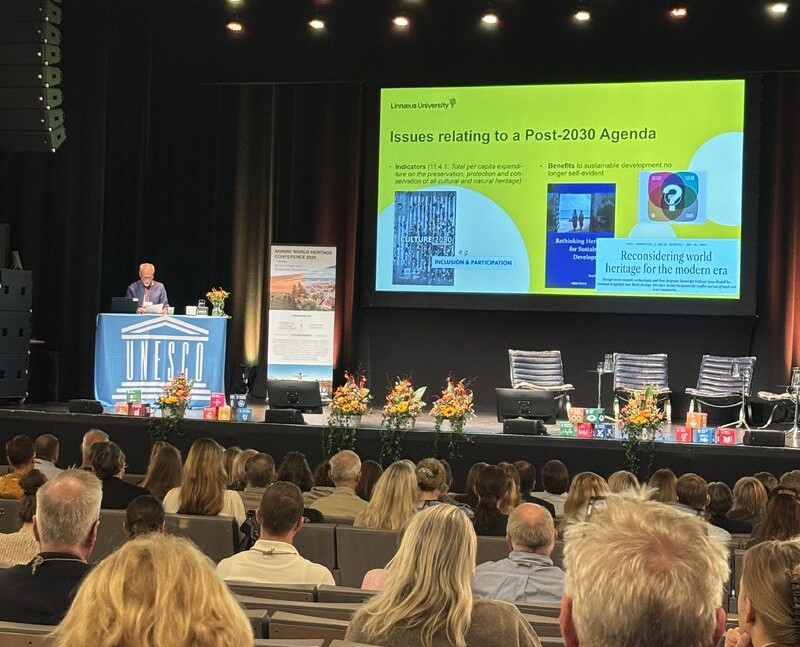
Cornelius Holtorf presented a keynote entitled “World Heritage in a Post-2030 Agenda”. He explored the ongoing international dialogue around a post-2030 agenda and its implications for World Heritage. The session highlighted how heritage can relate to future frameworks for sustainable development.
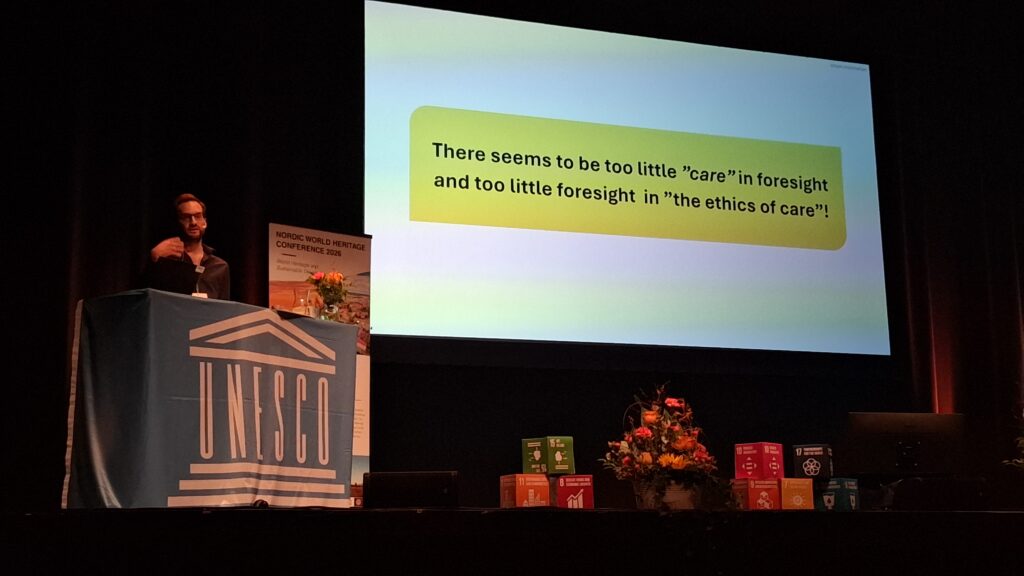
Gustav Wollentz talked about “The value in futures thinking for World Heritage”. He reflected on how future perspectives can—and should—be integrated into World Heritage work.
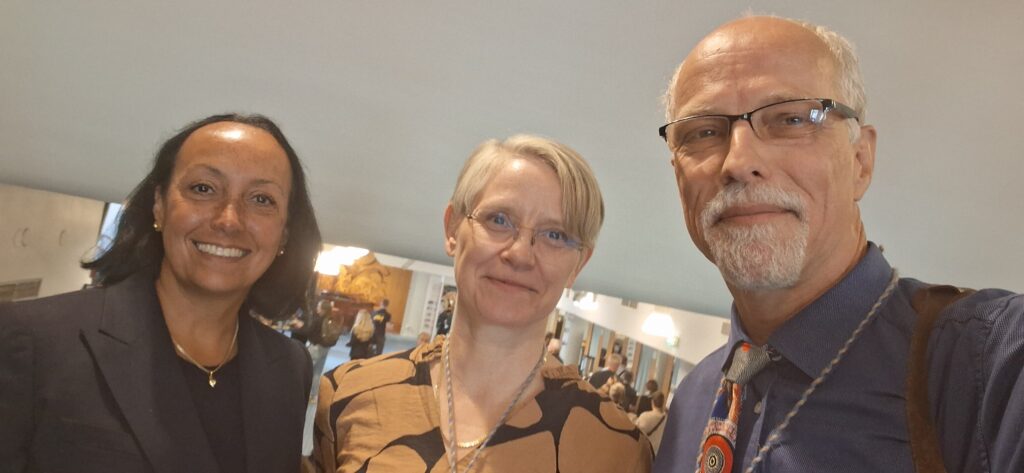
The meeting also provided an opportunity for meetings with colleagues from near and far. Here, from left to right: Elene Negussie (World Heritage Coordinator, Swedish National Heritage Board), Maria Wilenius (Secretary General, Swedish UNESCO Commission, and Cornelius Holtorf).


[…] The new funding for this and a number of additional smaller projects, means that the Climate Heritage Network is…
[…] Chair on Heritage Futures « Culture, cultural heritage and COP26 […]
[…] mer på Unescoprofessurens blogg http://blogg.lnu.se/unesco/?p=1061 Besök Öland 2050! […]